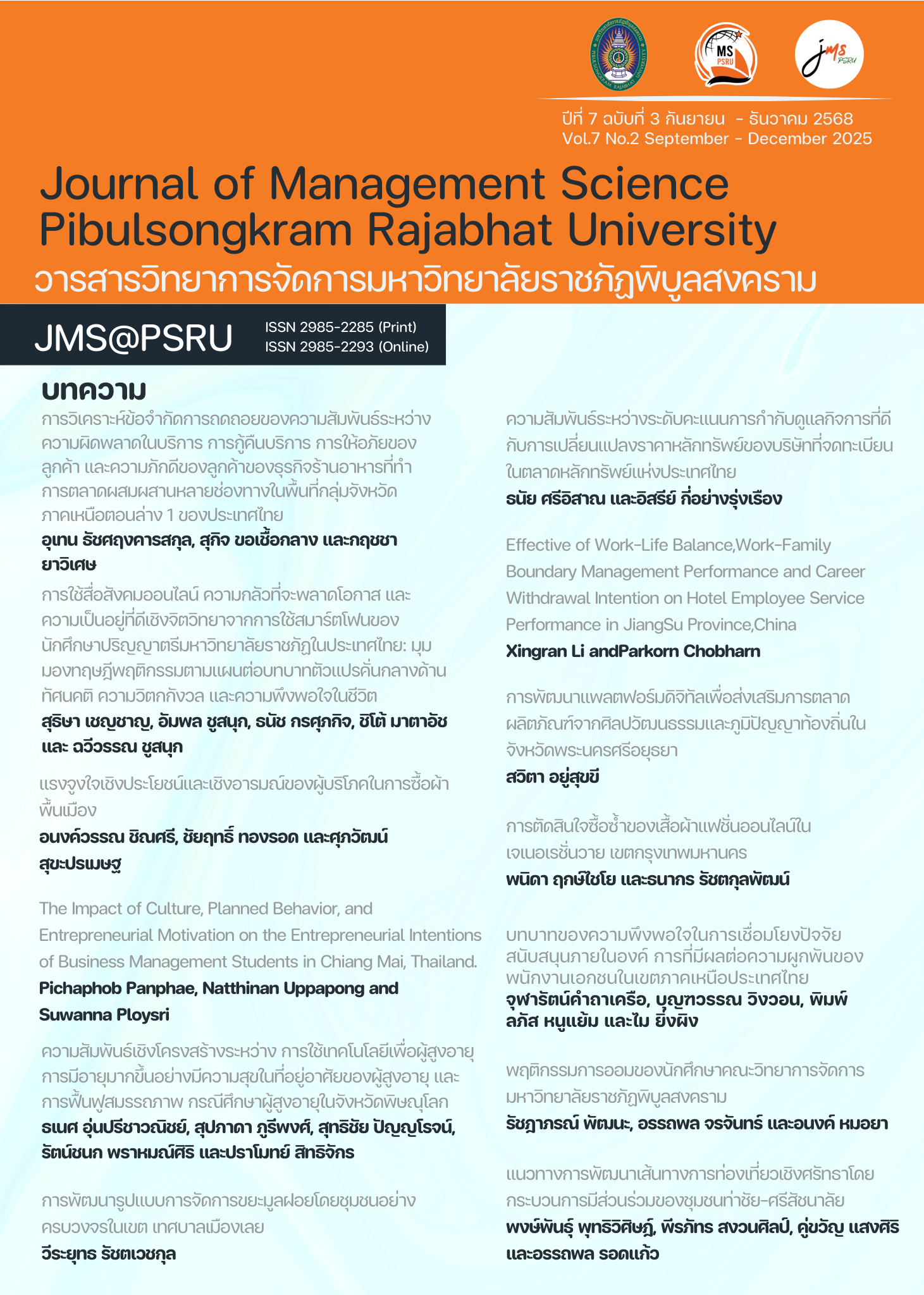
การวิเคราะห์ข้อจำกัดการถดถอยของความสัมพันธ์ระหว่างความผิดพลาดในบริการ การกู้คืนบริการ การให้อภัยของลูกค้า และความภักดีของลูกค้าของธุรกิจร้านอาหารที่ทำการตลาดผสมผสานหลายช่องทางในพื้นที่กลุ่มจังหวัดภาคเหนือตอนล่าง 1 ของประเทศไทย
คำสำคัญ:
ความผิดพลาดในบริการ , การกู้คืนบริการ , การให้อภัยของลูกค้า , ความภักดีของลูกค้า , ร้านอาหารที่ทำการตลาดแบบผสมผสานหลายช่องทางบทคัดย่อ
การวิจัยนี้วัตถุประสงค์เพื่อ ศึกษาระดับความคิดเห็นต่อความผิดพลาดในบริการ การกู้คืนบริการ การให้อภัยของลูกค้า และความภักดีของลูกค้า และศึกษาความสัมพันธ์ของความผิดพลาดในบริการ การกู้คืนบริการ
การให้อภัยของลูกค้า และความภักดีของลูกค้าของธุรกิจร้านอาหารที่ทำการตลาดแบบผสมผสานหลายช่องทางในพื้นที่กลุ่มจังหวัดภาคเหนือตอนล่าง 1 ของประเทศไทย การวิจัยนี้เป็นการวิจัยเชิงปริมาณโดยเก็บรวบรวมข้อมูลจากกลุ่มตัวอย่าง 750 คน ผ่านแบบสอบถามโดยมีค่าความเชื่อมั่นโดยรวมอยู่ระหว่าง 0.864 - 0.943 ความตรงและความเที่ยงที่มีค่า Cronbach’s alpha เฉลี่ยรวมเท่ากับ 0.886 ผลการวิจัยพบว่าผู้ตอบแบบสอบถามให้ความสำคัญกับการให้อภัยของลูกค้ามากที่สุด รองลงมาคือ ความภักดีของลูกค้า การกู้คืนบริการ และความผิดพลาดในบริการ ตามลำดับ การกู้คืนบริการมีความสัมพันธ์กับการให้อภัยของลูกค้าในระดับมากที่สุด รองลงมาคือ การกู้คืนบริการกับความภักดีของลูกค้า การให้อภัยของลูกค้ากับความภักดีของลูกค้า ความผิดพลาดในบริการกับความภักดีของลูกค้า ความผิดพลาดในบริการกับการกู้คืนบริการ และความผิดพลาดในบริการมีความสัมพันธ์ในทิศทางตรงข้ามกันกับการให้อภัยของลูกค้า ตามลำดับ
เอกสารอ้างอิง
กัลยา วานิชย์บัญชา. (2557). การวิเคราะห์สมการโครงสร้าง (SEM) ด้วย AMOS. กรุงเทพฯ: จุฬาลงกรณ์มหาวิทยาลัย.
ยุทธ ไกยวรรณ์. (2556). การวิเคราะห์โมเดลสมการโครงสร้างด้วย AMOS. กรุงเทพฯ: จุฬาลงกรณ์มหาวิทยาลัย.
Albrecht, K. (2016). Understanding the Effects of the presence of others in the service environment–A literature review, Journal of Business Market Management, 1, 541-563.
Babin, B., Zhuang, W., & Borges, A. (2021). Managing service recovery experience: Effects of the forgiveness for older consumers, Journal of Retailing and Consumer Services, 58, 102222.
Chou, P. F. (2015). An analysis of the relationship between service failure, service recovery and loyalty for low-cost carrier travelers. Journal of Air Transport Management, 47, 199-125.
Dorsey, J. T., Ashley, J., & Oliver, G. (2016). Service recovery strategies and their impact on customer loyalty: The role of perceived justice. Journal of Business Research, 69(4), 1857-1865.
Durmus, B., Ulusu, Y., & Erdem, S. (2013). Which dimensions affect private shopping e-customer loyalty?. Procedia- Social and Behavior Sciences, 99, 420-427.
Hair, J. F., Black, W. C., Babin, B. J., & Anderson, R. E. (2010). Multivariate Data Analysis (7th ed.). New Jesey: Pearson Prentice Hall.
Jung, N. Y. & Seock, Y. K. (2017). Effect of service recovery on customers' perceived justice, satisfaction, and wordof-mouth intentions on online shopping websites, Journal of Retailing and Consumer Services, 37, 23-30.
Kim, H., Kim, T., & Kim, W. G. (2009). The effects of perceived justice on recovery satisfaction, trust, word-of-mouth, and repurchase intention in restaurants. International Journal of Hospitality Management, 28(4), 523-532.
Kim, D., Ko, Y., Lee, J. L., & Kim, Y. C. (2019), The impact of CSR-linked sport sponsorship on consumers’ reactions to service failures. International Journal of Sports Marketing and Sponsorship, 21(1), 70-90.
Lewis, B. R. & McCann, P. (2004). Service failure and recovery: Evidence from the hotel industry. International Journal of Contemporary Hospitality Management, 16(1), 6-17.
Likert, R. (1967). The human organization: Its management and value. New York: McGraw-Hill.
McCullough, M. E., Bono, G., & Root, L. M. (2007). Rumination, emotion, and forgiveness: three longitudinal studies. Journal of personality and social psychology, 92(3), 490.
Migacz, S. J., Zou, S. S., & Petrick, J. F. (2017). The “Terminal” effects of service failure on airlines: examining service recovery with justice theory. Journal of Travel Research, 57(1), 83-98.
Nulty, D. D. (2008). The adequacy of response rates to online and paper surveys: What can be done?. Assessment & evaluation in higher education, 33(3), 301-314.
Oliver, R. L. (1999). Whence consumer loyalty?. Journal of Marketing, 63(4), 33-44.
Rosenmayer, A., McQuilken, L., Robertson, N., & Ogden, S. (2018). Omni-channel service failure and recoveries: refined typologies using Facebook complaints. Journal of Service Marketing, 32(3), 269-285.
Stevens, J. (1992). Applied Multivariate Statistics for the Social Sciences (2nd ed.). New Jersey: Lawrence Erlbaum Associates.
Tsarenko, Y. & Tojib, D. (2011). A transactional model of forgiveness in the service failure context: a customer-driven approach. Journal of Service Marketing, 25(5), 381-392.
Walker, L. J. H. (2019). The importance of customer forgiveness in service recovery. Journal of Services Marketing, 33(4), 447-458.
Xie, Y. and Peng, S. (2009). How to repair customer trust after negative publicity: the roles of competence, integrity, benevolence and forgiveness. Psychol. Market, 26(7), 572–589.
ดาวน์โหลด
เผยแพร่แล้ว
รูปแบบการอ้างอิง
ฉบับ
ประเภทบทความ
สัญญาอนุญาต
ลิขสิทธิ์ (c) 2025 คณะวิทยาการจัดการ มหาวิทยาลัยราชภัฎพิบูลสงคราม

อนุญาตภายใต้เงื่อนไข Creative Commons Attribution-NonCommercial-NoDerivatives 4.0 International License.
บทความที่ได้รับการตีพิมพ์ในวารสารวิทยาการจัดการมหาวิทยาลัยราชภัฏพิบูลสงคราม เป็นลิขสิทธิ์ของ คณะวิทยาการจัดการ มหาวิทยาลัยราชภัฎพิบูลสงคราม บทความที่ลงพิมพ์ใน วารสารวิทยาการจัดการมหาวิทยาลัยราชภัฎพิบูลสงคราม ถือว่าเป็นความเห็นส่วนตัวของผู้เขียน คณะบรรณาธิการไม่จำเป็นต้องเห็นด้วย ผู้เขียนต้องรับผิดชอบต่อบทความของตนเอง


