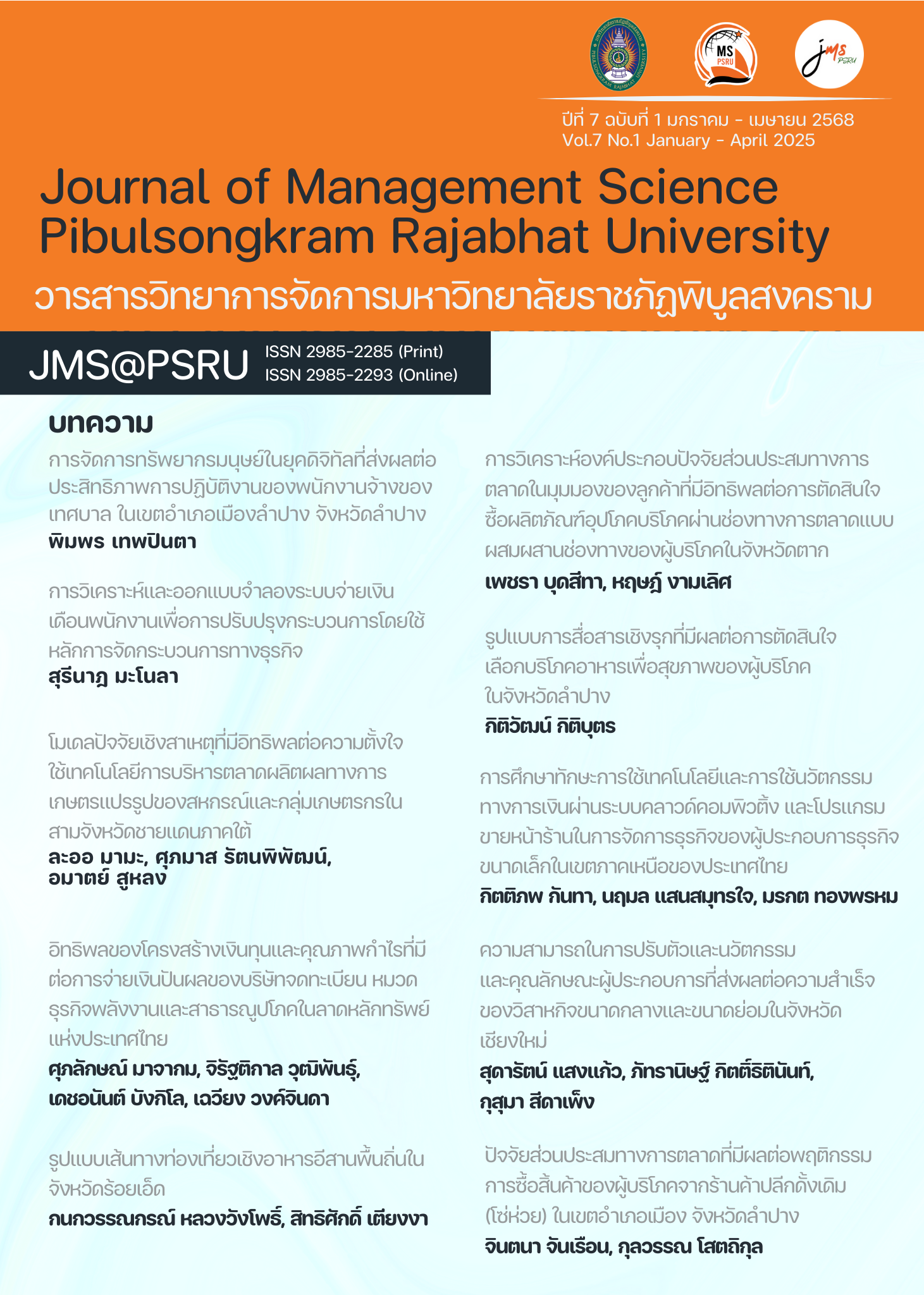
Influence of Adaptation, Innovation and Characteristics of Entrepreneurs on the Success of Small and Medium Enterprises in Chiang Mai Province
Keywords:
Adaptive and Innovative Capability, Entrepreneurial Characteristics, Business SuccessAbstract
Many small and medium enterprises (SMEs) in Chiang Mai province have had to shut down due to the rapid changes in the business environment. The objectives of this research were to examine adaptability and innovative capability and investigate the entrepreneurial characteristics that influence the success of SMEs in Chiang Mai. The data for this quantitative study were collected from 400 SME entrepreneurs in Chiang Mai. The results showed that most entrepreneurs were female, with an average age of 42.3 years, holding a bachelor's degree, and operating in the service sector for no more than five years. The findings showed that, in terms of their adaptability and innovative capability, entrepreneurial characteristics, the more entrepreneurs exhibited innovative thinking, resilience and adaptability, challenging goals, and risk taking, the more likely SMEs in Chiang Mai would be succeed.
References
เจษฎา จันทรา. (2562). คุณลักษณะสำคัญของผู้ประกอบการธุรกิจหอพักเอกชนในเขตตำบลช้างเผือก อำเภอเมือง จังหวัดเชียงใหม่ (การค้นคว้าอิสระปริญญามหาบัณฑิต). มหาวิทยาลัยราชภัฏเชียงใหม่, เชียงใหม่.
ณัฐกานต์ ปางศรี. (2563). การบริหารการจัดการของผู้ประกอบการธุรกิจ SME ขนาดกลางที่ประสบความสำเร็จ (การค้นคว้าอิสระปริญญามหาบัณฑิต). มหาวิทยาลัยรามคำแหง: กรุงเทพฯ
ทิบดี ทัฬหกรณ์ และธีระวัฒน์ จันทึก. (2561). ปัจจัยสู่ความสำเร็จของผู้ประกอบการเชิงสร้างสรรค์ ในยุคเศรษฐกิจสร้างสรรค์. Silpakorn University e-Journal (สาขามนุษยศาสตร์ สังคมศาสตร์ และศิลปะ), 11(1), 396-410.
ธนโชติ รุ่งศรีวัฒนา. (2566). คุณลักษณะของผู้ประกอบการที่มีอิทธิพลต่อความสำเร็จของวิสาหกิจขนาดย่อมในจังหวัดพิษณุโลก (การค้นคว้าอิสระปริญญามหาบัณฑิต). มหาวิทยาลัยเชียงใหม่: เชียงใหม่.
ธนะพัฒน์ วิริต. (2565). ปัจจัยที่มีอิทธิพลต่อความสำเร็จการดำเนินธุรกิจ (SMEs) จากสภาวะการแพร่ระบาดโรคโควิด-19 ของผู้ประกอบการในจังหวัดปทุมธานี. วารสารนวัตกรรมการศึกษาและการวิจัย, 6(2), 458-473.
พรพนา ศรีสถานนท์. (2565). คุณลักษณะของผู้ประกอบการภายใต้สถานการณ์ที่มีความผันผวน ไม่แน่นอน ซับซ้อน และคุลมเครือ (VUCA). วารสารรัชต์ภาคย์, 16(49), 130-145.
พิมพิกา พูลสวัสดิ์ และจิรวัฒน์ ทิพยรส. (2566). การรับรู้โอกาสเป็นผู้ประกอบการของนักศึกษาเจเนอเรชันซี: บทบาทตัวแปรคั่นกลางความคิดสร้างสรรค์ของผู้ประกอบการและความหลงใหลในการเป็นผู้ประกอบการ. วารสารบริหารธุรกิจ, 46(179), 23-53.
เวิร์กเพลส ฟรอม เมตา. (2024). การทำงานแบบยืดหยุ่นคืออะไร และมีประโยชน์ต่อธุรกิจอย่างไร. สืบค้น 27 เมษายน 2567, จาก https://www.facebook.com/business/help/1126725172362626
สถาบันวิจัยเพื่อการพัฒนาประเทศไทย. (2567). การทบทวนตัวชี้วัดศักยภาพชุมชนเพื่อการติดตามยุทธศาสตร์การสร้างความเป็นธรรมและลดความเหลื่อมล้ำในสังคมภายใต้แผนพัฒนาเศรษฐกิจและสังคมแห่งชาติ ฉบับที่ 12. สืบค้น 31 เมษายน 2567, จาก https://tdri.or.th/2024/03/940133/
สวลี วงศ์ไชยา และพีชญาดา พื้นผา. (2561). อิทธิพลของกลยุทธ์ธุรกิจและคุณลักษณะของผู้ประกอบการที่ส่งผลต่อความสำเร็จของธุรกิจขนาดกลางและขนาดย่อม. วารสารสมาคมนักวิจัย, 23(2), 139-152.
สุชาดา ทองคำเจริญ และจันทนา แสนสุข. (2565). ศักยภาพการจัดการธุรกิจและคุณลักษณะของผู้ประกอบการที่ส่งผลต่อความสำเร็จของธุรกิจไมซ์ (MICE) ในจังหวัดพระนครศรีอยุธยา. วารสารมหาจุฬาวิชาการ, 9(1), 109-127.
สัญญา บริสุทธิ์ และ นุจรีย์ ภาคาสัตย์. (2562). คุณลักษณะผู้ประกอบการ ภูมิความรู้ความชำนาญที่นำไปสู่ความสำเร็จทางธุรกิจของผู้ประกอบการกลุ่มเจนเนอเรชั่นวาย. Silpakorn University e-Journal (สาขามนุษยศาสตร์ สังคมศาสตร์ และศิลปะ), 12(5), 1090-1107.
สำนักงานส่งเสริมวิสาหกิจขนาดกลางและขนาดย่อม. (2567). SME big data. สืบค้น 15 กุมภาพันธ์ 2567 จาก https://www.smebigdata.com/msme/dashboard-b
อนพัทย์ พัฒนวงศ์วรัณ. (2566). กลยุทธ์การปรับตัวเพื่อความอยู่รอดของผู้ประกอบธุรกิจสตาร์ทอัพในยุคการพลิกผันทางดิจิทัล. วารสารวิชาการสังคมศาสตร์เครือข่ายวิจัยประชาชื่น, 5(1), 60-75.
Acedo, F. J. & Jones, M. V. (2007). Speed of internationalization and entrepreneurial cognition: Insights and a comparison between international new ventures, exporters and domestic firms. Journal of World Business, 42(3), 236-252.
Adam, N. A. & Alarifi, G. (2021). Innovation practices for survival of small and medium enterprises (SMEs) in the COVID-19 times: the role of external support. Journal of Innovation and Entrepreneurship, 10(1), 1-22.
Aftan, Y. & Hanapi, M. (2018). The impact of entrepreneurial motivation on small business performance in Iraq. International Journal of Academic Research in Business and Social Sciences, 8(1), 409-419.
Ardichvili, A., Cardozo, R., & Ray, S. (2003). A theory of entrepreneurial opportunity identification and development. Journal of Business Venturing, 18(1), 105-123.
Brown, J. A. & White, D. K. (2020). The role of risk-taking in business success: An empirical examination. Journal of Business Research, 112, 45-57.
Chisanga, Z. S., Boso, N., Adeola, O., & Oghazi, P. (2016). Investigating the path from firm innovativeness to financial performance: The roles of new product success, market responsiveness, and environment turbulence. Journal of Small Business Strategy, 26(1), 51–68.
Collins, C. J., Hanges, P. J., & Locke, E. A. (2004). The relationship of achievement motivation to entrepreneurial behavior: A meta-analysis. Human performance, 17(1), 95-117.
Fillis, I. A. N. & Rentschler, R. (2010). The role of creativity in entrepreneurship. Journal of Enterprising Culture, 18(01), 49-81.
Gambirage, C., Cyrino, A. B., Caetano da Silva, J., Barbosa, L. G. M., & Parente, R. C. (2023). Examining entrepreneurial successes and failures during the COVID-19 pandemic (2019–2023). Journal of Small Business and Enterprise Development, 30(7), 1298-1328.
George, D. & Mallery, P. (2003). SPSS for Windows step by step: A simple guide and reference. 11.0 update (4th ed.). Boston: Allyn & Bacon.
Green, E. J. & White, D. P. (2018). The limitations of achievement motivation in predicting business success. Journal of Business Psychology, 43(2), 223-245.
Green, S. J. & Davis, M. A. (2021). Feedback-seeking and business success: A longitudinal study. Journal of Business Management, 58(4), 112-127.
Hair, J., Black, W., Babin, B., Anderson, R., & Tatham, R. (2006). Multivariate data analysis (6th ed.). New Jersey: Pearson Education.
Hansson, C. & Abrantes, B. F. (2023). Strategic adaption (Capabilities) and the responsiveness to COVID-19’s business environmental threats. In essentials on dynamic capabilities for a contemporary world: Recent advances and case Studies (pp. 1-23). Cham: Springer Nature Switzerland.
Harris, E. L. & Wilson, J. T. (2020). The influence of responsibility and learning from failure on business growth. Journal of Business Research, 58(3), 512-53.
Hayward, M. L., Forster, W. R., Sarasvathy, S. D., & Fredrickson, B. L. (2010). Beyond hubris: How highly confident entrepreneurs rebound to venture again. Journal of Business Venturing, 25(6), 569-578.
Howard, C. (2021). Reset your business strategy in covid-19 recovery. Retrieved June 26, 2022, from https://www.gartner.com/smarterwithgartner/reset-your-business-strategy-in-covid-19-recovery.
Leković, B. & Marić, S. M. (2015). Measures of small business success performance–importance, reliability, and usability. Industrija, 43(2), 7-26.
Ling, Y. A. N., Simsek, Z., Lubatkin, M. H., & Veiga, J. F. (2008). Transformational leadership's role in promoting corporate entrepreneurship: Examining the CEO-TMT interface. Academy of Management Journal, 51(3), 557-576.
Mueller, S. L. & Thomas, A. S. (2001). Culture and entrepreneurial potential: A nine-country study of locus of control and innovativeness. Journal of Business Venturing, 16(1). 51-75.
Nunnally, J. C. (1978). Psychometric theory (2nd ed.). New York: McGraw-Hill.
Politis, D. (2008). Does prior start-up experience matter for entrepreneurs’ learning?: A comparison between novice and habitual entrepreneurs. Journal of Small Business and Enterprise Development, 15(3). 472-489.
Rauch, A. & Frese, M. (2007). Let's put the person back into entrepreneurship research: A meta-analysis on the relationship between business owners' personality characteristics, business creation, and success. European Journal of work and organizational psychology, 16(4), 353-385.
Sidek, S. & Zainol, F. A. (2011). Psychological characteristics and business performance of entrepreneurs in small construction industry in Malaysia. International Business and Management, 2(1), 170-185.
Taylor, A. M. & Adams, R. K. (2022). Accountability for failure and its impact on organizational success. Journal of Management Studies, 59(3), 325-340.
Tehseen, S., Johara, F., Halbusi, H. A., Islam, M. A., & Fattah, F. A. M. A. (2023). Measuring dimensions of perceived business success among Malaysian and Bangladeshi SME owners. Rajagiri Management Journal, 17(2), 102-124.
Vanichbuncha, K. (2011). Advanced Statistical Analysis with SPSS (9th ed.). Bangkok: Dharmasarn Printing.
Walliser, G. B., Robert R. C., & Haapio, H. (2011). Promoting business success through contract visualization. Journal of Law, Business, and Ethics, 17(1), 55-75.
Downloads
Published
How to Cite
Issue
Section
License
Copyright (c) 2025 Faculty of Management Science Pibulsongkram Rajabhat University

This work is licensed under a Creative Commons Attribution-NonCommercial-NoDerivatives 4.0 International License.
บทความที่ได้รับการตีพิมพ์ในวารสารวิทยาการจัดการมหาวิทยาลัยราชภัฏพิบูลสงคราม เป็นลิขสิทธิ์ของมหาวิทยาลัยราชภัฎพิบูลสงคราม
บทความที่ลงพิมพ์ใน วารสารวิทยาการจัดการมหาวิทยาลัยราชภัฎพิบูลสงคราม ถือว่าเป็นความเห็นส่วนตัวของผู้เขียนคณะบรรณาธิการไม่จำเป็นต้องเห็นด้วย ผู้เขียนต้องรับผิดชอบต่อบทความของตนเอง


