
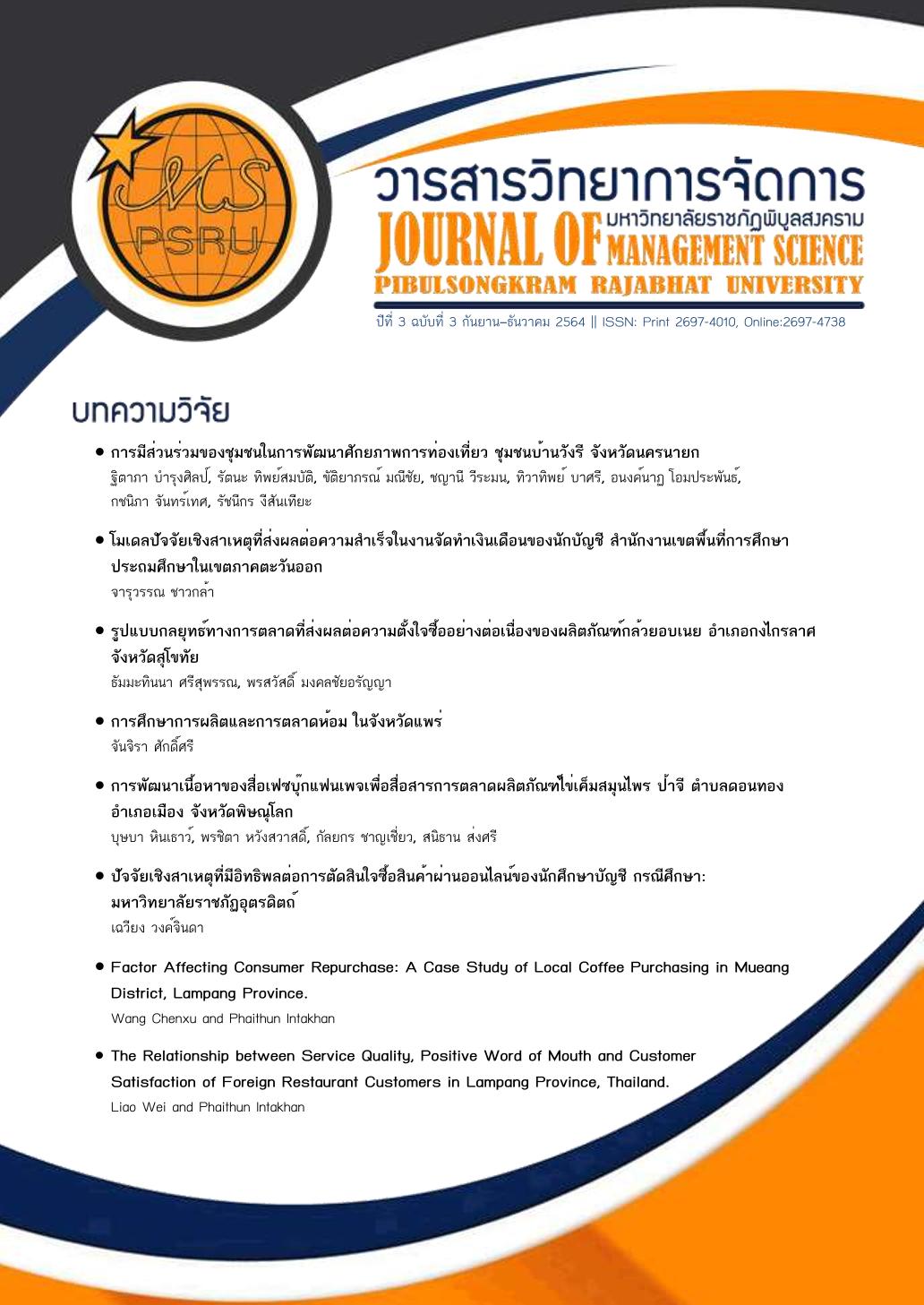
โมเดลปัจจัยเชิงสาเหตุที่ส่งผลต่อความสำเร็จในงานจัดทำเงินเดือนของนักบัญชี สำนักงานเขตพื้นที่การศึกษาประถมศึกษาในเขตภาคตะวันออก
คำสำคัญ:
ทักษะเชิงเทคนิค, ความเป็นมืออาชีพในงาน, ประสิทธิภาพในงานจัดทำเงินเดือน, ความสำเร็จในงานจัดทำเงินเดือนบทคัดย่อ
การวิจัยครั้งนี้มีวัตถุประสงค์เพื่อศึกษาโมเดลปัจจัยเชิงสาเหตุที่ส่งผลต่อความสำเร็จ ในงานจัดทำเงินเดือนโดยใช้แบบสอบถามเป็นเครื่องมือในการเก็บรวบรวมข้อมูลจากนักบัญชีสำนักงานเขตพื้นที่การศึกษาประถมศึกษาในเขตภาคตะวันออก จำนวน 148 คน ตัวแปรที่ใช้ในการวิจัย ประกอบด้วย ตัวแปรภายในแฝง 3 ตัวแปร คือความเป็นมืออาชีพในงาน ประสิทธิภาพในงานจัดทำเงินเดือน และความสำเร็จในงานจัดทำเงินเดือนตัวแปรภายนอกแฝง 1 ตัว คือ ทักษะเชิงเทคนิค วัดจากตัวแปรสังเกตได้ 12 ตัว เครื่องมือที่ใช้ในการวิจัยคือ แบบสอบถามที่ผู้วิจัยสร้างและพัฒนาขึ้นเกี่ยวกับปัจจัยเชิงสาเหตุที่ส่งผลต่อความสำเร็จ ในงานจัดทำเงินเดือนของนักบัญชีสำนักงานเขตพื้นที่การศึกษาประถมศึกษาในเขตภาคตะวันออก ซึ่งมีค่าสัมประสิทธิ์ความเที่ยงตั้งแต่ 0.942 ถึง 0.975 การวิเคราะห์ข้อมูลใช้เทคนิคการวิเคราะห์โมเดลสมการโครงสร้าง (SEM) ด้วยโปรแกรมลิสเรล ผลการวิจัย พบว่า ปัจจัยที่มีอิทธิพลทางตรงและทางอ้อมต่อความสำเร็จในงานจัดทำเงินเดือน ของนักบัญชีสำนักงานเขตพื้นที่การศึกษาประถมศึกษาในเขตภาคตะวันออก คือ ทักษะเชิงเทคนิค และผลการวิเคราะห์ข้อมูลยังพบว่า โมเดลการวิเคราะห์มีความสอดคล้องกับข้อมูลเชิงประจักษ์ (= 56.833, p-value = 0.386, df = 49 (
/df =1.159), RMSEA = 0.018, GFI = 0.954, AGFI = 0.951, NFI = 0.984, NNFI = 0.997, IFI = 0.998, CFI = 0.998) แสดงว่าโมเดลมีความเหมาะสมพอดีกับข้อมูลเชิงประจักษ์อยู่ในเกณฑ์ดี
เอกสารอ้างอิง
กรมบัญชีกลาง. (2564). ระบบจ่ายตรงเงินเดือนของกรมบัญชีกลาง (2564, ตุลาคม). คู่มือ,. สืบค้น 10 ตุลาคม 2564, จาก http://epayroll.cgd.go.th/CGDREG/CGDWEB/download.jsp?set_bg=3
สำนักงานคณะกรรมการการศึกษาขั้นพื้นฐาน. (2564). ระบบงานอิเล็กทรอนิกส์ (2564, ตุลาคม). ระบบงาน,. สืบค้น 10 ตุลาคม 2564, จาก https://www.obec.go.th/%E0%B8%A3%E0%B8%B0%E0%B8%9A%E0%B8%9A%E0%B8%87%E0%B8%B2%E0%B8%99
Aaker, D. A., Kumar, V., & Day, G. S. (2001). Marketing Research. New York: John Wiley and Son.
Barclay, D., Higgins, C., & Thompson, R. (1995). The partial least squares (PLS) approach to causal modeling: Personal computer adoption and use as an illustration. Technology studies, 2(2), 285-309.
Chow, W.S. & Chan, L.S. (2008). Social network, social trust and shared goals in organizational knowledge sharing. Information and Management, 45(7), 458-462.
Dai, L. & Song, F. (2016). Subjective Career Success: A Literature Review and Prospect. Journal of Human Resource and Sustainability Studies, 4(1), 238-242.
Elekwa, N. N. & Eme, O.I. (2013). An Analysis of Computerized Accounting and Payrolling System on Monthly Emolument in Nigerian Local Government. International Journal of Accounting Research, 1(3), 16-28.
Fornell, C. & Larcker, D.F. (1981). Evaluating structural equation models with unobservable variables and measurement error. Journal of Market Research, 18(1), 39-50.
Giorgi, G., Mucci, N., Fabio A. D., & Ariza-Montes, A. (2019). Editorial: new professionalism and the future of work: interdisciplinary perspectives on transformations in business-health relationships. Frontiers in Psychology, 10:2193. doi: 10.3389/fpsyg.2019.02193.
Hamidah, S. (2015). Humanistic soft skills learning for generating professional teacher performance. The 3rd UPI International Conference on Technical and Vocational Education and Training. Netherlands: Atlantis Press.
Hair, J.F., Black, W.C., Babin, B.J., & Anderson, R.E. (2010). Multivariate data analysis: A global perspective. (7th ed.). New Jersey: Pearson Education Inc.
Hopwood, N., Dadich, A., Elliot, C., & Moraby, K. (2021). How is brilliance enacted in professional practices? insights fromthe theory of practice architectures. Professions and Professionalism, 11(2), 1-22.
Khanna, V. (2015). Soft skills: a key to professional excellence. Journal of Research in Engineering, 5(1), 32-40.
Nunnally, J. C. (1978). Psychometric theory. New York: McGraw-Hill.
Nunnally, J. C. & Bernstein, I. H. (1994). Psychometric Theory. (3rd ed.). New York, NY: McGraw-Hill.
Palladan, A. A. & Palladan, N. Y. (2018). Employees Views on Payroll Computerization and Its Impact on Their Productivity: A Grounded Theory Approach. Arabian Journal of Business and bar A Management Review, 8(2), 1-5.
Pinto, L., Nunes, E., & Sousa, S. (2020). A framework to improve training and development of workers’ technical skills: effects on operational performance during company relocation. Procedia Manufacturing, 51(2020), 1806–1813.
Schumacker, R. E. & Lomax, R. G. (2010). A beginner’s guide to structural equation modeling. (3rd ed.). New Jersey: Lawrence Erlbaum Associates.
Suparjo, Y, C. & Akbar, M. (2020). The effect of integrity, professionalism, and innovation on service performance. Journal of Business and Behavioural Entrepreneurship, 4(1), 26-42.
Thite, M. & Sandhu, K. (2014). Where is my pay? critical success factors of a payroll system a system life cycle approach. Australasian Journal of Information Systems, 18(2), 149-164.
Tokarcikova, E., Malichová, E., Kucharčíková, A., & Durišová, M. (2020). Importance of technical and business skills for future it professionals. Amfiteatru Economic, 22(54), 567-578.
Yamoah, E. E. (2013). Relationship between compensation and employee productivity. Singaporean Journal of Business Economics and Management Studies, 2(1), 110-114.
ดาวน์โหลด
เผยแพร่แล้ว
รูปแบบการอ้างอิง
ฉบับ
ประเภทบทความ
สัญญาอนุญาต
ลิขสิทธิ์ (c) 2022 มหาวิทยาลัยราชภัฎพิบูลสงคราม

อนุญาตภายใต้เงื่อนไข Creative Commons Attribution-NonCommercial-NoDerivatives 4.0 International License.
บทความที่ได้รับการตีพิมพ์ในวารสารวิทยาการจัดการมหาวิทยาลัยราชภัฏพิบูลสงคราม เป็นลิขสิทธิ์ของ คณะวิทยาการจัดการ มหาวิทยาลัยราชภัฎพิบูลสงคราม บทความที่ลงพิมพ์ใน วารสารวิทยาการจัดการมหาวิทยาลัยราชภัฎพิบูลสงคราม ถือว่าเป็นความเห็นส่วนตัวของผู้เขียน คณะบรรณาธิการไม่จำเป็นต้องเห็นด้วย ผู้เขียนต้องรับผิดชอบต่อบทความของตนเอง


