
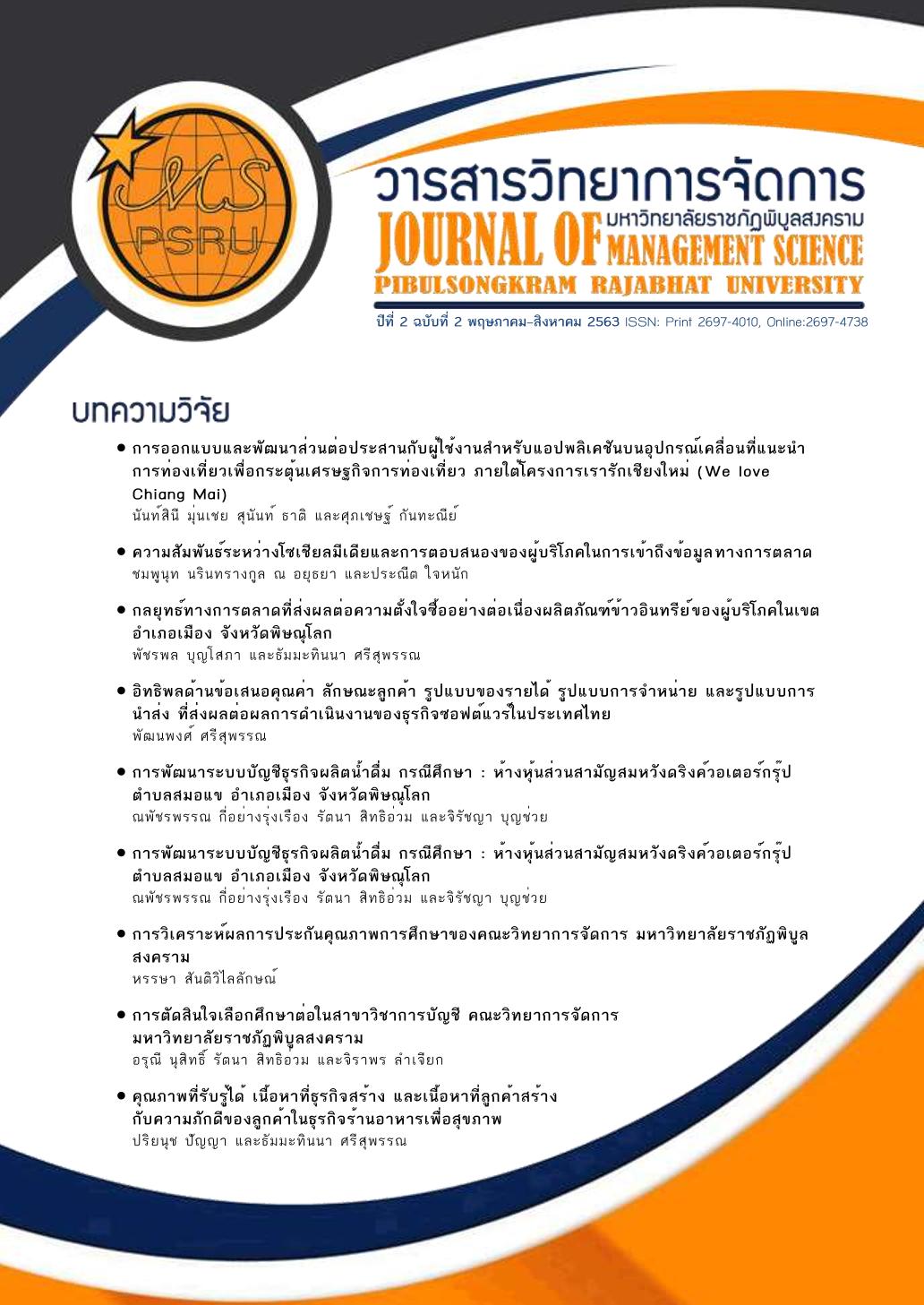
Perceived Value, Firm Generated Content, Used Generated Content and Customer Engagement on Health Restaurant
Keywords:
Perceived Quality, Firm Generate Content, Customer Generate Content, Customer LoyaltyAbstract
The purposes of this research were to investigated the effect of the perceived quality, firm generate content, customer generate content on the customer loyalty of healthy restaurant. The quantitive method was used 400 questionnaire as instrument for collection data. The instrument of data was being analyzed by using frequency, percentages, mean, standard deviation and the multiple regression analysis was used to analyze and test research hypotheses. The results have shown that the firm generate content was in high level, the customer generate content, perceived quality was in medium level. The result also insists that the perceived quality, firm generate content, customer generate content have impact on the customer loyalty of healthy restaurant. 62.6 percent. The customer generate content was in higher level following the perceived quality and firm generate content.
References
ฐปนนันท์ สัญญากรณ์, ธัมมะทินนา ศรีสุพรรณ และประสิทธิชัย นรากรณ์. (2561). อิทธิพลของเนื้อหาที่ถูกสร้างจากธุรกิจ เนื้อหาที่ถูกสร้างจากผู้ใช้และการรับรู้ตราสินค้าที่ส่งผลต่อคุณภาพที่รับรู้ได้และความภักดีในตราสินค้าบนเครือข่ายสังคมออนไลน์ของผู้ใช้บริการร้านอาหารเพื่อสุขภาพจังหวัดเชียงใหม่. วารสารมหาวิทยาลัยศิลปากร ฉบับภาษาไทยสาขามนุษยศาสตร์ สังคมศาสตร์และศิลปะ, 11(1), 322-342.
Bidyanand, J. (2014). Social Media, Brand Community, User generated comments and Brand Loyalty: Study of Indian Youth. IOSR Journal of Business and Management, 16(10), 122-131
Cochran, W. G. (1977). Sampling Techniques (3rd ed.). New York: John Wiley & Sons.
Godes, D. (2011), Opinion Leadership and Social Contagion in New Product Diffusion, Marketing Science, 30 (2), 224-29
Hutter, K., Hautz, J., Dennhardt, S. and Fuller, J. (2013), The impact of user interactions in social media on brand awareness and purchase intention: the case of MINI on Facebook, Journal of Product & Brand Management, 22(5), 342-351.
Kaplan, M. A., & Kozma, M. (2010). Users of the world, unite! The challenges and opportunities of Social Media Kelley School of Business Indiana University. Business Horizons, 53, 59-68.
Narakorn, P. & Seesupan, T., (2019). Conversation, Community, and E-Commerce as Social Commerce Model for Food and Beverage Business in Phitsanuloke Province. Humanities, Arts and Social Sciences Studies. (HASSS), 19(2), 101-119.
Downloads
Published
How to Cite
Issue
Section
License

This work is licensed under a Creative Commons Attribution-NonCommercial-NoDerivatives 4.0 International License.
บทความที่ได้รับการตีพิมพ์ในวารสารวิทยาการจัดการมหาวิทยาลัยราชภัฏพิบูลสงคราม เป็นลิขสิทธิ์ของมหาวิทยาลัยราชภัฎพิบูลสงคราม
บทความที่ลงพิมพ์ใน วารสารวิทยาการจัดการมหาวิทยาลัยราชภัฎพิบูลสงคราม ถือว่าเป็นความเห็นส่วนตัวของผู้เขียนคณะบรรณาธิการไม่จำเป็นต้องเห็นด้วย ผู้เขียนต้องรับผิดชอบต่อบทความของตนเอง


