
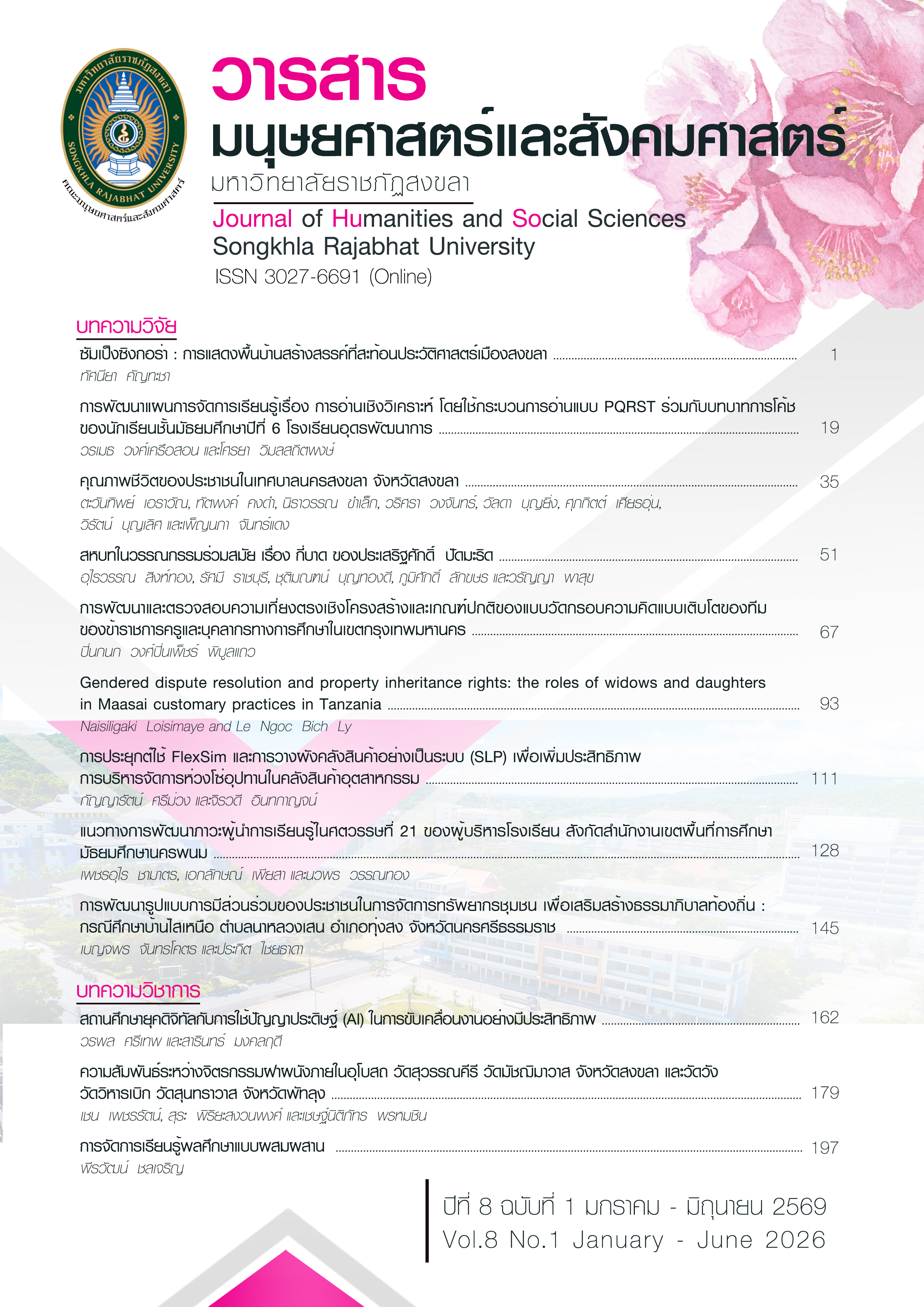
การพัฒนารูปแบบการมีส่วนร่วมของประชาชนในการจัดการทรัพยากรชุมชน เพื่อเสริมสร้างธรรมาภิบาลท้องถิ่น : กรณีศึกษาบ้านไสเหนือ ตำบลนาหลวงเสน อำเภอทุ่งสง จังหวัดนครศรีธรรมราช
Article Sidebar
Main Article Content
บทคัดย่อ
การวิจัยนี้มีวัตถุประสงค์เพื่อ 1) ศึกษาระดับการมีส่วนร่วมของประชาชนในการจัดการทรัพยากรชุมชนเพื่อเสริมสร้างธรรมาภิบาลท้องถิ่น 2) วิเคราะห์องค์ประกอบการมีส่วนร่วมของประชาชนในการจัดการทรัพยากรชุมชนโดยใช้การวิเคราะห์องค์ประกอบเชิงสำรวจ 3) พัฒนาและทดสอบความสอดคล้องเชิงโครงสร้างของรูปแบบความสัมพันธ์เชิงสาเหตุของปัจจัยที่มีอิทธิพลต่อระดับการมีส่วนร่วมของประชาชนในการจัดการทรัพยากรชุมชนโดยใช้การวิเคราะห์สมการโครงสร้าง และ 4) พัฒนารูปแบบการมีส่วนร่วมของประชาชนในการจัดการทรัพยากรชุมชนเพื่อเสริมสร้างธรรมาภิบาลท้องถิ่น โดยอาศัยผลการวิเคราะห์เชิงปริมาณและเชิงคุณภาพร่วมกัน การวิจัยเป็นการวิจัยแบบผสมผสาน โดยใช้ทั้งการวิจัยเชิงปริมาณและเชิงคุณภาพ กลุ่มตัวอย่างในการวิจัยเชิงปริมาณจำนวน 150 คน ประกอบด้วยประชาชนในพื้นที่ 97 คน ซึ่งเป็นชุดข้อมูลจากการวิจัยก่อนหน้า และผู้มีส่วนได้ส่วนเสียภายนอกพื้นที่ 53 คน ได้จากการสุ่มแบบเจาะจง เครื่องมือที่ใช้ในการวิจัยประกอบด้วยแบบสอบถามมาตรประมาณค่า 5 ระดับ และแบบสัมภาษณ์แบบกึ่งโครงสร้าง ซึ่งทั้งสองเครื่องมือผ่านการตรวจสอบความตรงเชิงเนื้อหาโดยผู้ทรงคุณวุฒิ 3 คน โดยมีค่าดัชนีความสอดคล้องระหว่างข้อคำถามกับวัตถุประสงค์ในระดับรายข้ออยู่ระหว่าง 0.67 ถึง 1.00 การวิเคราะห์ข้อมูลเชิงปริมาณใช้สถิติเชิงพรรณนา t-test การวิเคราะห์องค์ประกอบเชิงสำรวจ (EFA) และการวิเคราะห์รูปแบบสมการโครงสร้าง (SEM) ส่วนข้อมูลเชิงคุณภาพวิเคราะห์เชิงเนื้อหา ผลการวิจัยพบว่า ระดับการมีส่วนร่วมของประชาชนโดยรวมอยู่ในระดับสูง โดยมี 4 องค์ประกอบหลัก ได้แก่ การตัดสินใจ การดำเนินงาน การรับผลประโยชน์ และการประเมินผล รูปแบบความสัมพันธ์เชิงสาเหตุที่พัฒนาขึ้นมีความสอดคล้องกับข้อมูลเชิงประจักษ์ในระดับดี (χ²/df = 1.96, RMSEA = 0.045, CFI = 0.95, GFI = 0.93, TLI = 0.94) ปัจจัยที่ส่งผลต่อระดับการมีส่วนร่วมอย่างมีนัยสำคัญ ได้แก่ การเข้าถึงข้อมูลข่าวสาร ความเชื่อมั่นในองค์กรท้องถิ่น และประสบการณ์การมีส่วนร่วม ทั้งนี้ ข้อเสนอเชิงนโยบายมุ่งเน้นการสร้างกลไกการมีส่วนร่วมอย่างต่อเนื่องและการพัฒนาชุมชนให้มีธรรมาภิบาลท้องถิ่นที่เข้มแข็ง
Downloads
Article Details

อนุญาตภายใต้เงื่อนไข Creative Commons Attribution-NonCommercial-NoDerivatives 4.0 International License.
ลิขสิทธิ
เอกสารอ้างอิง
กุลการ มงคลชูโชคทวี และจุฑารัตน์ ชมพันธุ์. (2564). การมีส่วนร่วมของประชาชนในการจัดการทรัพยากรน้ำอย่างยั่งยืน: กรณีศึกษาโครงการอ่างเก็บน้ำคลองบ้านนา จังหวัดสระบุรี. วารสารการจัดการสิ่งแวดล้อม. 17(2), 22–41. doi: 10.14456/jem.2021.9
ประกิต ไชยธาดา และเบญจพร จันทรโคตร. (2568). การมีส่วนร่วมของประชาชนในการสร้างกลไกบริหารจัดการทรัพยากรชุมชนบ้านไสเหนือ ตำบลนาหลวงเสน อำเภอทุ่งสง จังหวัดนครศรีธรรมราช. วารสารมนุษยศาสตร์และสังคมศาสตร์ มหาวิทยาลัยนครพนม. 15(1), 246–260.
พระสุริโย สุขิโต. (2563). การมีส่วนร่วมของประชาชนในการจัดการสิ่งแวดล้อมขององค์การบริหารส่วนตำบลสนับทึบ อำเภอวังน้อย จังหวัดพระนครศรีอยุธยา. วารสารพุทธนวัตกรรมและการจัดการ. 3(2), 11–21.
พหล ศักดิ์คะทัศน์. (2553). การมีส่วนร่วมของประชาชนในการอนุรักษ์ทรัพยากรธรรมชาติ. วารสารวนศาสตร์. 29(1), 55-63.
วีระกิตติ์ เอกอัครวิจิตร, สุเนตร ธนศิลปะพิชิต และไพทูรย์ มาเมือง. (2567). รูปแบบการมีส่วนร่วมของประชาชนในการส่งเสริมให้เกิดชุมชนเข้มแข็ง. วารสารภักดีชุมพลปริทรรศน์. 2(2), 39–50.
แผนพัฒนาเศรษฐกิจและสังคมแห่งชาติ ฉบับที่ 13 (พ.ศ. 2566–2570). (2565). ราชกิจจานุเบกษา. สำนักงานสภาพัฒนาการเศรษฐกิจและสังคมแห่งชาติ. สืบค้นจาก https://www.nesdc.go.th/wp-content/themes/plant3-child/assets/pdf/13/article_file_20230307173518.pdf
สมภพ ระงับทุกข์ และปัญญา คล้ายเดช. (2561). ธรรมาภิบาลในองค์กรปกครองส่วนท้องถิ่นไทย. วารสารวิชาการธรรมทรรศน์. 18(3), 256–265.
Burdett, T. (2024). Community engagement, public participation and social impact assessment. In F. Vanclay and A. M. Esteves (Eds.), Handbook of social impact assessment and management. Edward Elgar Publishing, (308–324). doi: 10.4337/9781802208870.00030
Gaus, R., Ejderyan, O., Grêt-Regamey, A., Leach, W. D. and Buchecker, M. (2023).
How previous experiences shape actors’ current perspectives in integrated natural resource management. People and Nature. 5(6), 2048-2060. doi: 10.1002/pan3.10541
Hair, J. F., Black, W. C., Babin, B. J. and Anderson, R. E. (2019). Multivariate data analysis (8th ed.). Cengage Learning.
Hu, L. T. and Bentler, P. M. (1999). Cutoff criteria for fit indexes in covariance structure analysis: Conventional criteria versus new alternatives. Structural Equation Modeling: A Multidisciplinary Journal. 6(1), 1-55. doi: 10.1080/10705519909540118
Kantamaturapoj, K., Chanchitpricha, C., Hongsuwan, P., Suebsing, P., Thaweesuk, S. and Wibulpolprasert, S. (2023). Contextual attributes associated with public participation in environmental impact assessments in Thailand: Perspectives obtained from authorities and academics. Heliyon. 9(11), e21786. doi: 10.1016/j.heliyon.2023.e21786
Kasimba, S. A. and Lujala, P. (2022). Community based participatory governance platforms and sharing of mining benefits: Evidence from Ghana. Community Development Journal. 57(4), 635–654. doi: 10.1093/cdj/bsab021
Kibe, E., Nzomo, M. and Jonyo, F. (2023). Citizen Participation in Natural Resource Governance: A Case of Oil in South Sudan. European Journal of Development Studies. 3(5), 39-47. doi: 10.24018/ejdevelop.2023.3.5.293
Kline, R. B. (2016). Principles and practice of structural equation modeling (4th ed.). The Guilford Press.
Manirojana, P. (2022). Public participation for promote Thai cultural tourism and the development of OTOP Nawatwitee for reduce social equality. International Journal of Humanities and Social Science. 6(S5), 150-166. doi: 10.53730/ijhs.v6nS5.5214
Passaranon, K., Chaiear, N., Duangjumphol, N. and Siviroj, P. (2023). Enterprise-Based Participatory Action Research in the Development of a Basic Occupational Health Service Model in Thailand. International Journal of Environmental Research and Public Health. 20(8), 5538. doi: 10.3390/ijerph20085538
Putnam, R. D. and Garrett, S. R. (2020). The upswing: How America came together a century ago and how we can do it again. Simon & Schuster. Retrieved from https://www.simonandschuster.com/books/The-Upswing/Robert-D-Putnam/9781982129156
Ridzuan, M. R., Abd Rahman, N. A. S., Lai Kuan, K., Soon Yew, J. and Yaacob, N. A. (2021). Exploring the effects of good local governance on citizens’ trust in Malaysia. Journal of Administrative Science. 18(2), 129–149.
Rout, S. (2021). Sustainable community forestry: Insights from rural Thailand. Current World Environment. 16(3), 740–754. doi: 10.12944/CWE.16.3.8
Sánchez-Hernández, M. I. (2024). Strengthening Resilience: Social Responsibility and Citizen Participation in Local Governance. Administration Sciences. 14(10), 1-22. doi: 10.3390/admsci14100260
Silva, P., Mota, L. F., Carneiro, R., Valentim, R. and Teles, F. (2023). The Inner Functioning of Local Governance Networks in Centralized Countries: A ‘Brave New World’? Social Sciences. 12(5), 1-14. doi: 10.3390/socsci12050289
Simelio-Solà, N., Ferré-Pavia, C. and Herrero-Gutiérrez, F.-J. (2021). Transparent information and access to citizen participation on municipal websites. Profesional de la Información. 30(2), 1-10. doi: 10.3145/epi.2021.mar.11
Tongvijit, P. M., Nomnian, A., Sirisunhirun, S., Ploywan, P. and Arakpothchong, W. (2023). The model of good governance application toward human resource management in Buddhist University. International Journal of Professional Business Review. 8(5), 1-19. doi: 10.26668/businessreview/2023.v8i5.1279
United Nations Development Programme. (2022). SDG 16.7.2: Ensuring inclusive and responsive decision-making (Policy Brief). UNDP Oslo Governance Centre. Retrieved from https://www.undp.org/sites/g/files/zskgke326/files/2022-09/Final%20Policy%20Brief%2016%207%202.pdf
Wiyaboon, S. (2019). Community participation in local development projects. The Journal of the International Buddhist Studies College. 6(1), 18–24.
Yamane, T. (1973). Statistics: An introductory analysis (3rd ed.). Harper and Row.
