
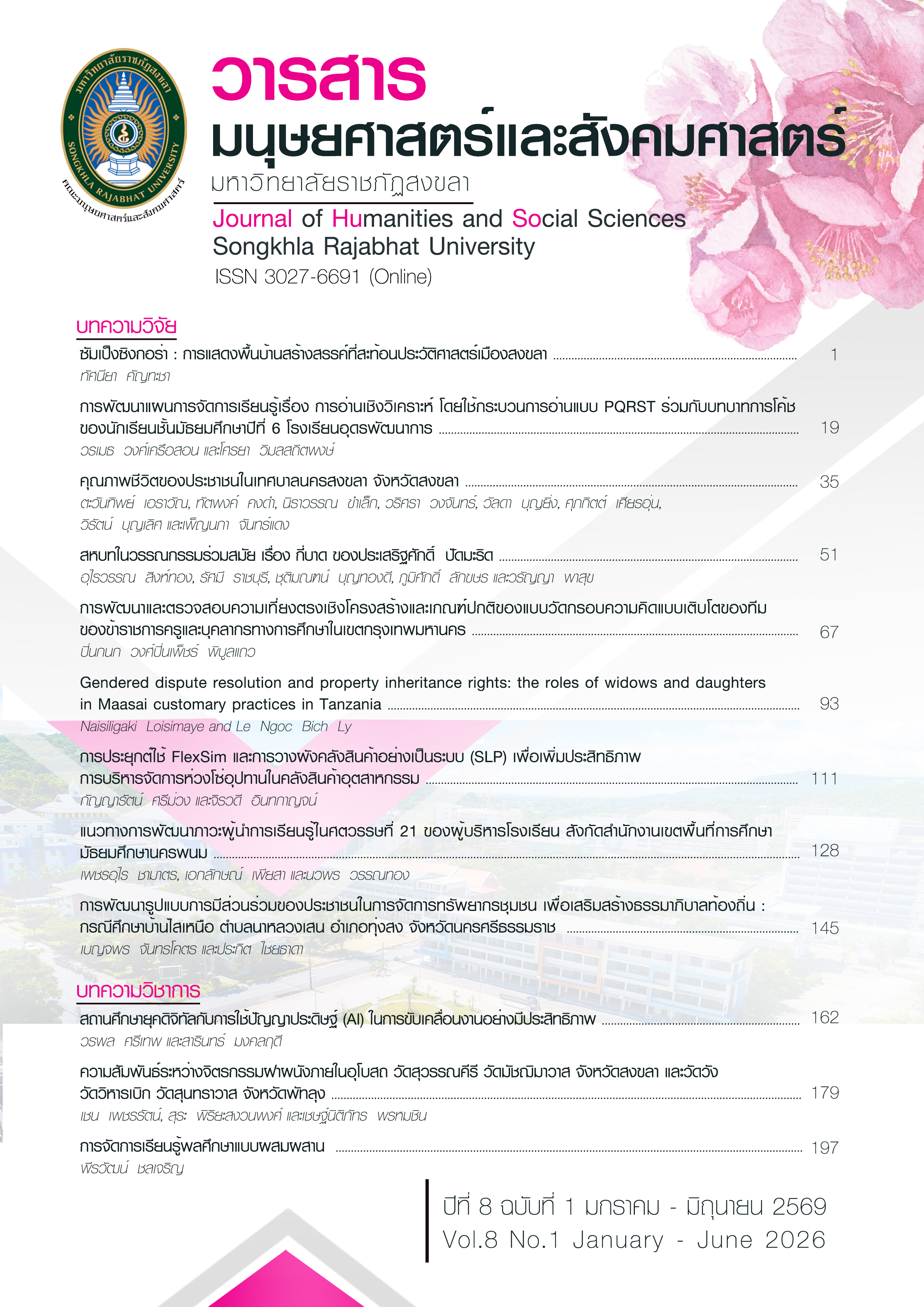
Development and validity of construct validity and norms of the team growth mindset scale for government teachers and educational personnel in Bangkok
Article Sidebar
Main Article Content
Abstract
The objectives of this research are: 1) to develop and validity of construct validity of the Team Growth Mindset Scale for government teachers and education personnel in Bangkok, and 2) to analyze norms of the Team Growth Mindset Scale for government teachers and educational personnel in Bangkok. The sample consisted of 421 secondary school teachers and educational personnel under Secondary Educational Service Area Office 1 and Office 2 in Bangkok. Participants were selected using proportional stratified random sampling, simple random sampling and convenience sampling. The research instrument was the Team Growth Mindset Scale. The content validity of the scale was assessed through the Item-Objective Congruence (IOC) index, with all items demonstrating an IOC value of 1.00. The item discrimination power, assessed through Corrected Item-Total Correlation (CITC), ranged from .716 to .929. The internal consistency reliability of the overall scale, measured by Cronbach’s alpha coefficient, was found to be .963. The statistics used included frequency, percentage, mean, standard deviation, skewness, kurtosis, confirmatory factor analysis, and percentile. The research findings were as follows: 1) the construct validity of the Team Growth Mindset Scale was consistent with empirical data (Chi-square=17.8, df=24, CFI=1.00, SRMR=0.0103, RMSEA=0.00). 2) The norms for the overall team growth mindset revealed that scores of 55.00 and above indicate a high level of team growth mindset. Scores between 50.00 and 54.99 reflect a fairly high level of team growth mindset, scores ranging from 47.00 to 49.99 indicate a moderately low level of team growth mindset, and scores below 47.00 represent a low level of team growth mindset.
Downloads
Article Details

This work is licensed under a Creative Commons Attribution-NonCommercial-NoDerivatives 4.0 International License.
ลิขสิทธิ
References
กระทรวงศึกษาธิการ. (2560). แผนการศึกษาแห่งชาติ พ.ศ. 2560-2579. พริกหวานกราฟฟิค.
จิราพร โสดแก้ว. (2565). การศึกษาปัจจัยที่ส่งผลต่อการคงอยู่ในวิชาชีพของข้าราชการครูสังกัดกรุงเทพมหานคร [วิทยานิพนธ์ปริญญามหาบัณฑิต]. สาขาวิชาการบริหารการศึกษา, คณะศึกษาศาสตร์, มหาวิทยาลัยศรีนครินทรวิโรฒ. สืบค้นจาก https://hdl.handle.net/20.500.14740/52736
ชนิตา รุ่งเรือง และเสรี ชัดแช้ม. (2559). กรอบความคิดเติบโต : แนวทางใหม่แห่งการพัฒนาศักยภาพมนุษย์. วิทยาการวิจัยและ วิทยาการปัญญา. 14(1), 1-13.
ณัชชา มหปุญญานนท์, วิภาดา พินลา และวิภาพรรณ พินลา. (2567). การพัฒนาตัวบ่งชี้และชุดเครื่องมือวัดศักยภาพเด็กไทยในศตวรรษที่ 21 ด้านกรอบความคิดเติบโต (Growth Mindset). วารสารศึกษาศาสตร์ มหาวิทยาลัยมหาสารคาม. 18(2), 156-174.
บัณฑิตา อินสมบัติ. (2554). ข้อพิจารณาในการคัดเลือกข้อคำถามที่มีอำนาจการจำแนก. วารสารวิชาการบัณฑิตศึกษา มหาวิทยาลัยราชภัฏนครสวรรค์. 6(16), 1-12.
พรชัย เทพปัญญา, ไพบูลย์ ช่างเรียน, นิยม รัตนอัมพรฤทธิ์, วนิดา สุจิรพรรณโรจน์ และพราวพิชชา เถลิงพล. (2561). การพัฒนาคุณภาพการศึกษาขั้นพื้นฐานของโรงเรียนในสังกัดกรุงเทพมหานคร. Veridian E-Journal, Silpakorn University สาขามนุษยศาสตร์ สังคมศาสตร์ และศิลปะ. 11(2), 476-492.
พฤธ รุ่งเจริญวัฒนกิจ, พิมพ์ประภา อมรกิจภิญโญ และธัญธรณ์ อมรกิจภิญโญ. (2566). ปัจจัยที่ส่งผลต่อคุณภาพชีวิตในการทำงานของข้าราชการครู สังกัดสำนักงานเขตพื้นที่การศึกษามัธยมศึกษากรุงเทพมหานคร เขต 1. Journal of Modern Learning Development. 8(8), 108-126.
มานิกา วิเศษสาธร, ปิยพงศ์ แซ่ตั้ง, รพีกรณ์ เปี่ยมพืช และจุฑามาส สรุปราษฎร์. (2565). การพัฒนาแบบวัด GROWTH MINDSET สำหรับครูผู้สอนวิทยาการคำนวณ. Journal of Education and Innovation. 24(2), 232–247.
มารุต พัฒผล. (ม.ป.ป.). Mindset ของครู. ศูนย์ผู้นำนวัตกรรมหลักสูตรและการเรียนรู้. สืบค้นจาก http://www.curriculumandlearning.com/upload/Mindset%20ของครู_1415862010.pdf
มณีรัศมิ์ พัฒนสมบัติสุข. (2564). การตรวจสอบคุณภาพเครื่องมือวิจัยทางการพยาบาลและสังคมศาสตร์. วารสารเครือข่ายวิทยาลัยพยาบาลและการสาธารณสุขภาคใต้. 8(2), 329–343.
วีรวรรณ วงศ์ปิ่นเพ็ชร์. (2568). สถิติสำหรับการวิจัยทางจิตวิทยา. สำนักพิมพ์มหาวิทยาลัยเชียงใหม่.
ศิวภรณ์ วงศ์เพชร. (2565). บทบาทของผู้บริหารสถานศึกษาในการทำงานเป็นทีมตามการรับรู้ของครู สังกัดสำนักงานเขตพื้นที่การศึกษามัธยมศึกษากรุงเทพมหานคร เขต 2. วารสารวิชาการสถาบันพัฒนาพระวิทยากร. 5(1), 29-39.
สถาบันทดสอบทางการศึกษาแห่งชาติ (องค์การมหาชน). (ม.ป.ป.). รายงานผลการทดสอบทางการศึกษาระดับชาติขั้นพื้นฐาน (O-NET) ปีการศึกษา 2566. สืบค้นจาก https://www.niets.or.th/th/catalog/view/3121
สมนึก ภัททิยธนี. (2541). การสร้างเกณฑ์ปกติ (Norms) และการขยายคะแนน T ปกติ. วารสารการวัดผลการศึกษา มหาวิทยาลัยมหาสารคาม. 4(1), 1-12.
สุภมาส อังศุโชติ, สมถวิล วิจิตรจรรยา และรัชนีกูล ภิญโญภานุวัฒน์. (2552). สถิติวิเคราะห์สำหรับการวิจัยทางสังคมศาสตร์และพฤติกรรมศาสตร์ : เทคนิคกาiใช้โปรแกรม LISREL (พิมพ์ครั้งที่ 2). สำนักพิมพ์มหาวิทยาลัยสุโขทัยธรรมาธิราช.
สุมาลี ขำอิน, พัชราภรณ์ ศรีสวัสดิ์ และวิไลลักษณ์ ลังกา. (2567). การพัฒนาเกณฑ์ปกติของวุฒิภาวะทางอาชีพของนักเรียนระดับมัธยมศึกษาตอนปลาย. วารสารสันติศึกษาปริทรรศน์ มจร. 12(5), 1954-1970.
สุวิมล ติรกานันท์. (2551). การสร้างเครื่องมือวัดตัวแปรในการวิจัยทางสังคมศาสตร์ : แนวทางสู่การปฏิบัติ (พิมพ์ครั้งที่ 2). สำนักพิมพ์มหาวิทยาลัยธรรมศาสตร์.
สำนักงานการศึกษาขั้นพื้นฐาน. (2567). เว็บไซต์ สำนักงานเขตพื้นที่การศึกษามัธยมศึกษาในสังกัด. สืบค้นจาก https://www.obec.go.th/เว็บไซต์-สพม-ในสังกัด
สำเริง บุญเรืองรัตน์. (2550). เปอร์เซ็นไทล์. ใน คณะศึกษาศาสตร์ มหาวิทยาลัยศรีนครินทรวิโรฒ (บ.ก.), สารานุกรมศึกษาศาสตร์ (ฉบับที่ 39, หน้า 20–24). สืบค้นจาก http://kids-d.swu.ac.th/dspace/bitstream/123456789/1691/1/v39.pdf
อิสระ บุญญะฤทธิ์. (2567). ระเบียบวิธีการวิจัยทางจิตวิทยาการทำงานและองค์การ : แนวทางเชิงปฏิบัติเพื่อศึกษาพฤติกรรมมนุษย์ในการทำงาน. สำนักพิมพ์ มหาวิทยาลัยเชียงใหม่.
อุมาพร พันธ์ศรี และอุไร สุทธิแย้ม. (2565). แรงจูงใจในการทำงานเป็นทีมของครูในโรงเรียนสังกัดกรุงเทพมหานครกลุ่มเขตกรุงเทพใต้. Journal of Roi Kaensarn Academi. 7(7), 299-312.
เอื้อมพร หลินเจริญ, สัจจะค์ อาวรัช และภิรดา จันทร์อินทร์. (2552). ปัจจัยเชิงสาเหตุที่ทำให้คะแนนการทดสอบ O-NET ของนักเรียนชั้นประถมศึกษาปีที่ 6 และมัธยมศึกษาปีที่ 6 ต่ำ (รายงานการวิจัย). สถาบันทดสอบทางการศึกษาแห่งชาติ (องค์การมหาชน). สืบค้นจาก https://www.niets.or.th/th/content/download/279
Abd-El-Fattah, S. M., and Yates, G. C. R. (2006). Implicit Theory of Intelligence Scale: Testing for Factorial Invariance and Mean Structure. In Proceeding of the Australian Association for Research in Education Conference (p.1-14). Adelaide, Australian Association for Research in Education.
Ahmad, N., Alias, F. A., Hamat, M. and Mohamed, S. A. (2024). Reliability analysis: Application of Cronbach’s alpha in research instruments. SIGCS: e-Learning@CS. Universiti Teknologi MARA Cawangan Pulau Pinang. Retrieved from https://appspenang.uitm.edu.my/sigcs/2024-2/Articles/20244_ReliabilityAnalysis-ApplicationOfCronbachsAlphaInResearchInstruments.pdf
Anastasi, A. (1985). Psychological testing: Basic concepts and common misconceptions. In A. M. Rogers & C. J. Scheirer (Eds.), The G. Stanley Hall lecture series. 5, (p. 87–120). American Psychological Association. doi: 10.1037/10052-003
Chantathai, P., Tesaputa, K. and Somprach, K. (2015). Development of Effective Teacher Program: Teamwork Building Program for Thailand’s Municipal Schools. International Education Studies. 8(9), 138-147. doi: 10.5539/ies.v8n9p138
Cohen-Chen, S., Halperin, E., Saguy, T. and Van Zomeren, M. (2014). Beliefs about the malleability of immoral groups facilitate collective action. Social Psychological and Personality Science. 5(2), 203-210. doi: 10.1177/1948550613491292
Dweck, C. S. (2000). Self-theories: Their role in motivation, personality and development. Psychology Press.
Dweck, C. S. (2006). Mindset: The new psychology of success. Random House Publishing Group.
Dweck, C. S. (2012Mindsets and human nature: promoting change in the Middle East, the schoolyard, the racial divide, and willpower. Am. Psychol. 67(8), 614-622. doi: 10.1037/a0029783
Hair, J. F., Jr., Gabriel, M. L. D. S., da Silva, D., and Braga Junior, S. (2019). Development and validation of attitudes measurement scales: Fundamental and practical aspects. RAUSP Management Journal. 54(4), 490–507. doi: 10.1108/RAUSP-05-2019-0098
Han, S. J., Jin, B., and Oh, J. (2019). Exploring Team Growth and Fixed Mindsets in Work Teams at a Large Korean Corporation. In Proceeding of Adult Education Research Conference (pp.1-6). New Prairie Press.
Han, S. J., Xie, L., Beyerlein, M. and Boehm, R. (2022). Examining the mediating role of team growth mindset on the relationship of individual mindsets and shared leadership. European Journal of Training and Development. 48(1-2), 234-252. doi: 10.1108/EJTD-08-2022-0084
Hallinger, P. and Kantamara, P. (2001). Exploring the cultural context of school improvement in Thailand. School Effectiveness and School Improvement. 12(4), 385–408. doi: 10.1076/sesi.12.4.385.3446
Hofstede Insights. (2021). Country Comparison: Thailand. Retrieved from https://www.hofstede-insights.com/country-comparison/thailand/
Karwowski, M. (2014). Creative mindsets: Measurement, correlates, consequences. Psychology of Aesthetics, Creativity, and the Arts. 8(1), 62-70. doi: 10.1037/a0034898
Keating, L. A. and Heslin, P. A. (2015). The potential role of mindsets in unleashing employee engagement. Human Resource Management Review. 25(4), 329-341. doi: 10.1016/j.hrmr.2015.01.008
Kline, R. B. (2016). Principles and practice of structural equation modeling (4th ed.). The Guilford Press.
Lottero-Perdue, P. and Lachapelle, C. P. (2019). Instruments to Measure Elementary Student Mindsets about Smartness and Failure in General and with Respect to Engineering. International Journal of Education in Mathematics Science and Technology. 7(2), 197-214. doi: 10.18404/ijemst.552468
Murphy, M. C. and Dweck, C. S. (2010). A culture of genius: How an organization’s lay theory shapes people’s cognition, affect, and behavior. Personality and Social Psychology Bulletin. 36(3), 283-296. doi: 10.1177/0146167209347380
Rigolizzo, M. and Amabile, T. (2015). Entrepreneurial creativity: The Role of Learning Processes and Work Environment Supports. In The Oxford Handbook of Creativity, Innovation and Entrepreneurship (p.61-78). Oxford University Press.
Rydell, R. J., Hugenberg, K., Ray, D. and Mackie, D. M. (2007). Implicit theories about groups and stereotyping: The role of group entitativity. Personality and Social Psychology Bulletin. 33(4), 549-558. doi: 10.1177/0146167206296956
Sigmundsson, H. and Haga, M. (2024). Growth Mindset Scale: Aspects of reliability and validity of a new 8-item scale assessing growth mindset. New Ideas in Psychology. 75, 1-5. doi: 10.1016/j.newideapsych.2024.101111
Turner, J. and Reynolds, K. (2012). Self-categorization theory. In P. A. Van Lange, A. W. Kruglanski, and E. T. Higgins (Eds.), Handbook of theories of social psychology (Vol. 2, pp. 399-417). SAGE. doi: 10.4135/9781446249222.n46
United Nations. (2015). Transforming our world: The 2030 Agenda for Sustainable Development. Retrieved from https://sdgs.un.org/2030agenda
Yeager, D. S. and Dweck, C. S. (2012). Mindsets That Promote Resilience: When Students Believe That Personal Characteristics Can Be Developed. Educational Psychologist. 47(4), 302-314. doi: 10.1080/00461520.2012.72280
Zhao, H., Zhang, J., Heng, S., and Qi, C. (2021). Team Growth Mindset and Team Scientific Creativity of College Students: The Role of Team Achievement Goal Orientation and Leader Behavioral Feedback. Thinking Skills and Creativity. 42, 1-12. doi:10.1016/j.tsc.2021.100957
