
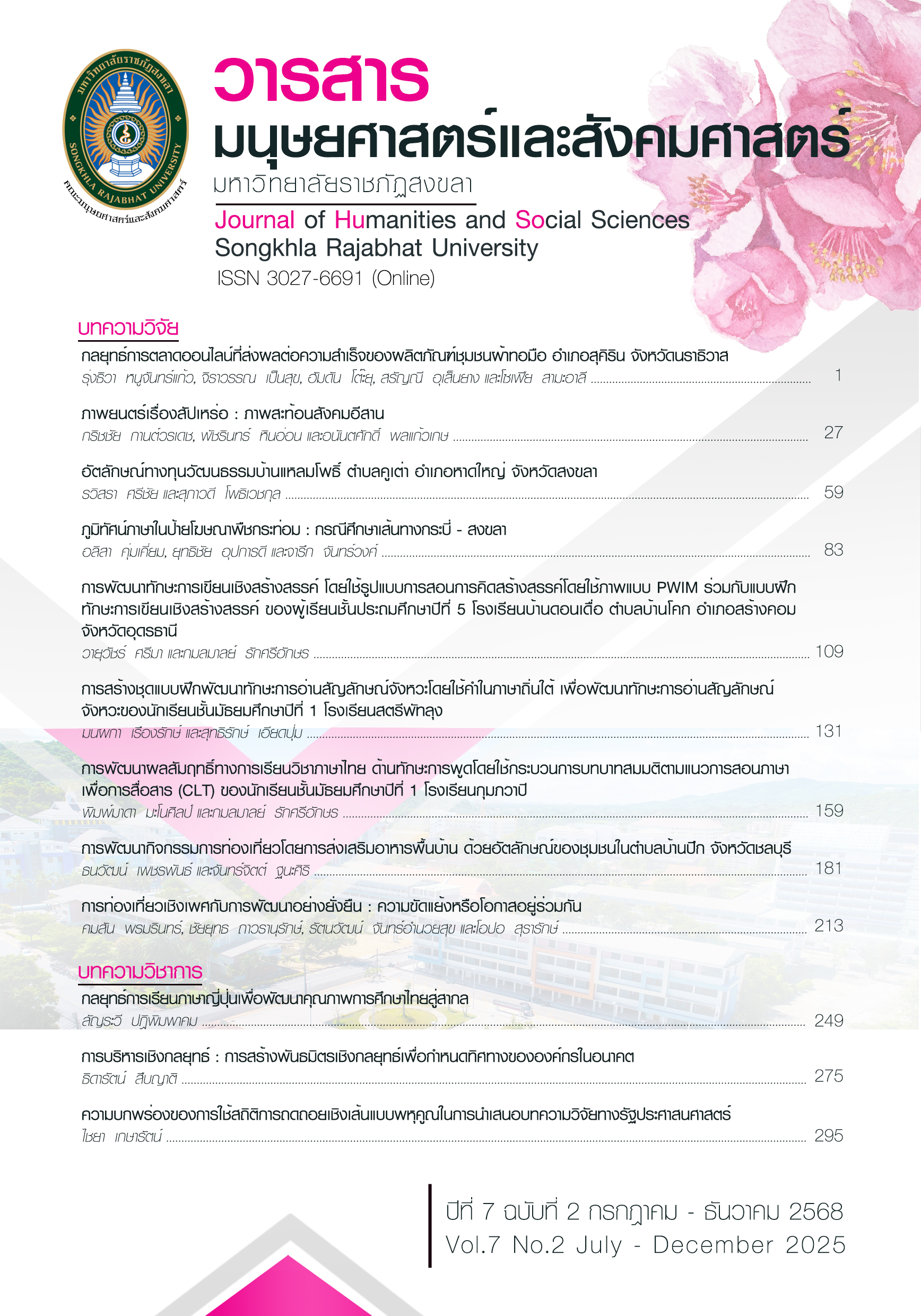
DEVELOPING CREATIVE WRITING SKILLS BY USING THE PWIM IMAGE-BASED CREATIVE THINKING TEACHING MODEL COMBINED WITH CREATIVE WRITING SKILLS EXERCISES OF STUDENTS IN GRADE 5 AT BAN DON DUA SCHOOL, BAN KHOK SUB-DISTRICT, SANGKHOM DISTRICT, UDON THANI PROVINCE
Article Sidebar
Main Article Content
Abstract
The purposes of this study aimed to 1) develop a lesson plan of Thai language courses on creative writing of students in Grade 5 using the PWIM image-based creative thinking teaching model combined with creative writing skills training., 2) to compare the creative writing achievement before and after learning of 5th grade students from using the lesson plan of Thai language course on creative writing and a creative thinking teaching model using PWIM images combined with creative writing skills exercises. To be effective according to the criteria of 65/65., the sample group in the research was 8 students in fifth grade at Ban Don Dua School, Ban Khok Sub-district, Sang Khom District, Udon Thani Province which were derived from specific selection. The implement used for the data collection consisted of 1) 5 lesson plans for teaching creative thinking using PWIM images together with creative writing skills exercises., 2) the subjective test for Pre-test and Post-test 1st edition. The data was analyzed by percentage, means, standard deviation and t-test.
The results of the research were found that 1) fifth grade students had creative writing skills from using the lesson plans of Thai language course on creative writing and a creative thinking teaching model using PWIM images combined with creative writing skills exercises. The post – test scores was higher than first checking at 67.50/69.57 2) The results of comparing achievement found that post – test scores was higher than their Pre-test scores at the .001 level of statistical significance.
Downloads
Article Details

This work is licensed under a Creative Commons Attribution-NonCommercial-NoDerivatives 4.0 International License.
ลิขสิทธิ
References
กนกพร จันทะกล. (2564). การพัฒนาความสามารถด้านการอ่านและการเขียนของนักเรียนชั้นประถมศึกษาปีที่ 4 โดยการจัดการเรียนรู้ตามรูปแบบการอ่านและการเขียนจากภาพ. [วิทยานิพนธ์การศึกษามหาบัณฑิต]. สาขาวิชาหลักสูตรและการสอน คณะศึกษาศาสตร์ มหาวิทยาลัยมหาสารคาม.
กรมวิชาการ กระทรวงศึกษาธิการ. (2545). การจัดสาระการเรียนรู้กลุ่มสาระการเรียนรู้ภาษาไทย ตามหลักสูตรการศึกษาขั้นพื้นฐาน พุทธศักราช 2544. (พิมพ์ครั้งที่ 3). กรุงเทพฯ: โรงพิมพ์คุรุสภาลาดพร้าว.
พิริยา หาญบำรุงธรรม และใจทิพย์ ณ สงขลา. (2565). การพัฒนาหนังสือการ์ตูนเออาร์ด้วยเทคนิค PWIM เพื่อพัฒนาความสามารถในการอ่านสำหรับนักเรียนประถมศึกษาตอนต้น. วารสารเทคโนโลยีและสื่อสารการศึกษา คณะศึกษาศาสตร์ มหาวิทยาลัยมหาสารคาม. 14(5), 22-35. สืบค้นเมื่อ 26 สิงหาคม 2566, จาก https://so02.tci-thaijo.org/index.php/etcedumsujournal/article/view/253285
สง่า วงค์ไชย. (2562). Picture Word Inductive Model: รูปแบบการสอนอ่านและเขียนสำหรับเด็กไทย. วารสาร Veridian E-Journal สาขามนุษยศาสตร์สังคมศาสตร์และศิลปะ. 12(2), 1113-1128. สืบค้นเมื่อ 25 สิงหาคม 2566, จาก https://he02.tci-thaijo.org/index.php/Veridian-E-Journal/article/view/128691
สุพัตรา ศรีธรรมมา. (2562). การพัฒนาความสามารถในการอ่านและการเขียนสะกดคำของนักเรียนชั้นประถมศึกษาปีที่ 1 โดยการจัดการเรียนรู้แบบ PWIM ร่วมกับแผนผังความคิด. [วิทยานิพนธ์ปริญญามหาบัณฑิต]. หลักสูตรศึกษาศาสตรมหาบัณฑิต สาขาวิชาหลักสูตรและการนิเทศ คณะศึกษาศาสตร์ มหาวิทยาลัยศิลปากร.
สำนักวิชาการและมาตรฐานการศึกษา. (2551). หลักสูตรแกนกลางการศึกษาขั้นพื้นฐาน พุทธศักราช 2551 กรุงเทพฯ: กระทรวงศึกษาธิการ.
อัจฉรา ชีวพันธ์. (2553). ภาษาพาสอน : เรื่องน่ารู้สำหรับครูภาษาไทย. (พิมพ์ครั้งที่ 7). กรุงเทพฯ: สำนักพิมพ์จุฬาลงกรณ์มหาวิทยาลัย.
Calhoun, E. F. (1999). Teaching Beginning Reading and Writing with the Picture Words Inductive model. Virginia: Association for Supervision and Curriculum Development.
