
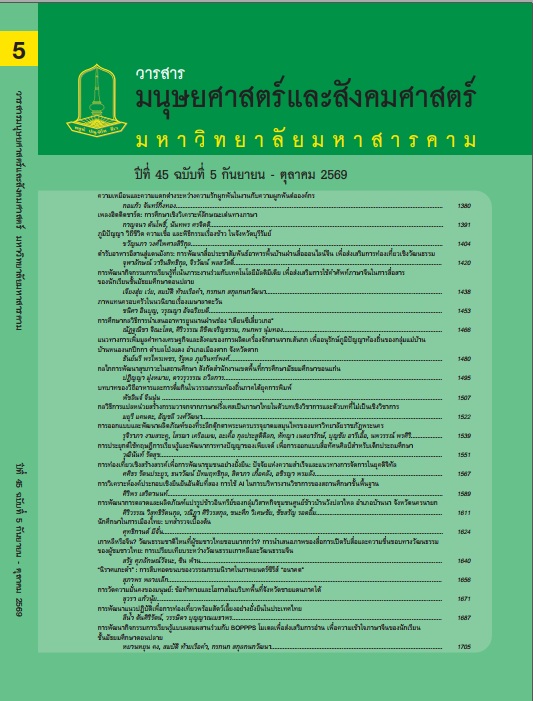
กลไกการพัฒนาสุขภาวะในสถานศึกษา สังกัดสำนักงานเขตพื้นที่การศึกษามัธยมศึกษาขอนแก่น
Article Sidebar
Main Article Content
Abstract
This research aimed to: 1) study and examine components and indicators of well-being for schools through content analysis from interviews with three experts; 2) validate the congruence of the well-being indicator model with empirical data using a 5-point rating scale questionnaire (with reliability coefficient of 0.978) from a sample of 360 administrators and teachers selected through multi-stage sampling; and 3) develop and evaluate a Mechanism for developing workplace well-being for schools by interviewing five experts to draft the mechanisms and assess their suitability, feasibility, and utility with five experts. The study employed a mixed-methods research design with a multi-phase approach. The research findings revealed that:
1) The study and verification of components and indicators of well-being in schools identified four main components with 13 indicators: 1) Organizational Relationships, comprising 4 indicators: self and others understanding, participation, effective communication, and trust; 2) Positive Work Environment and Atmosphere, comprising 3 indicators: space design, environmental management, and workplace safety; 3) Professional Growth, comprising 3 indicators: career advancement, recognition, and professional skill development; and 4) Work-Life Balance, comprising 3 indicators: time management, work efficiency, and life satisfaction.
2) The validation of the well-being indicator model for schools under the secondary educational service area office Khon Kaen showed consistency with empirical data, as evidenced by the following fit indices: Chi-square = 40.452, degrees of freedom = 28, p-value = 0.0602, GFI = 0.990, RMSEA = 0.035, SRMR = 0.017, CFI = 0.997, and TLI = 0.992.
3) The development mechanism for enhancing well-being in schools under the secondary educational service area office Khon Kaen consisted of 10 factors influencing development, 8 conditions for development, and 8 development processes. The evaluation results showed that the mechanism had very high suitability (= 4.86, S.D. = 0.35), high feasibility (
= 4.42, S.D. = 0.55), and very high utility (
= 4.89, S.D. = 0.32).
Article Details
References
ดาวรุวรรณ ถวิลการ. (2565). การพัฒนากลไกการบริหารความเสี่ยงในการประกันคุณภาพการศึกษาของสถานศึกษาขั้นพื้นฐาน. ค้นเมื่อ 30 สิงหาคม 2567, จาก https://www.onesqa.or.th/th/contentlist-view/1211/3432
เบญจมาศ ดวงเด่น. (2563). ปัจจัยที่ส่งผลต่อความสุขในการทำงานของพนักงานในธุรกิจผู้ให้บริการโทรศัพท์เคลื่อนที่ในเขตกรุงเทพมหานคร [สารนิพนธ์ปริญญาการจัดการมหาบัณฑิต]. วิทยาลัยการจัดการ มหาวิทยาลัยมหิดล.
พระราชบัญญัติคุ้มครองแรงงาน พ.ศ. 2541. (2541, 20 กุมภาพันธ์). ราชกิจจานุเบกษา. เล่ม 115 ตอนที่ 8 ก, หน้า 1.
ภีมพิพัฒน์ มโนมัยกุล และโชคชัย สุเวชวัฒนกูล. (2562). รูปแบบกิจกรรมการส่งเสริมความก้าวหน้าในสายอาชีพเพื่อสนับสนุนความทุ่มเทมีใจต่อองค์กรของพนักงานต้อนรับบนเครื่องบินในธุรกิจการบิน. วารสารวิทยาลัยดุสิตธานี, 14(2).
รัฐธรรมนูญแห่งราชอาณาจักรไทย พ.ศ. 2560. (2560). ราชกิจจานุเบกษา เล่ม 134 ตอนที่ 40 ก, หน้า 1–90. ค้นเมื่อ 30 สิงหาคม 2567, จาก http://www.ratchakitcha.soc.go.th
วิไลพร ทวีลาภพันทอง. (2561). ความสุขในการทำงานของพนักงานในองค์กร: แนวคิด ปัจจัยที่เกี่ยวข้อง และแนวทางการส่งเสริม. วารสารวิชาการมหาวิทยาลัยอีสเทิร์นเอเชีย ฉบับสังคมศาสตร์และมนุษยศาสตร์, 8(2), 23–32.
สำนักงานคณะกรรมการการศึกษาขั้นพื้นฐาน. (2567). นโยบายและจุดเน้นของ สพฐ. ประจำปีงบประมาณ พ.ศ. 2567–2568 และ Quick Win 2567. ค้นเมื่อ 30 สิงหาคม 2567, จาก https://www.obec.go.th/archives/964628
สำนักงานเขตพื้นที่การศึกษามัธยมศึกษาขอนแก่น. (2567). แผนปฏิบัติการประจำปีงบประมาณ พ.ศ. 2567. ค้นเมื่อ 30 สิงหาคม 2567, จาก https://www.kksec.go.th/2566/view_download.php?id=365
Creswell, J. W. (2015). A concise introduction to mixed methods research. Sage Publications.
Cronbach, L. J. (1951). Coefficient alpha and the internal structure of tests. Psychometrika, 16(3), 297–334.
Day, A., & Nielsen, K. (2017). What does our organization do to help our well-being? Creating healthy workplaces and workers. Society and Business Review, 12(2), 147–160.
Diener, E. (2000). Subjective well-being: The science of happiness and a proposal for a national index. American Psychologist, 55(1), 34–43.
Diener, E., & Seligman, M. E. P. (2021). Happiness and economic development: A global perspective. Oxford University Press.
Hair, J. F., Black, W. C., Babin, B. J., & Anderson, R. E. (2010). Multivariate data analysis. Pearson Prentice Hall.
Joint Committee on Standards for Educational Evaluation. (2010). The program evaluation standards: A guide for evaluators and evaluation users. Sage Publications.
Killingsworth, M. A., Kahneman, D., & Mellers, B. A. (2023). Income and emotional well-being: A conflict resolved. Proceedings of the National Academy of Sciences, 120(11).
Lawshe, C. H. (1975). A quantitative approach to content validity. Personnel Psychology, 28(4), 563–575.
Maslow, A. H. (1943). A theory of human motivation. Psychological Review, 50(4), 370–396.
Warr, P. (2007). Work, happiness, and unhappiness. Lawrence Erlbaum Associates.