
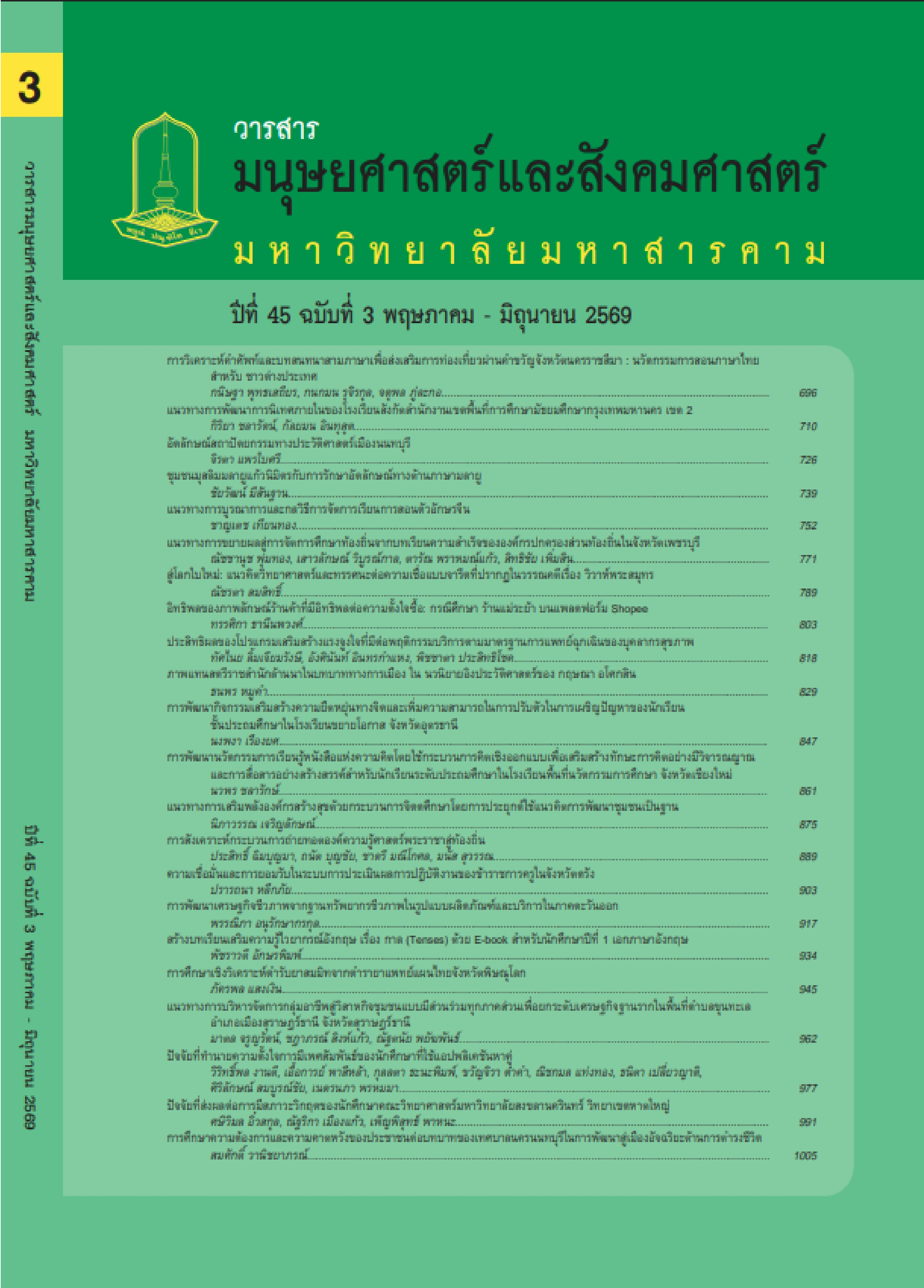
การพัฒนากิจกรรมเสริมสร้างความยืดหยุ่นทางจิตและเพิ่มความสามารถในการปรับตัวในการเผชิญปัญหาของนักเรียนชั้นประถมศึกษาในโรงเรียนขยายโอกาส จังหวัดอุดรธานี
Article Sidebar
Main Article Content
Abstract
The purpose of this research were 1)Develop a model of activities to enhance mental resilience and increase the ability to adapt when facing problems.2)Test the model of activities to enhance mental resilience and increase the ability to adapt when facing problems.3)Evaluate the model of activities to enhance mental resilience and increase the ability to adapt when facing problems for primary school students using the Research and Development method.The sample group for this experiment consisted of 30 primary school students in grades 3-6, aged between 9-12 years, studying in the second semester of the 2024 academic year at Nong Hai Witthaya School, under the Office of Primary Education Service Area 1, Udonthani Province. A purposive sampling method was used. The instruments included a mental resilience questionnaire, an adaptation ability questionnaire, and a satisfaction survey. Data analysis involved descriptive statistics such as percentages, mean (M), standard deviation (SD), t-test for dependent samples, and content analysis.The results revealed that:1.The developed model of activities to enhance the mental resilience of primary school students at the extended opportunity school included six activities: Building relationships and assessing mental resilience and adaptation.Developing social skills and relationships with others (I have).Developing and exploring strengths and building self-confidence (I am).Developing and practicing problem-solving skills and managing situations (I can).Enhancing adaptability skills and mental resilience (I have, I am, I can).Applying learned experiences to enhance adaptability in facing challenges.The key components of the model include:building relationships and assessing mental resilience and adaptation, developing social skills and relationships with others (I have), developing and exploring strengths and building self-confidence (I am), developing and practicing problem-solving skills and managing situations (I can), enhancing adaptability skills and mental resilience (I have, I am, I can), and applying learned experiences to enhance adaptability in facing challenges. The key components of the model include principles, objectives, processes, practical application, and evaluation.3.The results of the experiment with the activities model showed improvements in mental resilience in three areas: support from external sources (I have) (M = 4.09, SD = 0.26), internal characteristics and self-belief (I am) (M = 4.02, SD = 0.27), and problem-solving and coping skills (I can) (M = 4.09, SD = 0.26). The post-test averages were higher than pre-test scores, with significant statistical differences at the 0.01 level. For the adaptation ability test, there were improvements in four areas: emotional (M = 3.83, SD = 0.32), behavioral (M = 3.98, SD = 0.34), social (M = 3.98, SD = 0.38), and perception and attitude (M = 3.94, SD = 0.26). Post-test scores were significantly higher than pre-test scores at the 0.01 level.3.The students’ satisfaction with the activity model was at the highest level (M = 4.55, SD = 0.45).
Article Details
References
Chang, M. J., Negi, L. T., Samphel, T., & Won, S. (2024). Building resilience and social–emotional competencies in elementary school students through a short-term intervention program based on the SEE Learning curriculum. Behavioral Sciences, 14(6), 458. https://doi.org/10.3390/bs14060458 Gartland, D., Giallo, R., McDonald, M., MacDonald, J. A., Tapera, R., Riggs, E., ... & Brown, S. J. (2024). The Childhood Resilience Study: Resilience and emotional and behavioural wellbeing experienced by Australian Aboriginal and Torres Strait Islander boys and girls aged 5–9 years. PLOS ONE, 19(5), e0301620.https://doi.org/10.1371/journal.pone.0301620 Grotberg, E. H. (1995). A guide to promoting resilience in children: Strengthening the human spirit. Bernard Van Leer Foundation. Huang, W., Wu, P., Li, J., Zhou, Y., Xiong, Z., Su, P., Wan, Y., Tao, F., & Sun, Y. (2025). Effectiveness of a universal resilience-focused intervention for children in the school setting: A randomized controlled trial. Journal of Affective Disorders, 368, 695–703. https://doi.org/10.1016/j.jad.2024.09.120 Kang, H. I., & Chung, I.-J. (2022). The effects of satisfaction with play and leisure activities on children's quality of life: The differences between elementary and middle school students. Journal Name, Volume(Issue), Page range. DOI : 10.24300/jkscw.2022.09.71.3.61 Lee, M.-S., & Yu, H. K. (2022). Development of resilience scale for elementary school students. Journal of Educational Psychology, 114(6), 1234–1245. https://doi.org/10.1037/edu0000661 Litvin, I., Zorochkina, T., & Shpak, V. (2024). Psychological features of younger school-age children. Pedagogical Sciences: Theory, History, Innovation, 4(138), 346–356. Sumy State Pedagogical University named after A. S. Makarenko. Livshun, O., & Olkhovetskyi, S. (2023). Motivational sphere of primary school students: Aspects of formation. Psychological Journal, 10.31499/2617-2100.10.2023.285316. Luthar, S. S., Cicchetti, D., & Becker, B. (2000). The construct of resilience: A critical evaluation and guidelines for future work. Child Development, 71(3), 543-562. Masten, A. S. (2014). Ordinary magic: Resilience in development. Guilford Publications.Zimmer-Gembeck, M. J., & Skinner, E. A. (2016). The development of coping: Implications for psychopathology and resilience. Developmental Review, 41, 1-28. Miles, M. B., & Huberman, A. M. (1994). Qualitative data analysis: An expanded sourcebook (2nd ed.). Sage Publications. Min, H. J., Park, S.-H., Lee, S.-H., Lee, B.-H., Kang, M., Kwon, M. J., Muckenhofer, B., Wolf, V. A., Riedl, D., Park, K. R. (2024). The effects of elementary school students' perceived parental educational support on school adjustment, academic engagement, and satisfaction with science learning. Retrieved from https://discovery.researcher.life/article/--/d997703ecf7335e69e0dac9b670988c1
สำนักงานคณะกรรมการการศึกษาขั้นพื้นฐาน. (2564). รายงานประจำปีการศึกษา 2564. กระทรวงศึกษาธิการ. สำนักงานสถิติแห่งชาติ. (2565). สถิติเด็กและเยาวชนไทย ปี 2565. ชาย โพธิสิตา. (2549). ศาสตร์และศิลป์แห่งการวิจัยเชิง คุณภาพ. พิมพ์ครั้งที่ 2. กรุงเทพฯ: อมรินทร์พริ้นติ้งแอนด์ พับลิชชิ่ง.
