
A Study of People's Needs and Expectations on the Role of Nonthaburi City Municipality in Development to the Smart Living City
Article Sidebar
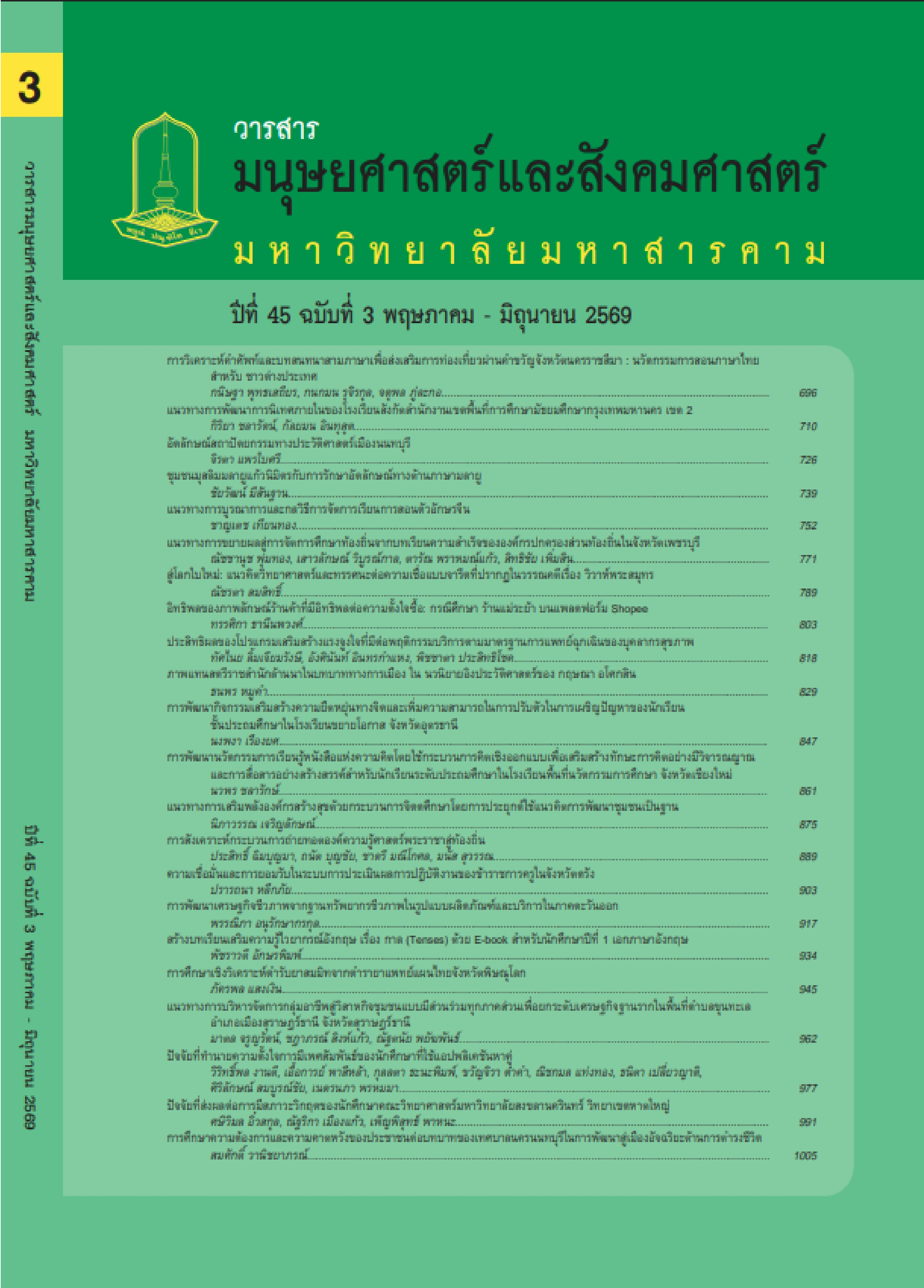
Main Article Content
Abstract
This research aims to 1) explore the needs and expectations of residents in developing a Smart Living City, 2) analyze factors influencing these needs and expectations, and 3) propose strategies for advancing toward a Smart Living City. A mixed-methods research methodology was employed. The findings revealed that most participants were female, aged 45-59 years, held a bachelor’s degree, had a household income not exceeding 30,000 baht per month, and had resided in the area for over 10 years. The key needs identified were: 1) health-related aspects, including PM 2.5 dust management and real-time health information; 2) safety-related aspects, such as comprehensive CCTV installation; and 3) convenience-related aspects, including the development of recreational areas and transportation systems accessible to all population groups. Recommendations from the research include enhancing urban safety, integrating health technologies, and expanding urban green spaces. Factors influencing the demand for Smart Living City development include age, educational level, and household income. Proposed development strategies include: 1) leveraging smart technologies to improve residents’ quality of life, 2) implementing health management technologies for all age groups, 3) developing public green spaces, and 4) adopting smart transportation systems to facilitate inclusive mobility.
Article Details
References
วนัทยา มงคล. (2021). 7 เมืองอัจฉริยะติดอันดับโลก ส่องเมืองเขาส่งเสริมไทยเราให้ก้าวไกล https://hhcthailand.com/top-7-smart-cities-in-the-world/
สำนักงานส่งเสริมเศรษฐกิจดิจิทัล (2565). 7 Smart City indicators. https://www.depa.or.th/ storage/ app/media/file/1555573273.pdf
สำนักงานสภาพัฒนาการเศรษฐกิจและสังคมแห่งชาติ และศูนย์บริการวิชาการแห่งจุฬาลงกรณ์มหาวิทยาลัย. (2565). คู่มือแนวทางการวางแผนพัฒนาเมืองในอนาคตให้น่าอยู่อย่างยั่งยืน. ศูนย์บริการวิชาการแห่งจุฬาลงกรณ์มหาวิทยาลัย.
สำนักงานเทศบาลนครนนทบุรี (2566). แผนพัฒนาท้องถิ่น พ.ศ.2566-2570. นนทบุรี : ฝ่ายแผนงานและงบประมาณ กองวิชาการและแผนงาน เทศบาลนครนนทบุรี.
อลงกต สารกาล. (2563). ความสำเร็จขององค์กรปกครองท้องถิ่นในการจัดการสิ่งแวดล้อมเมืองที่ยั่งยืน: บทเรียนจากเทศบาลเมืองกาฬสินธุ์. วารสารสังคมศาสตร์ จุฬาลงกรณ์มหาวิทยาลัย, 50(2), 71-100.
อัครวินท์ ศาสนพิทักษ์. (2565). เมืองอัจฉริยะ: การสังเคราะห์ความหมาย. วารสารวิชาการวิทยาลัยบริหารศาสตร์, 5(1), 126-141.
เอกชัย สุมาลีและคณะ. (2562). โครงการวิจัยเชิงปฏิบัติการ การพัฒนาท้องถิ่นสู่เมืองอัจฉริยะยั่งยืน ระยะที่ 2. กรุงเทพฯ : สถาบันพระปกเกล้าและศูนย์วิจัยนครอัจฉริยะ (SCRC) มหาวิทยาลัยเทคโนโลยีพระจอมเกล้าเจ้าคุณทหารลาดกระบัง.
อรทัย ก๊กผลและคณะ. (2562). รายงานสถานการณ์การกระจายอำนาจ : บทสำรวจการพัฒนาเมืองอัจฉริยะขององค์กรปกครองส่วนท้องถิ่น ประจำปี พ.ศ.2562. กรุงเทพฯ: วิทยาลัยพัฒนาการปกครองท้องถิ่น สถาบันพระปกเกล้า.
Angelidou, M. (2015). Smart cities: A conjuncture of four forces. Cities, 47, 95-106.
Ashaye, O., & Alharahsheh, H. (2021). Smart City Development and Implications, 467-473. https://doi.org/10.4018/978-1-7998-6600-8.CH018.
Bastos, D., Fermandez-Caballero, A., Pereira, A., & Rocha N. P. (2022). Smart City Applications to Promote Citizen Participation in City Management and Governance: A Systematic Review. Informatics, 9(4). 89-101.
Chen, K., Wang, J., & Zhang, H. (2020). Artificial Intelligence and IoT-based Solutions for Sustainable Smart Cities: A Systematic Review. Sustainable Cities and Society, 61, 102327.
Cohen, B. (2014). Smart City Index Master Indicators Survey https://smartcitiescoucil.com/ resources/smart-city-index-master-indicators-survey
Das, R. K., Panda, M., & Ali, S. (2023). Digital Skills Gap in Smart City Development: Challenges and Solutions. Journal of Urban Technology, 30(2), 45-62.
Delitheou, V., Michalaki, E., & Tsavalias, K. (2020). Smart Cities and Development. PSN: Urbanization & Urban Development (Topic). https://doi.org/10.2139/ssrn.3657603.
Giffinger, R., Ferner, C., Kramer, H., Meijers, E., & Pichler, M. N. (2007). Smart Cities: Ranking of European medium-sized cities. Austria: Centre of Regional Science Vienna University of Technology.
Hall, R. E., Bowerman, B., Braverman, J., Taylor, J., Todosow, H., & Von, W. U. (2000). The vision of a smart city. Upton, NY: Brookhaven National Lab.
Hartley, K., & Aldag, A. (2024). Public trust and support for government technology: Survey insights about Singapore's smart city policies. Cities, 154, 105368.
Hollands, R. G. (2008). Will the real smart city please stand up? Intelligent, progressive or entrepreneurial? City, 12(3), 303-320.
Kim, S., Hong, P., Lee, T., Lee, A., & Park, S. (2022). Determining Strategic Priorities for Smart City Development: Case Studies of South Korean and International Smart Cities. Sustainability. https://doi.org/10.3390/su141610001.
Kitchin, R. (2014). The real-time city? Big data and smart urbanism. GeoJournal, 79(1), 1-14.
Kourtit, K., Kijkamp, P., & Arribas, D. (2012). Smart cities in perspective: A comparative European study by mean of self-organizing maps. Innovation: The European Journal of Social Science Research, 25(2), 229-246.
Kozhakhmet, M., & Alzhanov, A. (2023). Maintaining the Needs of Citizens in Smart City. Vestnik of M. Kozybayev North Kazakhstan University. https://doi.org/ 10.54596/2958-0048-2023-1-8-13.
Lara, A. P., Costa, E. M. D., Furlani, T. Z., & Yigitcanlar, T. (2016). Smartness that matters: towards a comprehensive and human-centered characterization of smart cities. Journal of Open Innovation: Technology, Market, and Complexity, 2(8), 1-13.
Lim, Y., Edelenbos, J., & Gianoli, A. (2019). Identifying the results of smart city development: Findings from systematic literature review. Cities, 95, 102397. https://doi.org/10.1016/J.CITIES.2019.102397.
Mashau, N. L., Kroeze, J. H., & Howard, G. R. (2022). Key Factors for Assessing Small and Rural Municipalities’ Readiness for Smart City Implementation. Smart Cities. 5, 1742-1751.
Masik, G., Sagan, I., & Scott, J. (2021). Smart City strategies and new urban development policies in the Polish context. Cities. https://doi.org/10.1016/j.cities.2020.102970.
Mayaud, J. R., Tran, M., Pereira, R. H., & Nuttall, R. (2019). Future access to essential services in a growing smart city: The case of Surrey, British Columbia. Computers, Environment and Urban Systems, 73, 1-15.
McKinsey Global Institute. (2018, June). Smart Cities: Digital Solutions for a more Livable Future. McKinsey Global Institute.
Nam, T., & Pardo, T. A. (2011). Conceptualizing smart city with dimensions of technology, people, and institutions. Proceedings of the 12th Annual International Digital Government Research Conference: Digital Government Innovation in Challenging Times, 282-291.
Nijkamp, P., Lombardi, P., Giordano, S., Caragliu, A., Del B. C., Deakin, M., & Kourtir, K. (2011). An advance triple-helix network model for smart cities performance. Research Memorandum, 45, 1-22.
Padua, D. (2021). Digital Cultural Transformation. Springer International Publishing.
Piro, G., Cianci, I., Grieco, L. A., Boggia, G., & Camarda, P. (2014). Information centric services in smart cities. Journal of Systems and Software, 88, 169-188.
Pozdniakova, A. M. (2017). Smart sustainable cities: the concept and approaches to measurement. Acta Innovations, (22), 5-19.
Sadeq, W., & Çevik, M. (2022). Smart Cities: A Strategic Approach to Urban Sustainability. 2022 International Symposium on Multidisciplinary Studies and Innovative Technologies (ISMSIT), 142-152. https://doi.org/10.1109/ISMSIT56059. 2022.9932790.
Santa, A.-M. I. (2022). Prosumer-A New Mindset for Citizens in Smart Cities. Smart Citities, 5, 1409-1420.
Sharifi, A., Khavarian-Garmsir, A. R., & Kummitha, R. K. R. (2021). The COVID-19 pandemic: Lessons for urban resilience and smart city development. Cities, 112, 103126.
Shuang, Q., & Zheng, Z. (2024). Analysis on the impact of smart city construction on urban greenness in China's megacities. Journal of Environmental Management, 355, 120568.
Sontiwanich, P., Boonchai, C., & Beeton, R. J. (2022). An unsustainable smart city: lessons from uneven citizen education and engagement in Thailand. Sustainability, 14(20), 13315.
Thuzar, M. (2011). Urbanozation in South East Asia: Developing Smart Cities for the Future?. Regional Outlook. Singapore: Yusof Ishak Institute.
Trencher, G. (2019). Towards the smart city 2.0: Empirical evidence of using smartness as a tool for tackling social challenges. Technological Forecasting and Social Change. https://doi.org/10.1016/J.TECHFORE.2018.07.033.
UN-Habitat. (2011). Cities and Climate Change: Policy Directions. Global Report on Human Settlements 2011.
Washbum, D., Sindhu, U., Balaouras, S., Dines, R. A., Hayes, N. M., & Nelson, L. E. (2010). Helping CIOs Understand ‘Smart City’ Initiative: Defining the Smart City, its Drivers, and the Role of the CIO. Cambridge, MA: Forrester Research, Inc.
Yigitcanlar, T. (2016). Technology and the city : system applications and implications. New York : Routlrdge.
Yigitcanlar, T., Butler, L., & Windle, E. (2023). Privacy and surveillance in smart cities: A critical analysis of emerging challenges. Telematics and Informatics, 77, 101932.
Zhang, L., Chen, J., & Liu, B. (2022). Financial Sustainability of Smart City Initiatives: Evidence from Global Case Studies. Sustainability, 14(15), 9234.
Zhao, J. (2011). Towards sustainable cities in China: Analysis and assessment of some Chinese cities in 2008. New York: Springer.
Zhuang, H., Zhang, J., B., S., & Muthu, B. (2020). Sustainable Smart City Building Construction Methods. Sustainability. https://doi.org/10.3390/su12124947.
