
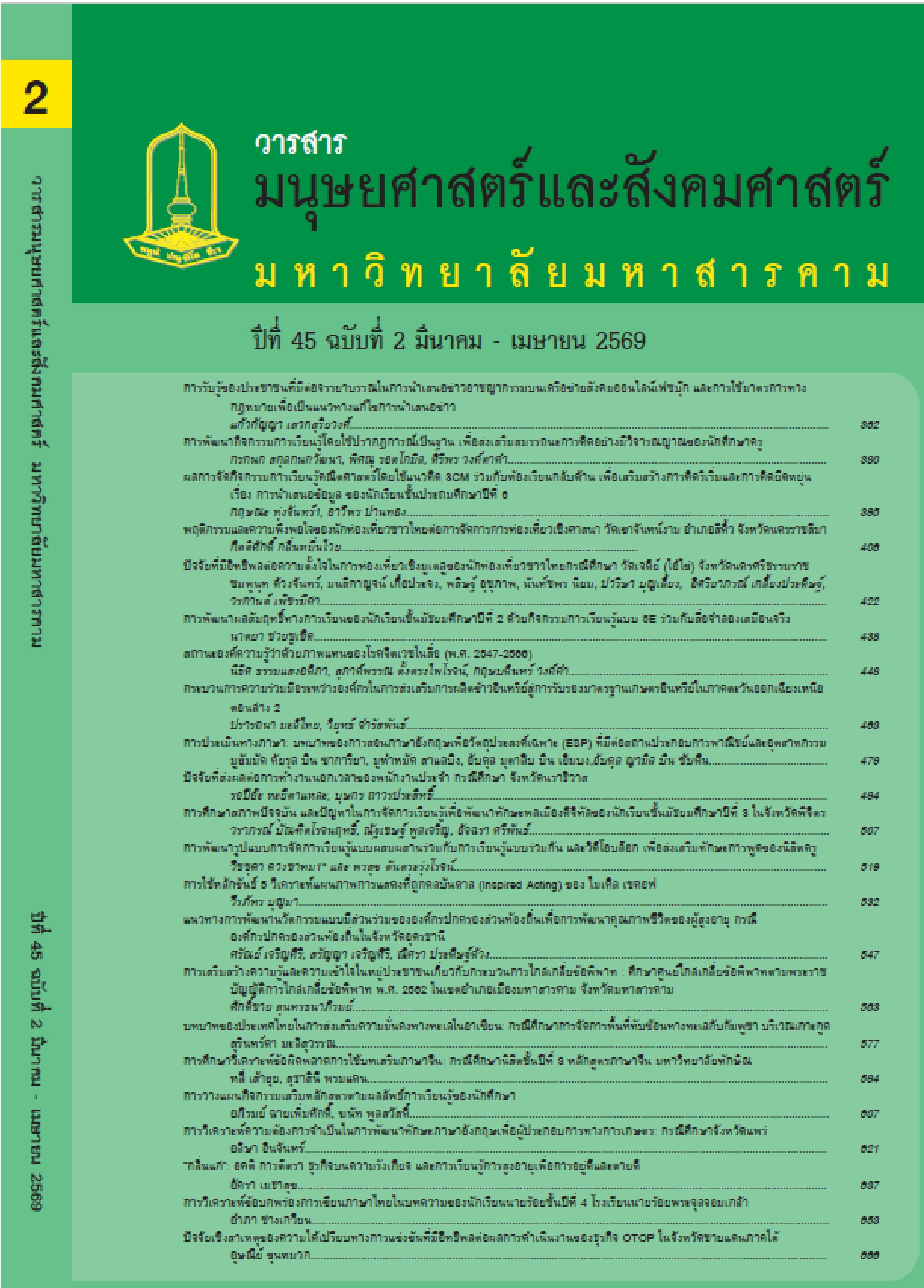
การพัฒนาผลสัมฤทธิ์ทางการเรียนของนักเรียนชั้นมัธยมศึกษาปีที่ 2 ด้วยกิจกรรม การเรียนรู้แบบ 5E ร่วมกับสื่อจำลองเสมือนจริง
Article Sidebar
Main Article Content
Abstract
The objectives of this research were to:
1)
compare the pre- and post-test academic achievement scores in science on the topic of the solar system and evaluate these scores with the criterion of
7
0 percent and
2)
assess students' satisfaction with the 5E learning activities integrated with interactive simulation. The participants in this study consisted of 35 Grade 8 students from a trilingual program at a large secondary school in Bangkok, selected through cluster sampling. The study was conducted during the second semester of the 2023 academic year. The research instruments included both experimental tools and data collection tools. The experimental tools comprised lesson plans based on the 5E instructional model combined with interactive simulation. The data collection tools included a four-choice multiple-choice test to measure students' learning achievement and a five-point Likert scale satisfaction questionnaire to assess students’ perceptions after completing the activities. The statistical methods used for data analysis included mean, percentage, standard deviation, and t-test for one sample. The results show that: 1)There was a statistically significant difference at the 0.05 level between pre-test and post-test scores. 2
The post-test scores surpassed the 70 percent criterion. 3) Both the overall and individual aspects of student satisfaction were at a high level.
Article Details
References
กระทรวงศึกษาธิการ. (2560). ตัวชี้วัดและสาระการเรียนรู้แกนกลาง กลุ่มสาระการเรียนรู้วิทยาศาสตร์(ฉบับปรับปรุง
พ.ศ. 2559) ตามหลักสูตรแกนกลางการศึกษาขั้นพื้นฐาน พุทธศักราช 2551(ปรับปรุง พ.ศ. 2560).
กรุงเทพฯ: โรงพิมพ์ชุมชนสหกรณ์การเกษตรแห่งประเทศไทย.
กรองทิพย์ บัวภา และวารีรัตน์ แก้วอุไร. (2566). การพัฒนากิจกรรมการเรียนรู้แบบสืบเสาะหาความรู้ร่วมกับการใช้
เทคโนโลยีเสมือนจริงเพื่อเสริมสร้างมโนทัศน์ทางวิทยาศาสตร์สำหรับนักเรียนชั้นมัธยมศึกษาศึกษาปีที่ 3.
Journal of Modern Learning Development, 9(4), 93-103.
ชาญวิทย์ คำเจริญ และขวัญหทัย กวดนอก. (2566). การพัฒนาปฏิบัติการฟิสิกส์พื้นฐานด้วยการใช้สื่อจำลองโต้ตอบ
เสมือนจริง.วารสารบรรณศาสตร์ มหาวิทยาลัยศรีนครินทรวิโรฒ, 16(2), 51-61.
ทิศนา แขมมณี. (2560). ศาสตร์การสอน: องค์ความรู้เพื่อการจัดกระบวนการเรียนรู้ที่มีประสิทธิภาพ(พิมพ์ครั้งที่ 21).
สำนักพิมพ์แห่งจุฬาลงกรณ์มหาวิทยาลัย.
บุญชม ศรีสะอาด. (2545). การวิจัยเบื้องต้น (พิมพ์ครั้งที่ 7). สุวีริยาสาส์น.
พันธ์ธีรา รัตนพันธุ์ และกัญญารัตน์ โคจร. (2566). การจัดกิจกรรมการเรียนรู้โดยใช้แบบจําลองเป็นฐานผ่านระบบออนไลน์
ที่มีต่อการสร้างคำอธิบายทางวิทยาศาสตร์ เรื่อง เคมีไฟฟ้า ของนักเรียนชั้นมัธยมศึกษาปีที่ 5. วารสาร
ศึกษาศาสตร์ มหาวิทยาลัยศิลปากร, 21(1), 231-248.
สถาบันทดสอบทางการศึกษาแห่งชาติ. (2566). ประกาศผล O-NET. สืบค้นเมื่อ 23 ธันวาคม 2023,
จาก https://www.niets.or.th/th/content/view/11821
สถาบันส่งเสริมการสอนวิทยาศาสตร์และเทคโนโลยี (สสวท.). (2567). ผลการประเมิน PISA 2022: บทสรุปสำหรับผู้บริหาร.
สืบค้นเมื่อ 19 ตุลาคม 2024, จาก https://pisathailand.ipst.ac.th
เอกรัตน์ จันทร์หอม และจิตราภรณ์ วงค์คำจันทร์. (2565). การพัฒนาการจัดการเรียนรู้แบบสืบเสาะหาความรู้ 7ขั้น ร่วมกับ
แบบจำลองไฟฟ้าเพื่อส่งเสริมความสามารถในการแก้ปัญหาของนักเรียนชั้นมัธยมศึกษาปีที่ 5. Journal of Roi
Et Rajabhat University, 16(3), 199-210.
Gillies, R. (2020). Inquiry-based Science Education. Taylor & Francis.
Kavanagh, S. S., Rainey, E. C., & Zibrio, E. A. (2022). Promoting collaborative work skills through inquiry-based
learning and virtual environments. International Journal of STEM Education, 9(1), 112-129.
Makransky, G., & Petersen, G. B. (2021). Investigating the effectiveness of virtual simulations in supporting science
education: A meta-analysis. Journal of Science Education and Technology, 30(3), 432-448.
Mayer, R. E. (2009). Multimedia learning (2nd ed.). Cambridge University Press.
Mosely, G., Harris, J., & Grushka, K. (2021). Design education in schools: An investigation of the Australian
Curriculum: Technologies. International Journal of Technology and Design Education, 31, 677–695.
Najib, M. N. M., Yaacob, A., & Md-Ali, R. (2022). Effects of Phet Interactive Simulation Activities
on Secondary School Students’ Physics Achievement. South Asian Journal of Social
Science & Humanities, 5(1), 26-39.
Sartika, M. (2021). Constructivism Approach through Learning Cycle Model of Biology to Improve Student
Learning Outcomes. Journal of Educational Management and Leadership, 2(1), 34-38.
Yager, R. E., & Akcay, H. (2010). The advantage of an inquiry approach for science instruction in middle grades.
School Science & Mathematics, 110, 5-12.
