
Factors Affecting the Intention to Mutelu Tourism of Thai Tourists: A Case Study of Wat Chedi (Ai Khai) Nakhon Si Thammarat Province
Article Sidebar
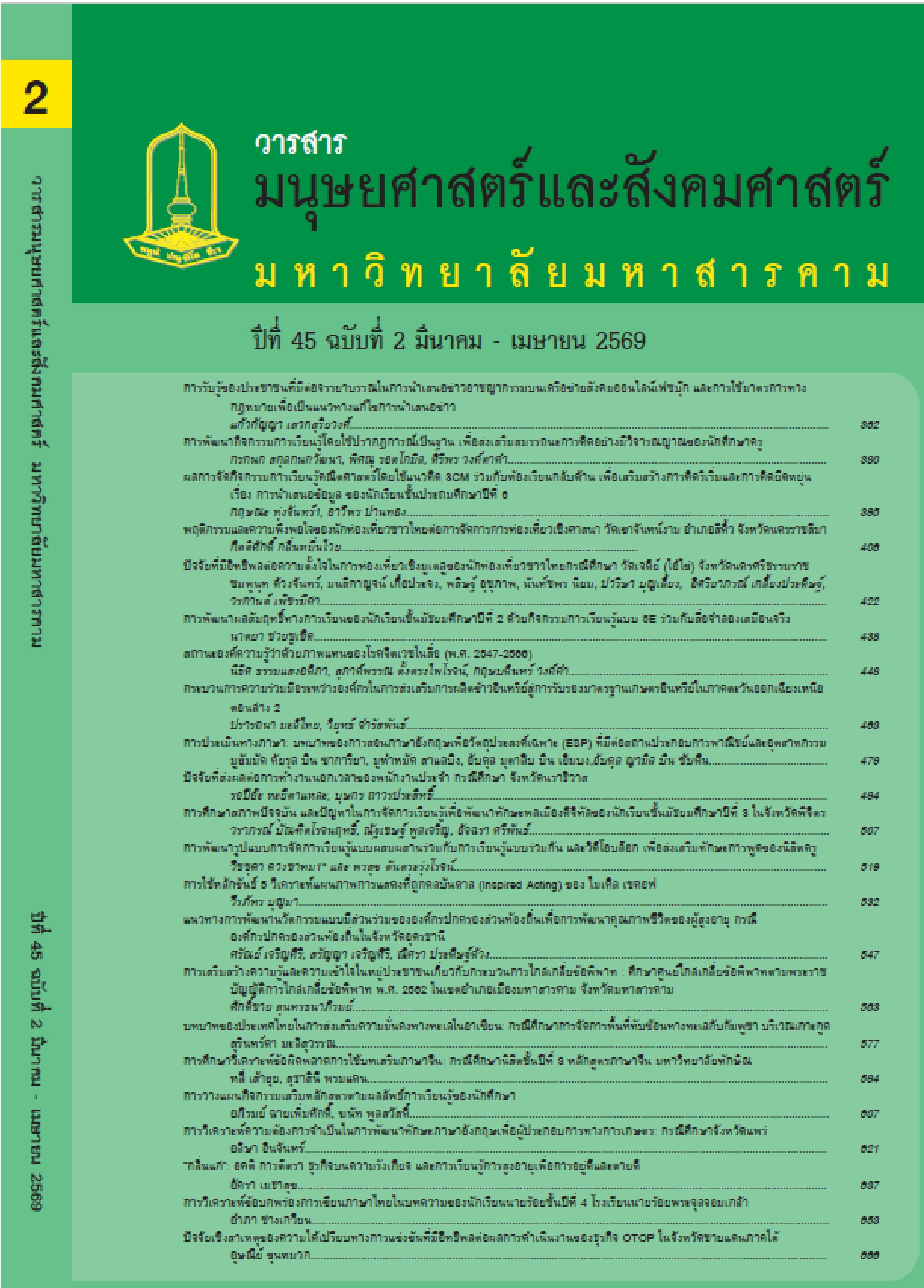
Main Article Content
Abstract
This research aimed to analyze factors affecting Thai tourists' travel intentions by applying the Theory of Planned Behavior and electronic word-of-mouth concepts as a conceptual framework. The study employed quantitative research methodology, collecting data through questionnaires from 341 Thai tourists at Wat Chedi (Ai Khai) in Nakhon Si Thammarat Province using purposive sampling. Data were analyzed using descriptive statistics and stepwise multiple regression analysis. The results showed high levels of all factors, ranked from highest to lowest: travel intention ( = 4.19), attitude toward behavior ( = 4.12), subjective norms ( = 3.92), perceived behavioral control ( = 3.92), and electronic word-of-mouth ( = 3.87). The analysis revealed that attitude toward behavior (β = 0.387), subjective norms (β = 0.318), and perceived behavioral control (β = 0.131) significantly affected travel intentions at the 0.05 level. These three variables collectively explained 28.7% of the variance in travel intentions. The findings support the importance of the Theory of Planned Behavior and highlight the significance of developing marketing strategies focused on creating positive attitudes to promote tourism in the area.
Article Details
References
กรุงเทพธุรกิจ. (2566). รายงานวิจัยเศรษฐกิจแนวโน้มการท่องเที่ยวเชิงศรัทธาในประเทศไทย. https://www.bangkokbiznews.com/politics/1084069
กองพัฒนาบริการท่องเที่ยว กรมการท่องเที่ยว. (2565). แผนพัฒนาบริการท่องเที่ยว พ.ศ. 2566-2570. กรมการท่องเที่ยว.
สรัญพร สุรวิชัย และสุวารี นามวงค์. (2563). การพัฒนาจุดหมายปลายทางแหล่งท่องเที่ยวเชิงจิตวิญญาณกับพฤติกรรมนักท่องเที่ยวในจังหวัดเชียงใหม่. วารสารวิทยาลัยดุสิตธานี, 14(1), 145-164.
สุธิษา เชญชาญ. (2563). ปัจจัยที่ส่งผลต่อความตั้งใจมาเที่ยวซํ้าและความยินดีแนะนำของนักท่องเที่ยวชาวไทยที่มีต่อแหล่งท่องเที่ยวมรดกทางประวัติศาสตร์ในจังหวัดลพบุรี [วิทยานิพนธ์ปริญญาบริหารธุรกิจดุษฎีบัณฑิต]. มหาวิทยาลัยรังสิต.
อธิป จันทร์สุริย์. (2564). มูเตลู: ความเชื่อกับการท่องเที่ยว. วารสารทีทัศน์วัฒนธรรม สำนักศิลปะและวัฒนธรรม มหาวิทยาลัยราชภัฏบ้านสมเด็จเจ้าพระยา, 20(1), 220-240.
Ajzen, I. (1991). The theory of planned behavior. Organizational Behavior and Human Decision Processes, 50(2), 179-211.
Ajzen, I. (2020). The theory of planned behavior: Frequently asked questions. Human Behavior and Emerging Technologies, 2(4), 314-324.
Berger, J. (2014). Word of mouth and interpersonal communication: A review and directions for future research. Journal of Consumer Psychology, 24(4), 586-607.
Chu, S. C., & Kim, J. (2018). The current state of knowledge on electronic word-of-mouth in advertising research. International Journal of Advertising, 37(1), 1-13.
Han, H., & Kim, Y. (2010). An investigation of green hotel customers' decision formation: Developing an extended model of the theory of planned behavior. International Journal of Hospitality Management, 29(4), 659-668.
Hsu, C. H., & Huang, S. (2012). An extension of the theory of planned behavior model for tourists. Journal of Hospitality & Tourism Research, 36(3), 390-417.
Ismagilova, E., Slade, E., Rana, N. P., & Dwivedi, Y. K. (2020). The effect of characteristics of source credibility on consumer behaviour: A meta-analysis. Journal of Retailing and Consumer Services, 53, 1-9.
Jalilvand, M. R., & Samiei, N. (2012). The impact of electronic word of mouth on a tourism destination choice: Testing the theory of planned behavior (TPB). Internet Research, 22(5), 591-612.
Jalilvand, M. R., Samiei, N., Dini, B., & Manzari, P. Y. (2012). Examining the structural relationships of electronic word of mouth, destination image, tourist attitude toward destination and travel intention: An integrated approach. Journal of Destination Marketing & Management, 1(1-2), 134-143.
Kim, S., Kim, J., & Park, S. (2017). The effects of perceived value, website trust and hotel trust on online hotel booking intention. Sustainability, 9(12), 1-14.
Kline, R. B. (2005). Principles and practice of structural equation modeling (2nd ed.). Guilford Press.
Likert, S. (1961). New patterns of management. McGraw-Hill.
Litvin, S. W., Goldsmith, R. E., & Pan, B. (2018). A retrospective view of electronic word-of-mouth in hospitality and tourism management. International Journal of Contemporary Hospitality Management, 30(1), 313-325.
Liu, X. S. (2019). A probabilistic explanation of Pearson's correlation. Teaching Statistics, 41, 115–117.
Meng, B., & Han, H. (2016). Effect of environmental perceptions on bicycle travelers' decision-making process: Developing an extended model of goal-directed behavior. Asia Pacific Journal of Tourism Research, 21(11), 1184-1197.
Miles, J. (2014). Tolerance and Variance Inflation Factor. In N. Balakrishnan, T. Colton, B. Everitt, W. Piegorsch, F. Ruggeri, & J. L. Teugels (Eds.), Wiley StatsRef: Statistics Reference Online (pp. 1-15). John Wiley & Sons, Ltd.
Milton, S. (1986). A sample size formula for multiple regression studies. The Public Opinion Quarterly, 50(1), 112–118.
Nunnally, J. C., & Bernstein, I. H. (1994). The assessment of reliability. Psychometric Theory, 3, 248-292.
Rasoolimanesh, S. M., Seyfi, S., Rather, R. A., & Hall, C. M. (2022). Investigating the mediating role of visitor satisfaction in the relationship between memorable tourism experiences and behavioral intentions in heritage tourism context. Tourism Review, 77(2), 687-709.
Rovinelli, R. J., & Hambleton, R. K. (1977). On the use of content specialists in the assessment of criterion-referenced test item validity. Dutch Journal of Educational Research, 2, 49-60.
Tommasetti, A., Singer, P., Troisi, O., & Maione, G. (2018). Extended Theory of Planned Behavior (ETPB): Investigating customers’ perception of restaurants’ sustainability by testing a structural equation model. Sustainability, 10(7), 1-21.
Wang, L., Wong, P. P. W., & Zhang, Q. (2021). Travellers’ destination choice among university students in China amid COVID-19: Extending the theory of planned behaviour. Tourism Review, 76(4), 749-763.
Wei, Y., Liu, H., & Park, K. S. (2021). Examining the structural relationships among heritage proximity, perceived impacts, attitude and residents' support in intangible cultural heritage tourism. Sustainability, 13, 1-14.
Wibawa, B. M., Mardhotillah, R. R., & Elfita, R. A. (2022). Intention to visit religious destination: Subjective norms, religiosity and attitude. Journal of Halal Research, Policy, and Industry, 1(1), 1-7.
Yen, C. L. A., & Tang, C. H. H. (2019). The effects of hotel attribute performance on electronic word-of-mouth (eWOM) behaviors. International Journal of Hospitality Management, 76, 9-18.
