
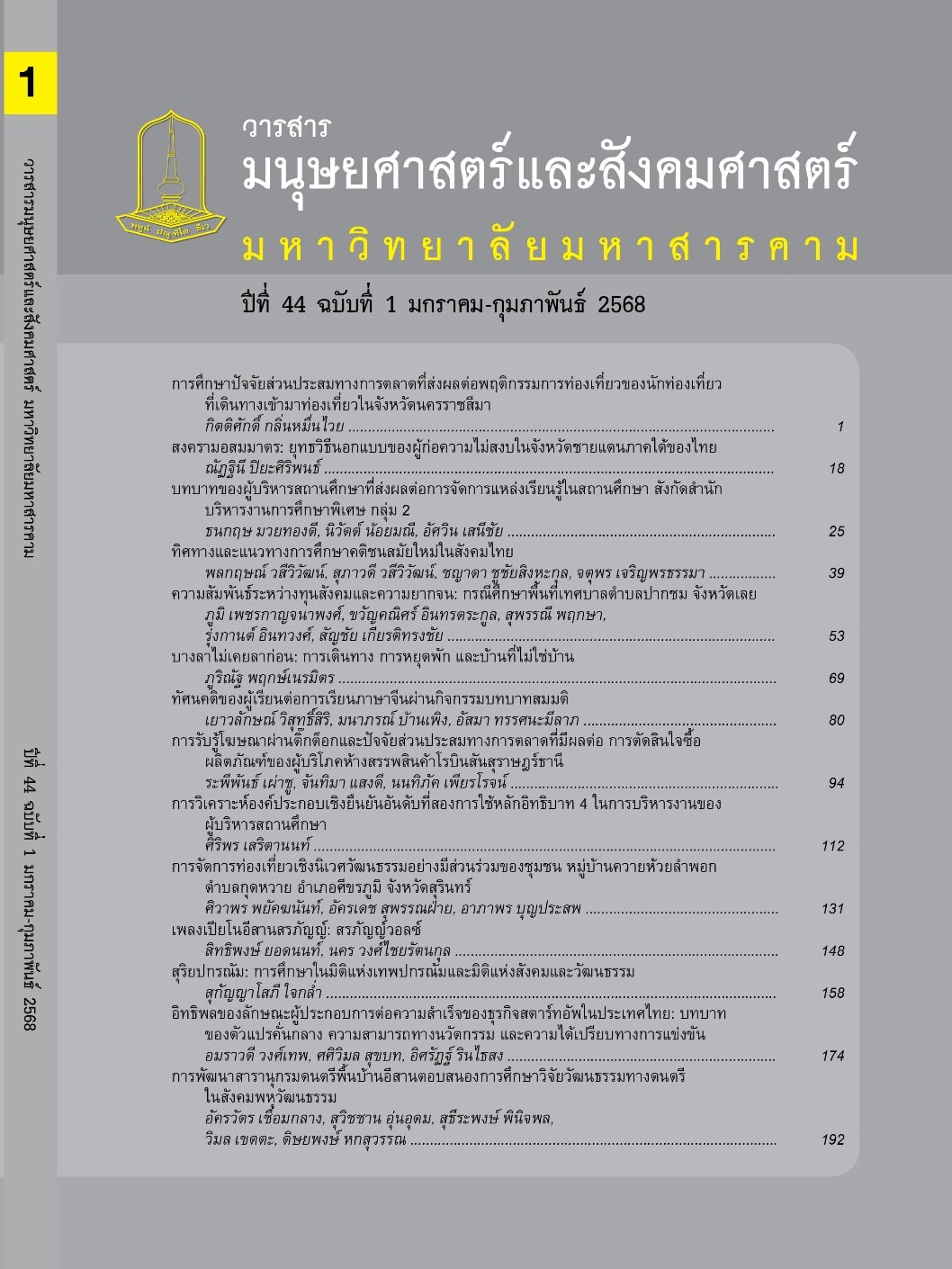
Development of an Isaan Folk Music Encyclopedia to Address Research and Educational Needs
Article Sidebar
Main Article Content
Abstract
The objective of this study is to explore and compile knowledge of Isaan folk music, with the aim of developing a contemporary Isaan folk music encyclopedia. The research methodology employs a mixed-method approach, incorporating document analysis, fieldwork, group discussions, and surveys to gather insights from relevant stakeholders. The target groups include music and language experts, local community leaders, and Isaan folk artists. A sample study of feedback from potential users, including students, academics, and music researchers, is also conducted. The research utilizes purposive sampling techniques and employs research tools such as document analysis, interviews, and opinion surveys. Statistical analysis methods such as mean, standard deviation, and content analysis are utilized for data analysis.
Research Findings. The collection and analysis of documents related to Isaan folk music have provided preliminary data for the establishment of a basic vocabulary. Content analysis from field interviews and group seminars has revealed several observations: 1) Some words have similar meanings but different regional names. 2) Some words have multiple meanings. 3) Some points of information remain unclear, requiring further investigation. Therefore, the focus is on studying words with preliminary conclusions. The resulting encyclopedia includes definitions, illustrations, and musical notes for 50 words. Evaluation of stakeholder feedback on format and content indicates overall suitability, providing a comprehensive database of Isaan folk music with detailed descriptions and current musical notes from contemporary local artists.
Article Details
References
เฉลิมศักดิ์ พิกุลศรี.(2539). การดนตรีไทยทางเลือกแห่งนิยามดนตรีวิทยาหรือมนุษยสังคีตวิทยา. วาราสารคำดนตรี, 1(1), 18-22
บรูซ แกสตัน. (2531). ความคิดที่เกี่ยวกับดนตรีของโลก, วารสารถนนดนตรี. 2(9): 6-29.
ประเวศ วะสี. (2534) การศึกษาของชาติกับภูมิปัญญาท้องถิ่น. ใน เสรีพงษ์พิศ (บ.ก.) ภูมิปัญญาชาวบ้านกับการพัฒนาชนบท. สรุปผลการสนทนาทางวิชาการเรื่องภูมิปัญญาชาวบ้านกับการดำเนินงานด้านวัฒนธรรม เล่ม 2(น.17 – 33). อมรินทร์พริ้นติ้งแอนด์ พับลิชชิ่ง.
ปัญญา รุ่งเรือง. (2546). หลักวิชามานุษยดุริยางควิทยา. กรุงเทพมหานคร: คณะมนุษยศาสตร์,มหาวิทยาลัยเกษตรศาสตร์.
ราชบัณฑิตยสถาน. (2556). พจนานุกรมฉบับราชบัณฑิตยสถาน พ.ศ. 2554. กรุงเทพฯ : นานมีบุ๊คส์พับลิเคชั่นส์
พวงรัตน์ ทวีรัตน์. (2540). วิธีการวิจัยทางพฤติกรรมศาสตร์และสังคมศาสตร์. พิมพ์ครั้งที่ 7. กรุงเทพฯ : สำนักทดสอบทางการศึกษาและจิตวิทยา มหาวิทยาลัยศรีนครินทร์วิโรฒประสานมิตร.
พูนพิศ อมาตยกุล. (2540). ลำนำแห่งสยาม. พิมพลักษณ์, กรุงเทพฯ : สำนักพิมพ์นิตยสาร HI-Fi Stereo
สุกรี เจริญสุข.(2530) . ดุริยางคศาสตร์ชาติพันธุ์. ถนนดนตรี. 1(12), 38-41.
สุภางค์ จันทวานิช. (2547).วิธีการวิจัยเชิงคุณภาพ.(พิมพ์ครั้งที่ 12). กรุงเทพมหานคร: สำนักพิมพ์แห่งจุฬาลงกรณ์มหาวิทยาลัย..
อมรา ประสิทธิ์รัฐสินธุ์. (2550). ภาษาศาสตร์สังคม (พิมพ์ครั้งที่ 4). กรุงเทพฯ : โรงพิมพ์จุฬาลงกรณ์ มหาวิทยาลัย.
อาทิตย์ โพธิ์ศรีทอง. (2558). รายงานวิจัยกาเมลัน :วงดนตรีประจำชาติของอินโดนีเซีย. กรุงเทพฯ :คณะศึกษาศาสตร์ มหาวิทยาลัยศรีนครินทรวิโรฒ.
Byerly, Alison. (1989). "The Language of the Soul": George Eliot and Music Nineteenth-Century Literature,44(1), 1-17
