
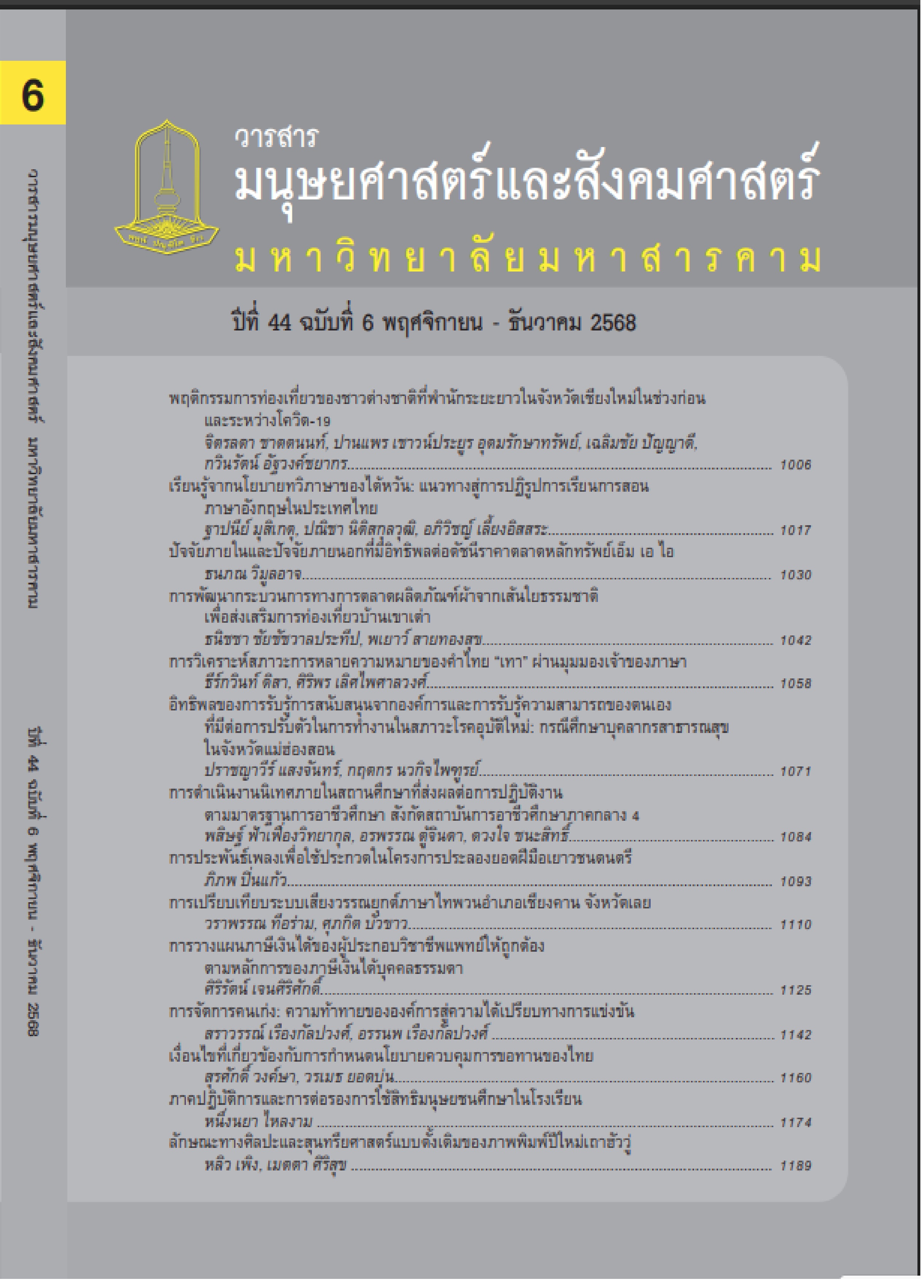
พฤติกรรมการท่องเที่ยวของชาวต่างชาติที่พำนักระยะยาวในจังหวัดเชียงใหม่ในช่วงก่อนและระหว่างโควิด-19
Article Sidebar
Main Article Content
Abstract
Abstract
The objectives of this research are to study the travel behavior of foreigners staying long-term in Chiang Mai Province before and during COVID-19. This research is quantitative research. The research tool was a questionnaire. The researcher collected data using a snowball sampling method with a sample size of 380 people. After that, the questionnaire was compiled and checked for completeness. Then use the computer to analyze the statistical data. The Statistics used include frequency and are summarized as percentage, mean and standard deviation.
The results of the study found that most foreigners staying long term in Chiang Mai are male. Are over 66 years of age and have American citizenship. The duration of stay in Thailand is less than 7 years, most are on temporary visas. Have marital status bachelor’s degree level Retired occupation There is a source of expenses from business/occupation. There are accommodation expenses per month of 11,001 - 19,000 baht, travel expenses per month less than 5,001 baht, daily living expenses per month 9,601 - 19,200 baht, and other expenses per month less than 8,001 baht.
Article Details
References
กระทรวงการท่องเที่ยวและกีฬา. (2554). แผนพัฒนาการท่องเที่ยวแห่งชาติ พ.ศ. 2555-2559. https://www.mots.go.th/download/ImplementationofThePolicy/NotificationofTheNationalTourismPolicy.pdf
กองเศรษฐกิจการท่องเที่ยวและกีฬา. (2564). สถานการณ์การท่องเที่ยวเดือนสิงหาคม 2564. https://mots.go.th/download/article/article_20210929113313.pdf
จิราวดี รัตนไพฑูรย์ชัย. (2557). ตลาดนักท่องเที่ยวผู้สูงอายุ: โอกาสใหม่ไทยเติบโตรับ AEC. หนังสือพิมพ์กรุงเทพธุรกิจ, ASEAN:1.
เฉลิมพล แจ่มจันทร์ และอรไท โสภารัตน์. (2555). การพำนักระยะยาวของคนญี่ปุ่นในจังหวัดเชียงใหม่: การวิเคราะห์ปัจจัยกำหนดในช่วงก่อนและหลังการพำนัก. https://cmudc.library.cmu.ac.th/frontend/Info/item/dc:139685
รชฏ เลียงจันทร์. (2564, 4 กุมภาพันธ์). เศรษฐกิจไทยจะเป็นอย่างไร หากเราต้องอยู่กับโควิด-19 ไปตลอดกาล. วิจัยกรุงศรี, 1-8.
วลัยพร กาญจนการุณ และธีรัช ปัญโญ. (2557). ปัจจัยที่มีอิทธิพลต่อการตัดสินใจขยายเวลาพำนักอยู่ของผู้พำนักระยะยาวของชาวญี่ปุ่นในจังหวัดเชียงใหม่. มนุษยศาสตร์สาร, 15(1), 179-212. https://cmudc.library.cmu.ac.th/frontend/Info/item/dc:168788
วารัชต์ มัธยมบุรุษ. (2556). การตลาดการท่องเที่ยวสำหรับนักท่องเที่ยวชาวญี่ปุ่นที่พำนักระยะยาวในจังหวัดเชียงใหม่. Journal of Thai Hospitality and Tourism, 8(2), 48–61. https://so04.tci-thaijo.org/index.php/tourismtaat/article/view/15421
สำนักเลขาธิการนายกรัฐมนตรี. (2564). ครม.เห็นชอบมาตรการดึงดูดชาวต่างชาติศักยภาพสูงพำนักระยะยาวในไทยตั้งเป้า 5 ปี มีชาวต่างชาติฐานะเศรษฐกิจสูง/ผู้เชี่ยวชาญ 1 ล้านคนในไทย เพิ่มปริมาณเงินใช้จ่ายในระบบเศรษฐกิจ. https://www.thaigov.go.th/news/contents/details/45814
สุดปรารถนา ดวงแก้ว. (2558). การปรับตัวทางสังคมและวัฒนธรรมของคนญี่ปุ่นวัยหลังเกษียณที่พำนักระยะยาวในจังหวัดเชียงใหม่ ประเทศไทย. วารสารญี่ปุ่นศึกษา, 31(2), 57-75. https://doi.org/10.14456/jsj.2015.5
สุดารัตน์ อุทธารัตน์ และนิเวศน์ พูนสุขเจริญ. (2564). ปัจจัยสนับสนุนการเป็นเองพำนักระยะยาวที่น่าอยู่อย่างยั่งยืน: คู่มือการพัฒนาเมืองพำนักระยะยาวที่น่าอยู่อย่างยั่งยืนของเมืองเชียงใหม่. ศูนย์วิจัยและพัฒนาการท่องเที่ยว สถาบันวิจัยสังคม มหาวิทยาลัยเชียงใหม่.
Chiang, L., Manthiou, A., Tang, L. R., Shin, J., & Morrison, A. (2014). A comparative study of generational preferences for trip-planning resources: A case study of international tourists to Shanghai. Journal of Quality Assurance in Hospitality & Tourism, 15(1), 78–99. https://doi.org/10.1080/1528008X.2014.855536
Seaton, A. V. (1994). Tourism and media. In S. J. Witt & L. Moutinho (Eds.), Tourism marketing and management handbook. Prentice-Hall.
