
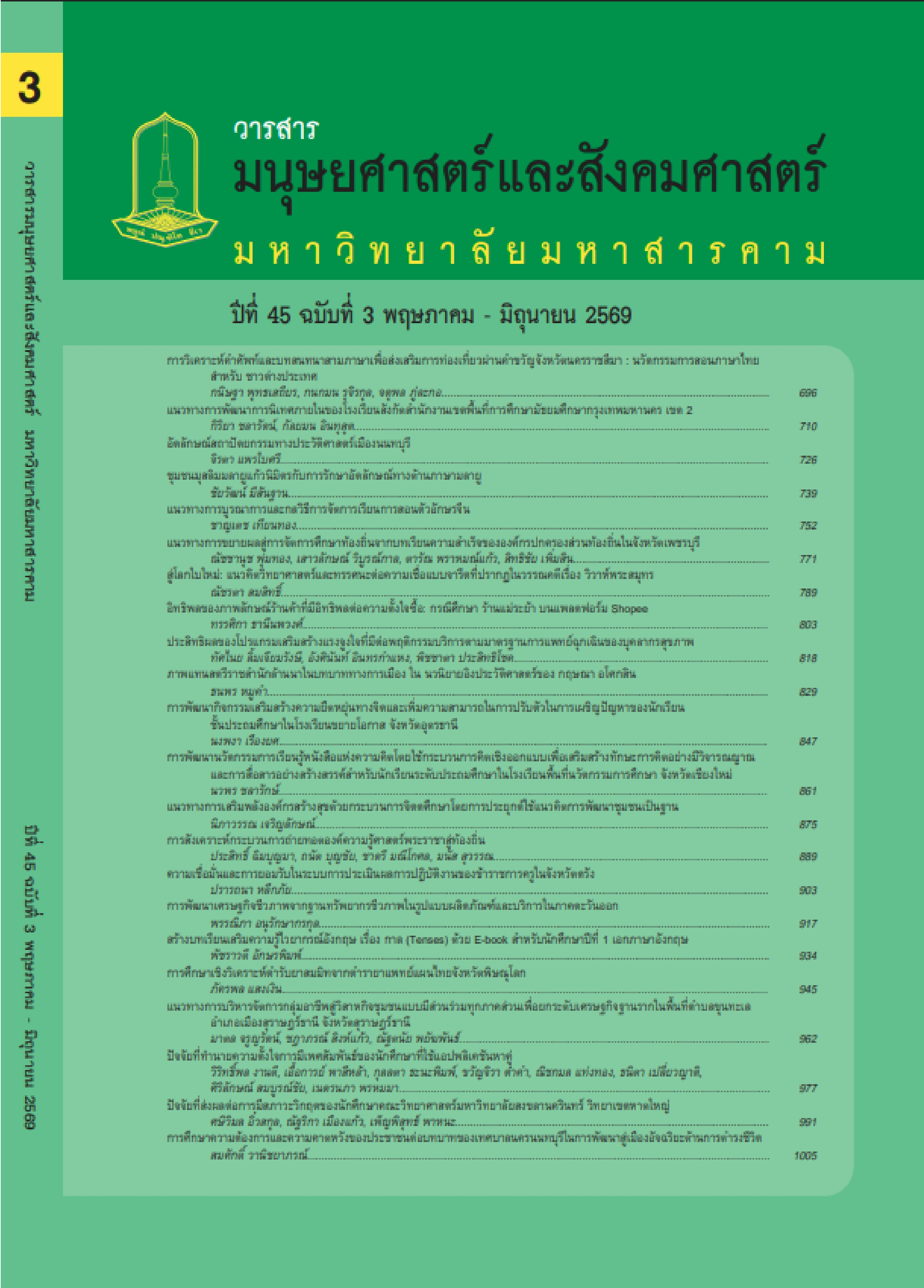
การศึกษาความต้องการและความคาดหวังของประชาชนต่อบทบาทของเทศบาลนครนนทบุรีในการพัฒนาสู่เมืองอัจฉริยะด้านการดำรงชีวิต
Article Sidebar
Main Article Content
บทคัดย่อ
การวิจัยครั้งนี้มีวัตถุประสงค์เพื่อ 1) สำรวจความต้องการและความคาดหวังของประชาชนในการพัฒนาสู่เมืองอัจฉริยะด้านการดำรงชีวิต (Smart Living City) 2) วิเคราะห์ปัจจัยที่ส่งผลต่อความต้องการและความคาดหวังของประชาชนในการพัฒนาสู่เมืองอัจฉริยะด้านการดำรงชีวิต (Smart Living City) และ 3) ค้นหาแนวทางพัฒนาสู่เมืองอัจฉริยะด้านการดำรงชีวิต (Smart Living City) ใช้ระเบียบวิธีวิจัยแบบผสมผสาน ทั้งวิธีวิจัยเชิงปริมาณและวิธีวิจัยเชิงคุณภาพ ผลการวิจัยพบว่า ความต้องการและความคาดหวังของประชาชนในการพัฒนาสู่เมืองอัจฉริยะด้านการดำรงชีวิต (Smart Living City) มีดังนี้ 1) ด้านสุขภาพ คือการจัดการฝุ่นละออง PM 2.5 และข้อมูลด้านสุขภาพแบบเรียลไทม์ 2) ด้านความปลอดภัย คือ การติดตั้งกล้องวงจรปิดทั่วถึง และ 3) ส่วนด้านสิ่งอำนวยความสะดวก คือ การพัฒนาสถานที่พักผ่อนและการจัดการขนส่งที่เข้าถึงทุกกลุ่มประชากร สำหรับปัจจัยที่ส่งผลต่อความต้องการพัฒนาสู่เมืองอัจฉริยะด้านการดำรงชีวิต ได้แก่ อายุ ระดับการศึกษา และรายได้ต่อครัวเรือน แนวทางพัฒนาได้แก่ 1) การใช้เทคโนโลยีอัจฉริยะเพื่อยกระดับคุณภาพชีวิตของประชาชน 2) การใช้เทคโนโลยีจัดการสุขภาพประชาชนทุกช่วงวัย 3) การพัฒนาพื้นที่สาธารณะสีเขียว และ 4) การจัดการขนส่งอัจฉริยะเพื่อเพิ่มความสะดวกในการเดินทางสำหรับทุกคน
Article Details
เอกสารอ้างอิง
วนัทยา มงคล. (2021). 7 เมืองอัจฉริยะติดอันดับโลก ส่องเมืองเขาส่งเสริมไทยเราให้ก้าวไกล https://hhcthailand.com/top-7-smart-cities-in-the-world/
สำนักงานส่งเสริมเศรษฐกิจดิจิทัล (2565). 7 Smart City indicators. https://www.depa.or.th/ storage/ app/media/file/1555573273.pdf
สำนักงานสภาพัฒนาการเศรษฐกิจและสังคมแห่งชาติ และศูนย์บริการวิชาการแห่งจุฬาลงกรณ์มหาวิทยาลัย. (2565). คู่มือแนวทางการวางแผนพัฒนาเมืองในอนาคตให้น่าอยู่อย่างยั่งยืน. ศูนย์บริการวิชาการแห่งจุฬาลงกรณ์มหาวิทยาลัย.
สำนักงานเทศบาลนครนนทบุรี (2566). แผนพัฒนาท้องถิ่น พ.ศ.2566-2570. นนทบุรี : ฝ่ายแผนงานและงบประมาณ กองวิชาการและแผนงาน เทศบาลนครนนทบุรี.
อลงกต สารกาล. (2563). ความสำเร็จขององค์กรปกครองท้องถิ่นในการจัดการสิ่งแวดล้อมเมืองที่ยั่งยืน: บทเรียนจากเทศบาลเมืองกาฬสินธุ์. วารสารสังคมศาสตร์ จุฬาลงกรณ์มหาวิทยาลัย, 50(2), 71-100.
อัครวินท์ ศาสนพิทักษ์. (2565). เมืองอัจฉริยะ: การสังเคราะห์ความหมาย. วารสารวิชาการวิทยาลัยบริหารศาสตร์, 5(1), 126-141.
เอกชัย สุมาลีและคณะ. (2562). โครงการวิจัยเชิงปฏิบัติการ การพัฒนาท้องถิ่นสู่เมืองอัจฉริยะยั่งยืน ระยะที่ 2. กรุงเทพฯ : สถาบันพระปกเกล้าและศูนย์วิจัยนครอัจฉริยะ (SCRC) มหาวิทยาลัยเทคโนโลยีพระจอมเกล้าเจ้าคุณทหารลาดกระบัง.
อรทัย ก๊กผลและคณะ. (2562). รายงานสถานการณ์การกระจายอำนาจ : บทสำรวจการพัฒนาเมืองอัจฉริยะขององค์กรปกครองส่วนท้องถิ่น ประจำปี พ.ศ.2562. กรุงเทพฯ: วิทยาลัยพัฒนาการปกครองท้องถิ่น สถาบันพระปกเกล้า.
Angelidou, M. (2015). Smart cities: A conjuncture of four forces. Cities, 47, 95-106.
Ashaye, O., & Alharahsheh, H. (2021). Smart City Development and Implications, 467-473. https://doi.org/10.4018/978-1-7998-6600-8.CH018.
Bastos, D., Fermandez-Caballero, A., Pereira, A., & Rocha N. P. (2022). Smart City Applications to Promote Citizen Participation in City Management and Governance: A Systematic Review. Informatics, 9(4). 89-101.
Chen, K., Wang, J., & Zhang, H. (2020). Artificial Intelligence and IoT-based Solutions for Sustainable Smart Cities: A Systematic Review. Sustainable Cities and Society, 61, 102327.
Cohen, B. (2014). Smart City Index Master Indicators Survey https://smartcitiescoucil.com/ resources/smart-city-index-master-indicators-survey
Das, R. K., Panda, M., & Ali, S. (2023). Digital Skills Gap in Smart City Development: Challenges and Solutions. Journal of Urban Technology, 30(2), 45-62.
Delitheou, V., Michalaki, E., & Tsavalias, K. (2020). Smart Cities and Development. PSN: Urbanization & Urban Development (Topic). https://doi.org/10.2139/ssrn.3657603.
Giffinger, R., Ferner, C., Kramer, H., Meijers, E., & Pichler, M. N. (2007). Smart Cities: Ranking of European medium-sized cities. Austria: Centre of Regional Science Vienna University of Technology.
Hall, R. E., Bowerman, B., Braverman, J., Taylor, J., Todosow, H., & Von, W. U. (2000). The vision of a smart city. Upton, NY: Brookhaven National Lab.
Hartley, K., & Aldag, A. (2024). Public trust and support for government technology: Survey insights about Singapore's smart city policies. Cities, 154, 105368.
Hollands, R. G. (2008). Will the real smart city please stand up? Intelligent, progressive or entrepreneurial? City, 12(3), 303-320.
Kim, S., Hong, P., Lee, T., Lee, A., & Park, S. (2022). Determining Strategic Priorities for Smart City Development: Case Studies of South Korean and International Smart Cities. Sustainability. https://doi.org/10.3390/su141610001.
Kitchin, R. (2014). The real-time city? Big data and smart urbanism. GeoJournal, 79(1), 1-14.
Kourtit, K., Kijkamp, P., & Arribas, D. (2012). Smart cities in perspective: A comparative European study by mean of self-organizing maps. Innovation: The European Journal of Social Science Research, 25(2), 229-246.
Kozhakhmet, M., & Alzhanov, A. (2023). Maintaining the Needs of Citizens in Smart City. Vestnik of M. Kozybayev North Kazakhstan University. https://doi.org/ 10.54596/2958-0048-2023-1-8-13.
Lara, A. P., Costa, E. M. D., Furlani, T. Z., & Yigitcanlar, T. (2016). Smartness that matters: towards a comprehensive and human-centered characterization of smart cities. Journal of Open Innovation: Technology, Market, and Complexity, 2(8), 1-13.
Lim, Y., Edelenbos, J., & Gianoli, A. (2019). Identifying the results of smart city development: Findings from systematic literature review. Cities, 95, 102397. https://doi.org/10.1016/J.CITIES.2019.102397.
Mashau, N. L., Kroeze, J. H., & Howard, G. R. (2022). Key Factors for Assessing Small and Rural Municipalities’ Readiness for Smart City Implementation. Smart Cities. 5, 1742-1751.
Masik, G., Sagan, I., & Scott, J. (2021). Smart City strategies and new urban development policies in the Polish context. Cities. https://doi.org/10.1016/j.cities.2020.102970.
Mayaud, J. R., Tran, M., Pereira, R. H., & Nuttall, R. (2019). Future access to essential services in a growing smart city: The case of Surrey, British Columbia. Computers, Environment and Urban Systems, 73, 1-15.
McKinsey Global Institute. (2018, June). Smart Cities: Digital Solutions for a more Livable Future. McKinsey Global Institute.
Nam, T., & Pardo, T. A. (2011). Conceptualizing smart city with dimensions of technology, people, and institutions. Proceedings of the 12th Annual International Digital Government Research Conference: Digital Government Innovation in Challenging Times, 282-291.
Nijkamp, P., Lombardi, P., Giordano, S., Caragliu, A., Del B. C., Deakin, M., & Kourtir, K. (2011). An advance triple-helix network model for smart cities performance. Research Memorandum, 45, 1-22.
Padua, D. (2021). Digital Cultural Transformation. Springer International Publishing.
Piro, G., Cianci, I., Grieco, L. A., Boggia, G., & Camarda, P. (2014). Information centric services in smart cities. Journal of Systems and Software, 88, 169-188.
Pozdniakova, A. M. (2017). Smart sustainable cities: the concept and approaches to measurement. Acta Innovations, (22), 5-19.
Sadeq, W., & Çevik, M. (2022). Smart Cities: A Strategic Approach to Urban Sustainability. 2022 International Symposium on Multidisciplinary Studies and Innovative Technologies (ISMSIT), 142-152. https://doi.org/10.1109/ISMSIT56059. 2022.9932790.
Santa, A.-M. I. (2022). Prosumer-A New Mindset for Citizens in Smart Cities. Smart Citities, 5, 1409-1420.
Sharifi, A., Khavarian-Garmsir, A. R., & Kummitha, R. K. R. (2021). The COVID-19 pandemic: Lessons for urban resilience and smart city development. Cities, 112, 103126.
Shuang, Q., & Zheng, Z. (2024). Analysis on the impact of smart city construction on urban greenness in China's megacities. Journal of Environmental Management, 355, 120568.
Sontiwanich, P., Boonchai, C., & Beeton, R. J. (2022). An unsustainable smart city: lessons from uneven citizen education and engagement in Thailand. Sustainability, 14(20), 13315.
Thuzar, M. (2011). Urbanozation in South East Asia: Developing Smart Cities for the Future?. Regional Outlook. Singapore: Yusof Ishak Institute.
Trencher, G. (2019). Towards the smart city 2.0: Empirical evidence of using smartness as a tool for tackling social challenges. Technological Forecasting and Social Change. https://doi.org/10.1016/J.TECHFORE.2018.07.033.
UN-Habitat. (2011). Cities and Climate Change: Policy Directions. Global Report on Human Settlements 2011.
Washbum, D., Sindhu, U., Balaouras, S., Dines, R. A., Hayes, N. M., & Nelson, L. E. (2010). Helping CIOs Understand ‘Smart City’ Initiative: Defining the Smart City, its Drivers, and the Role of the CIO. Cambridge, MA: Forrester Research, Inc.
Yigitcanlar, T. (2016). Technology and the city : system applications and implications. New York : Routlrdge.
Yigitcanlar, T., Butler, L., & Windle, E. (2023). Privacy and surveillance in smart cities: A critical analysis of emerging challenges. Telematics and Informatics, 77, 101932.
Zhang, L., Chen, J., & Liu, B. (2022). Financial Sustainability of Smart City Initiatives: Evidence from Global Case Studies. Sustainability, 14(15), 9234.
Zhao, J. (2011). Towards sustainable cities in China: Analysis and assessment of some Chinese cities in 2008. New York: Springer.
Zhuang, H., Zhang, J., B., S., & Muthu, B. (2020). Sustainable Smart City Building Construction Methods. Sustainability. https://doi.org/10.3390/su12124947.
