
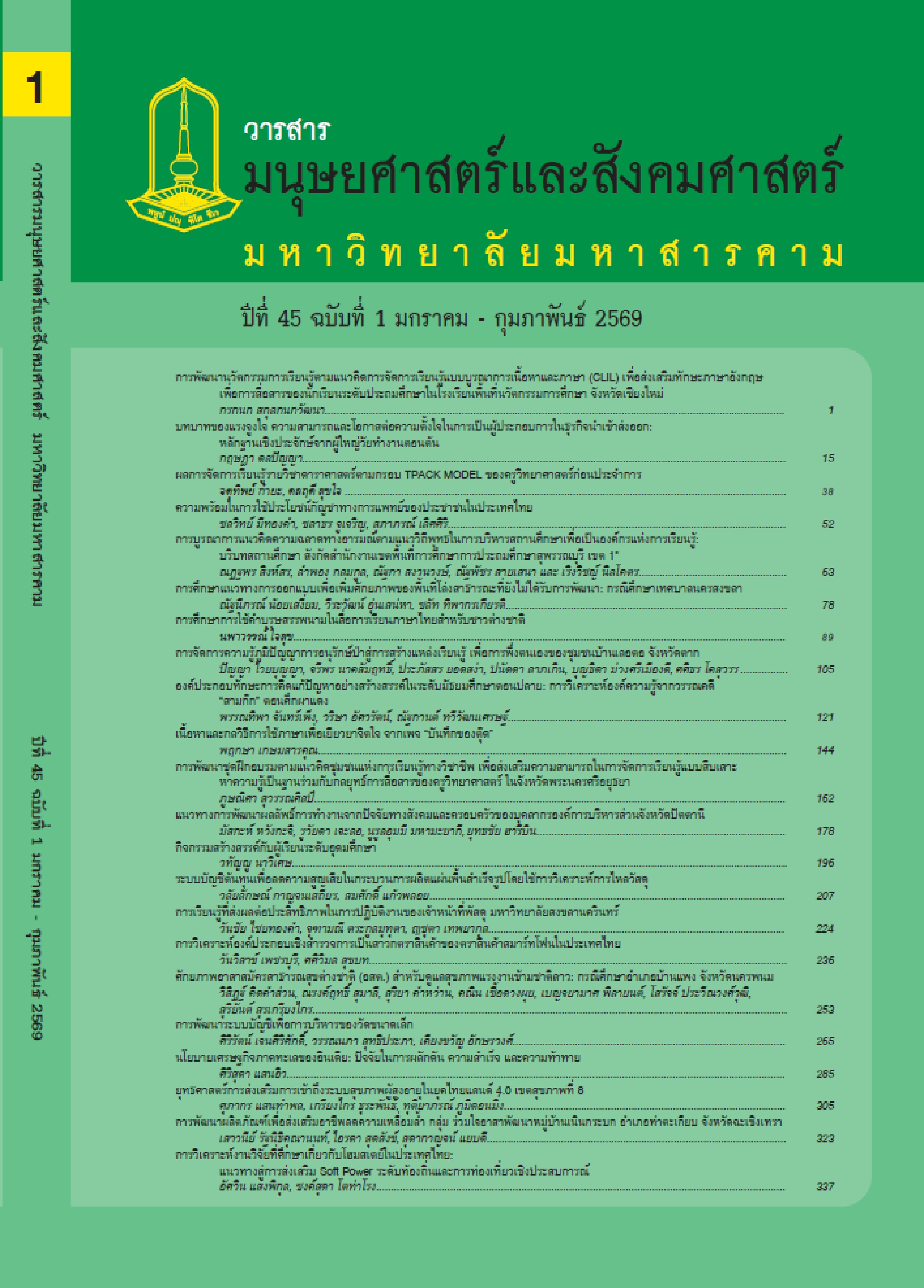
แนวทางการพัฒนาผลลัพธ์การทำงานจากปัจจัยทางสังคมและครอบครัวของบุคลากรองค์การบริหารส่วนจังหวัดปัตตานี
Article Sidebar
Main Article Content
บทคัดย่อ
การวิจัยนี้มุ่งศึกษาปัจจัยทางสังคมและครอบครัวที่ส่งผลต่อผลลัพธ์การทำงานของบุคลากรองค์การบริหารส่วนจังหวัดปัตตานี โดยมีวัตถุประสงค์เพื่อ 1) ศึกษาระดับการสนับสนุนทางสังคม ครอบครัว และผลลัพธ์ด้านการทำงาน 2) วิเคราะห์ปัจจัยที่ส่งผลต่อผลลัพธ์การทำงาน 3) เสนอแนวทางการพัฒนาผลลัพธ์ด้านการทำงาน การวิจัยนี้ใช้วิธีวิจัยเชิงผสมผสาน โดยเก็บข้อมูลผ่านแบบสอบถามและการสัมภาษณ์ กลุ่มตัวอย่างคือบุคลากรจำนวน 150 คนที่สุ่มตัวอย่างแบบง่าย และผู้ให้ข้อมูลเชิงคุณภาพจำนวน 3 ท่าน การวิเคราะห์ข้อมูลเชิงปริมาณใช้สถิติเชิงพรรณนา การทดสอบค่าที (T-test) และ การทดสอบค่าเอฟ (F-test) โดยวิธี LSD และการวิเคราะห์ความถดถอยแบบพหุคูณ (Multiple Regression Analysis) ส่วนข้อมูลเชิงคุณภาพใช้การวิเคราะห์เชิงเนื้อหา
ผลการวิจัยพบว่า 1) ระดับความคิดเห็นเกี่ยวกับการสนับสนุนทางสังคมและครอบครัวอยู่ในระดับมาก โดยเฉพาะการสนับสนุนจากครอบครัวที่มีค่าเฉลี่ยสูงสุดในด้านการสนับสนุนจากสมาชิกในครอบครัวและการสนับสนุนทางอารมณ์ 2) การสนับสนุนทางการปฏิบัติ การสนับสนุนทางจิตวิทยา และการสนับสนุนทางอารมณ์ เป็นปัจจัยที่ส่งผลอย่างมีนัยสำคัญต่อผลลัพธ์การทำงานของบุคลากร 3) แนวทางการพัฒนาผลลัพธ์ด้านการทำงานประกอบด้วยการส่งเสริมการสนับสนุนทางสังคมในองค์กรและการสนับสนุนจากครอบครัว เช่น การจัดกิจกรรมกลุ่ม การสร้างบรรยากาศที่ดีในที่ทำงาน และการสนับสนุนด้านอารมณ์จากครอบครัว การศึกษานี้ชี้ให้เห็นถึงความสำคัญของการสนับสนุนทางสังคมและครอบครัวต่อการพัฒนาสมดุลชีวิตและประสิทธิภาพการทำงานในองค์กร โดยเฉพาะในมุมมองการบริหารงานบุคคล
Article Details
เอกสารอ้างอิง
กนกรัตน์ คุ้มบัว. (2542). การประเมินประสิทธิภาพการทำงานในธุรกิจ. กรุงเทพฯ: สำนักบริหารธุรกิจ.
พิชิต เทพวรรณ์. (2554). การบริหารสมดุลชีวิตและการทำงาน. กรุงเทพฯ: ซีเอ็ดยูเคชั่น.
Abdullah, A., & Rahman, M. (2023). Cross-cultural comparisons of work-life balance strategies in Southeast Asia. Asian Journal of Business Research, 12(1), 25-40.
Alderfer, C. P. (1969). An empirical test of a new theory of human needs. Organizational Behavior and Human Performance, 4(2), 142–175. https://doi.org/10.1016/0030-5073(69)90004-X
Alderfer, C. P. (1969). An empirical test of a new theory of human needs. Organizational Behavior and Human Performance, 4(2), 142-175. https://doi.org/10.1016/0030-5073(69)90004-X
Bakker, A. B., & Demerouti, E. (2017). Job demands–resources theory: Taking stock and looking forward. Journal of Occupational Health Psychology, 22(3), 273–285. https://doi.org/10.1037/ocp0000056
Barerra, M. (1986). Distinctions between social support concepts, measures, and models. American Journal of Community Psychology, 14(4), 413-445. https://doi.org/10.1007/BF00922627
Cobb, S. (1976). Social support as a moderator of life stress. Psychosomatic Medicine, 38(5), 300-314. https://doi.org/10.1097/00006842-197609000-00003
Cronbach, L. J., & Meehl, P. E. (1955). Construct validity in psychological tests. Psychological Bulletin, 52(4), 281–302. https://doi.org/10.1037/h0040957
Greenhaus, J. H., & Allen, T. D. (2020). Work-life balance: A review and extension of the literature. Journal of Vocational Behavior, 122, 103472. https://doi.org/10.1016/j.jvb.2020.103472
Haar, J. M., Russo, M., Suñe, A., & Ollier-Malaterre, A. (2014). Outcomes of work–life balance on job satisfaction, life satisfaction and mental health: A study across seven cultures. Journal of Vocational Behavior, 85(3), 361–373. https://doi.org/10.1016/j.jvb.2014.08.010
House, J. S. (1981). Work stress and social support. Reading, MA: Addison-Wesley.
Jones, A. M., Brown, C. P., & Black, E. (2023). Social support and job satisfaction: A longitudinal study. Human Resource Management Journal, 33(2), 150–170.
Krejcie, R. V., & Morgan, D. W. (1970). Determining sample size for research activities. Educational and Psychological Measurement, 30(3), 607-610. https://doi.org/10.1177/001316447003000308
Miller, R. J. (2024). The role of organizational policies in promoting work-life balance. Management Review, 58(1), 85–100.
Mok, P. H., & Lee, S. W. (2020). The influence of flexible work arrangements on job satisfaction. International Journal of Human Resource Management, 31(4), 455–475.
Nguyen, T. H., & Tran, Q. P. (2022). Work-life balance in the context of Vietnamese organizations: A case study analysis. Journal of Asian Business Studies, 16(3), 245–258.
Peterson, E. and Plowman, E.G. (1989). Business organization and management. Homewood, llinois: Richard D. Irwin.
Smith, J., & Gardner, D. (2021). Managing life-work conflict: Role transitions and boundary management. Journal of Organizational Behavior, 42(4), 602–615.
Super, D. E. (1980). A life-span, life-space approach to career development. Journal of Vocational Behavior, 16(3), 282–298. https://doi.org/10.1016/0001-8791(80)90056-1
Wang, S., & Zhang, Y. (2022). Exploring the impact of work-life integration on employee well-being. Journal of Occupational Health Psychology, 27(2), 125–140. https://doi.org/10.1037/ocp0000305
