
The Impact of COVID-19 on Thai Products on Chinese Online Platform
Article Sidebar
Main Article Content
Abstract
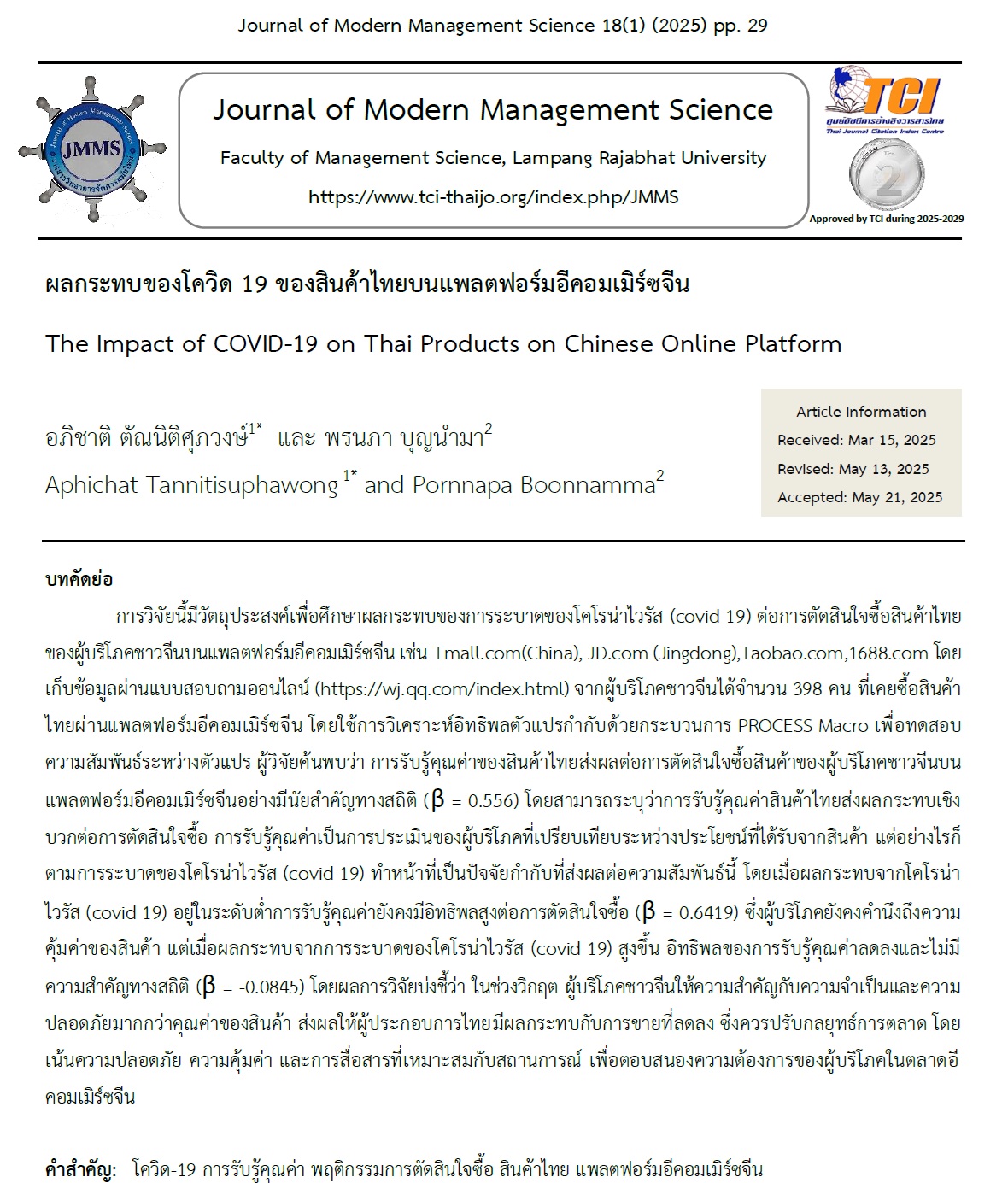
This study investigates the impact of the COVID-19 outbreak on Chinese consumers’ purchasing decisions of Thai products on major Chinese e-commerce platforms, including Tmall.com, JD.com, Taobao.com, and 1688.com. Data were collected through an online questionnaire (https://wj.qq.com/index.html) from 398 Chinese consumers who had experience purchasing Thai products on these platforms. The analysis employed the PROCESS Macro to test the moderated relationship between perceived value and purchase decision under varying levels of COVID-19 impact. The results indicate that the perceived value of Thai products significantly influences purchase decisions among Chinese consumers (β = 0.556), suggesting a strong positive relationship. Specifically, when the perceived impact of the COVID-19 outbreak is low, the influence of perceived value on purchase decisions remains high and statistically significant (β = 0.6419), indicating that consumers continue to value the worth of products. However, under conditions of high COVID-19 impact, the effect of perceived value decreases and becomes statistically insignificant (β = -0.0845). These findings highlight that in times of crisis, Chinese consumers tend to prioritize necessity and safety over product value, which negatively affects the sales performance of Thai products in the Chinese market. Therefore, Thai entrepreneurs should adapt their marketing strategies to emphasize safety, value, and appropriate communication aligned with the situation to effectively meet the changing demands of consumers in the Chinese e-commerce landscape.
Article Details

This work is licensed under a Creative Commons Attribution-NonCommercial-NoDerivatives 4.0 International License.
The article must be considered and accepted for publication by the editorial board of the Faculty of Management Science, Lampang Rajabhat University. The articles have been reviewed by a peer (peer review) and the author must update according to the suggestion if available before publication. Articles that are not considered the editorial team will inform the results of the consideration but will not send the original to the author.
JMMS is the Faculty of Management Science journal, Lampang Rajabhat University. Jmms published both print and online editions. We allow the use of articles for academic use under the scope of copyright law.
References
ขจร จิตร์ธนสาร และ สรวงภรณ์ สัจภาพพิชิต. (2024). ผลกระทบของโควิด-19 ต่อพฤติกรรมผู้บริโภคในธุรกิจบริการที่เปลี่ยนแปลงไปและแนวทางในการรับมือของผู้ประกอบการธุรกิจบริการในกรุงเทพมหานครและปริมณฑล. วารสารสหวิทยาการสังคมศาสตร์และการสื่อสาร, 7(1), 110-124.
จิรวรรณ กิติวนารัตน์, นพวรรณ วิเศษสินธุ์ และ ภัทรา สุขะสุคนธ์. (2022). การปรับตัวธุรกิจร้านอาหารภายหลังวิกฤตโควิด-19. วารสารวิทยาการจัดการปริทัศน์, 24(2), 137-146.
ประเสริฐศักดิ์ โพธิ์ทอง. (2022). ผลกระทบของการแพร่ระบาดของไวรัสโควิด-19 ต่อพฤติกรรมผู้บริโภคที่เปลี่ยนไป. วารสารวิทยาการจัดการปริทัศน์, 24(3), 263-273.
หัตถพันธ์ วงชารี. (2020). การแปลและการตรวจสอบมาตรวัดการซื้อด้วยความตื่นตระหนก ฉบับภาษาไทย. วารสารสหศาสตร์ศรีปทุมชลบุรี, 6(3), 43-53.
อาทิตย์ ว่องไวตระการ และสันติธร ภูริภักดี. (2019). อิทธิพลของปัจจัยส่วนประสมทางการตลาดและเครื่องมือสื่อสารทางการตลาดออนไลน์ที่มีผลต่อการรับรู้ของผู้บริโภคในการตัดสินใจซื้อสินค้าผ่านร้านค้าออนไลน์. จันทรเกษมสาร, 25(1), 17-30.
Butcher, K., Sparks, B., & O’Callaghan, F. (2002). Effect of social influence on repurchase intentions. Journal of Services Marketing, 16(6), 503–514.
Cochran, W. G. (1977). Sampling techniques (3rd ed.). New York, NY: John Wiley & Sons.
Cronbach, L. J. (1951). Coefficient alpha and the internal structure of tests. Psychometrika, 16(3), 297–334.
Das, D., Sarkar, A., & Debroy, A. (2022). Impact of COVID-19 on changing consumer behaviour: Lessons from an emerging economy. International Journal of Consumer Studies, 46(3), 692–715.
Di Crosta, A., Ceccato, I., Marchetti, D., La Malva, P., Maiella, R., Cannito, L., … Verrocchio, M. C. (2021). Psychological factors and consumer behavior during the COVID-19 pandemic. PLoS ONE, 16(8), Article e0256095. https://doi.org/10.1371/journal.pone.0256095
Dohle, S., Schreiber, M., Wingen, T., & Baumann, M. (2022). Blaming others for their illness: The influence of health-related implicit theories on blame and social support. Journal of Applied Social Psychology, 52(4), 210–219.
Hardesty, D. M., & Bearden, W. O. (2009). Consumer behavior and retailing. Journal of Retailing, 85(3), 239–240.
Hayes, A. F. (2012). PROCESS: A versatile computational tool for observed variable mediation, moderation, and conditional process modeling [White paper]. University of Kansas. https://afhayes.com/public/process2012.pdf
Hellier, P. K., Geursen, G. M., Carr, R. A., & Rickard, J. A. (2003). Customer repurchase intention: A general structural equation model. European Journal of Marketing, 37(11/12), 1762–1800.
Hurley, J., Morris, S., & Portelance, G. (2018). Examining the debt implications of the Belt and Road Initiative. CGD Policy Paper, 121. Center for Global Development.
Kotler, P., Keller, K. L., Brady, M., Goodman, M., & Hansen, T. (2016). Marketing management (3rd ed.). Pearson Higher Ed.
Likert, R. (2017). The method of constructing an attitude scale. In Scaling (pp. 233–242). Routledge.
Roggeveen, A. L., Grewal, D., Karsberg, J., Noble, S. M., Nordfält, J., Patrick, V. M., … Cooper, N. (2021). Forging meaningful consumer-brand relationships through creative merchandise offerings and innovative merchandising strategies. Journal of Retailing, 97(1), 81–98.
San Yap, C. W., & Yazdanifard, R. (2014). How consumer decision making process differ from youngster to older consumer generation. Journal of Research in Marketing, 2(2), 151–156.
Sánchez-Fernández, R., & Iniesta-Bonillo, M. Á. (2007). The concept of perceived value: A systematic review of the research. Marketing Theory, 7(4), 427–451.
Sheth, J. (2020). Business of business is more than business: Managing during the Covid crisis. Industrial Marketing Management, 88, 261–264.
Tanrikulu, C. (2021). Theory of consumption values in consumer behaviour research: A review and future research agenda. International Journal of Consumer Studies, 45(6), 1176–1197.
Vázquez-Martínez, U. J., Morales-Mediano, J., & Leal-Rodríguez, A. L. (2021). The impact of the COVID-19 crisis on consumer purchasing motivation and behavior. European Research on Management and Business Economics, 27(3), Article 100166. https://doi.org/10.1016/j.iedeen.2021.100166
Wodnicka, M., & Skurpel, D. (2021). Growth global market of e-commerce cross border: The case of Poland. In Proceedings of the International Conference on Business and Economics (pp. 123–134). Springer.
Xu, X.-Y., Tayyab, S. M. U., Chang, F.-K., & Zhao, K. (2021). Hierarchical value-attainment paths of CBEC consumers: A means-end-chain perspective. Internet Research, 31(2), 699–736.
Zeithaml, V. A. (1988). Consumer perceptions of price, quality, and value: A means-end model and synthesis of evidence. Journal of Marketing, 52(3), 2–22.
