
The Impact of Environment, Social and Governance (ESG) Practices on Financial Risk Management in Listed Companies on the Stock Exchange of Thailand of the SET100
Article Sidebar
Main Article Content
Abstract
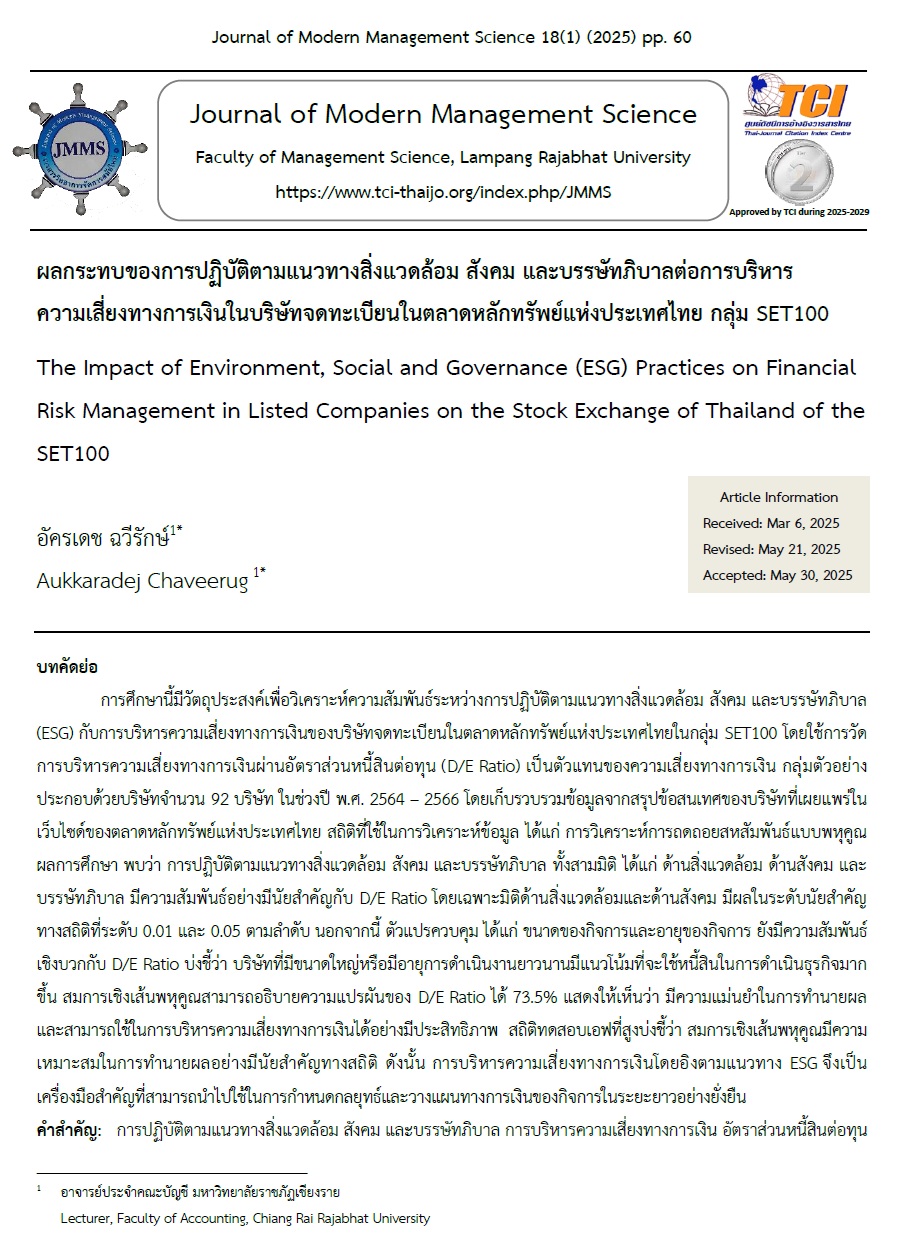
This study aims to analyze the relationship between compliance with Environmental, Social and Governance (ESG) practices and financial risk management among listed companies in the Stock Exchange of Thailand (SET100 group). Financial risk management is measured using the debt-to-equity ratio (D/E Ratio) as a proxy for financial risk. The sample consists of 92 companies during the period 2021–2023, with data collected from company information summaries published on the official website of the Stock Exchange of Thailand. The statistical method employed for data analysis is multiple regression analysis. The results reveal that compliance with ESG practices in all three dimensions environmental, social, and governance has a statistically significant relationship with the D/E Ratio. In particular, the environmental and social dimensions show significance at the 0.01 and 0.05 levels, respectively. Additionally, control variables, namely company size and firm age, are found to have a positive relationship with the D/E Ratio, indicating that larger and older companies tend to rely more on debt financing. The multiple regression model explains 73.5% of the variation in the D/E Ratio, demonstrating a high level of predictive accuracy and effectiveness in financial risk management. Furthermore, a high F-statistic confirms that the regression model is statistically appropriate for prediction. Therefore, financial risk management based on ESG practices is a key strategic tool that can be applied in long-term and sustainable financial planning for businesses.
Article Details

This work is licensed under a Creative Commons Attribution-NonCommercial-NoDerivatives 4.0 International License.
The article must be considered and accepted for publication by the editorial board of the Faculty of Management Science, Lampang Rajabhat University. The articles have been reviewed by a peer (peer review) and the author must update according to the suggestion if available before publication. Articles that are not considered the editorial team will inform the results of the consideration but will not send the original to the author.
JMMS is the Faculty of Management Science journal, Lampang Rajabhat University. Jmms published both print and online editions. We allow the use of articles for academic use under the scope of copyright law.
References
ตลาดหลักทรัพย์แห่งประเทศไทย. (2565). แนวทางการดำเนินงานด้านความยั่งยืนของบริษัทจดทะเบียน. ตลาดหลักทรัพย์แห่งประเทศไทย. https://www.set.or.th
ตลาดหลักทรัพย์แห่งประเทศไทย. (2567). รายงานและฐานข้อมูลบริษัทจดทะเบียนในตลาดหลักทรัพย์แห่งประเทศไทย. https://www.set.or.th
Albuquerque, R., Koskinen, Y., & Zhang, C. (2020). Corporate social responsibility and firm risk: Theory and empirical evidence. Management Science, 66 (10), 4451–4469. https://doi.org/10.1287/mnsc.2019.3475
Awaysheh, A., Heron, R. A., & Perry, T. (2020). Corporate social responsibility and firm risk: Evidence from product recalls. Journal of Financial Economics, 137(1), 86–105. https://doi.org/10.1016/j.jfineco.2020.02.009
Chen, H., Zhang, Y., & Zhou, X. (2023). ESG performance and firm risk: Evidence from unexpected events. Journal of Risk and Financial Management, 16(1), Article 13. https://doi.org/10.3390/jrfm16010013
Cheng, B., Ioannou, I., & Serafeim, G. (2021). Corporate social responsibility and access to finance. Strategic Management Journal, 35(1), 1–23. https://doi.org/10.1002/smj.2131
Clark, G. L., Feiner, A., & Viehs, M. (2015). From the stockholder to the stakeholder: How sustainability can drive financial outperformance. University of Oxford. https://ssrn.com/abstract=2508281
Dhaliwal, D. S., Li, O. Z., Tsang, A., & Yang, Y. G. (2014). Corporate social responsibility disclosure and the cost of equity capital: The roles of stakeholder orientation and financial transparency. Journal of Accounting and Public Policy, 33(4), 328–355. https://doi.org/10.1016/j.jaccpubpol.2014.04.006
Ding, R., Ferreira, C., & Wongchoti, U. (2016). Does it pay to be different? Relative CSR performance and its impact on firm value. Journal of Corporate Finance, 41, 392–409. https://doi.org/10.1016/j.jcorpfin.2016.10.004
Dömötör, B. (2023). Large firm effect in enterprise risk management. Acta Oeconomica, 73(3), 403–418. https://doi.org/10.1556/032.2023.00023
Eccles, R. G., & Klimenko, S. (2019). The investor revolution. Harvard Business Review, 97(3), 106–116. https://hbr.org/2019/05/the-investor-revolution
Fatemi, A., Glaum, M., & Kaiser, S. (2018). ESG performance and firm value: The moderating role of disclosure. Global Finance Journal, 38, 45–64. https://doi.org/10.1016/j.gfj.2017.03.001
Fernando, G. D., Wasiuzzaman, S., & Zulkafli, A. H. (2021). The impact of ESG disclosure on firm performance: The role of CEO duality. Sustainability, 13(11), 6150. https://doi.org/10.3390/su13116150
Freeman, R. E. (1984). Strategic Management: A Stakeholder Approach. Boston, MA: Pitman.
Friede, G., Busch, T., & Bassen, A. (2015). ESG and financial performance: Aggregated evidence from more than 2000 empirical studies. Journal of Sustainable Finance & Investment, 5(4), 210–233. https://doi.org/10.1080/20430795.2015.1118917
Garcia-Sanchez, I. M., Cuadrado-Ballesteros, B., & Frias-Aceituno, J. V. (2023). Corporate governance and financial risk: Evidence from ESG practices in emerging markets. Journal of Business Ethics, 182(2), 325–342. https://doi.org/10.1007/s10551-021-04835-9
Garcia, A. S., Mendes-Da-Silva, W., & Orsato, R. J. (2022). Sensitive industries produce better ESG performance? Evidence from emerging markets. Journal of Cleaner Production, 343, Article 130919. https://doi.org/ 10.1016/j.jclepro.2022.130919
Ghosh, S., & Ghosh, A. (2015). Firm age and capital structure: Evidence from emerging markets. Journal of Corporate Finance, 31, 42–62. https://doi.org/10.1016/j.jcorpfin.2014.12.003
Giese, G., Lee, L. E., Melas, D., Nagy, Z., & Nishikawa, L. (2019). Foundations of ESG investing: How ESG affects equity valuation, risk, and performance. The Journal of Portfolio Management, 45(5), 69–83. https://doi.org/10.3905/jpm.2019.45.5.069
Hamzah, Z. Z., Gursida, H., & Indrayono, Y. (2024). Determinants of Financial Distress and the Role of Firm Size the Variables are CR, DAR, to FD and FS as Moderation. The Es Economics and Entrepreneurship, 3(1), 87–99. https://doi.org/10.58812/esee.v3i01.317
Harrison, J. S., Barney, J. B., Freeman, R. E., & Phillips, R. A. (2019). Stakeholder theory: The state of the art. Cambridge University Press. https://doi.org/10.1017/9781108656068
Jensen, M. C., & Meckling, W. H. (1976). Theory of the firm: Managerial behavior, agency costs and ownership structure. Journal of Financial Economics, 3(4), 305–360. https://doi.org/10.1016/0304-405X(76)90026-X
Jones, T. M., Harrison, J. S., & Felps, W. (2022). How applying instrumental stakeholder theory can provide a sustainable competitive advantage. Academy of Management Review, 47(1), 48–70. https://doi.org/10.5465/amr.2018.0130
Khan, M., Serafeim, G., & Yoon, A. (2016). Corporate sustainability: First evidence on materiality. The Accounting Review, 91(6), 1697–1724. https://doi.org/10.2308/accr-51383
Kotsantonis, S., Pinney, C., & Serafeim, G. (2016). ESG integration in investment management: Myths and realities. Journal of Applied Corporate Finance, 28(2), 10–16. https://doi.org/10.1111/jacf.12169
Krüger, P. (2015). Corporate goodness and shareholder wealth. Journal of Financial Economics, 115(2), 304–329. https://doi.org/10.1016/j.jfineco.2014.09.008
Kutner, M. H., Nachtsheim, C. J., & Neter, J. (2005). Applied linear regression models (4th ed.). McGraw-Hill/Irwin.
Lee, S., & Park, J. (2021). The role of corporate governance in mitigating financial risk: ESG perspectives. Sustainability Accounting, Management and Policy Journal, 12(4), 721–739. https://doi.org/10.1108/ SAMPJ-11-2020-0435
Li, T., Gong, X., & Zeng, C. (2022). ESG performance and debt financing: Evidence from China. Finance Research Letters, 45, Article 102449. https://doi.org/10.1016/j.frl.2021.102449
Lins, K. V., Servaes, H., & Tamayo, A. (2017). Social capital, trust, and firm performance: The value of corporate social responsibility during the financial crisis. The Journal of Finance, 72(4), 1785–1824. https://doi.org/10.1111/jofi.12505
Ng, A. C., & Rezaee, Z. (2021). Business sustainability performance and cost of equity capital. Sustainability Accounting, Management and Policy Journal, 12(2), 298–325. https://doi.org/10.1108/SAMPJ-07-2020-0267
Roykornkaew, C. (2023). Effect of environment, social, and governance (ESG) on the cost of debt: The case of export-oriented firms in the Stock Exchange of Thailand [Independent Study]. Thammasat University. https://ethesisarchive.library.tu.ac.th/thesis/2023/TU_2023_6502022038_17954_29395.pdf
Smith, L., & Williams, B. (2020). ESG and financial performance: Aggregated evidence from more than 1,000 studies. Journal of Sustainable Finance & Investment, 10(4), 300–319. https://doi.org/10.1080/20430795.2020.1724860
Zahller, K. A., Thomas, C. H., & Huxley, C. (2021). Stakeholder orientation and the cost of capital: Evidence from social capital. Journal of Business Ethics, 169(2), 267–285. https://doi.org/10.1007/s10551-020-04552-2
