
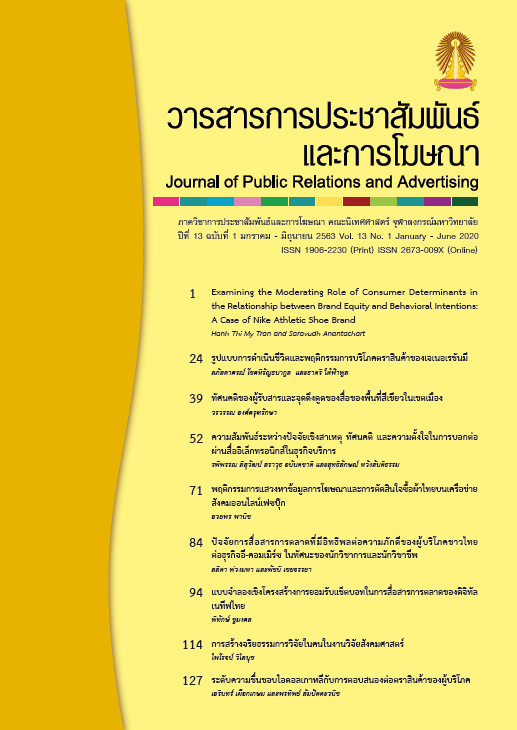
Examining the Moderating Role of Consumer Determinants in the Relationship between Brand Equity and Behavioral Intentions: A Case of Nike Athletic Shoe Brand
Article Sidebar
Main Article Content
บทคัดย่อ
บทความชิ้นนี้มีวัตถุประสงค์เพื่อศึกษาอิทธิพลของคุณค่าตราสินค้าต่อความตั้งใจเกิดพฤติกรรมของผู้บริโภค (ได้แก่ การกลับมาซื้อซ้ำ และการแนะนำบอกต่อ) รวมถึงตรวจสอบถึงปัจจัยที่เป็นตัวแปรกำกับการตัดสินใจของผู้บริโภค (คือ ความไว้วางใจ ความพึงพอใจ และการรับรู้การบอกต่อผ่านสื่ออิเล็กทรอนิกส์) ผ่านกรณีศึกษาที่เป็นรองเท้ากีฬาไนกี้ในประเทศไทย โดยใช้การวิจัยเชิงปริมาณในลักษณะการวิจัยเชิงสำรวจแบบเก็บข้อมูลครั้งเดียวกับกลุ่มตัวอย่าง จำนวน 220 คน อายุระหว่าง 18-25 ปี ที่กำลังศึกษาหรือทำงาน อยู่ในเขตเมืองชั้นในของกรุงเทพมหานคร และเป็นผู้ใช้สินค้าไนกี้อยู่ในปัจจุบัน ผลการศึกษาพบว่า คุณค่าตราสินค้ามีความสัมพันธ์เชิงบวกกับความตั้งใจเกิดพฤติกรรม นอกจากนั้น ความไว้วางใจ ความพึงพอใจ และการรับรู้การบอกต่อผ่านสื่ออิเล็กทรอนิกส์ สามารถเปลี่ยนแปลงหรือลดความแข็งแกร่ง ของความสัมพันธ์ระหว่างคุณค่าตราสินค้าและความตั้งใจเกิดพฤติกรรม ในกรณีของรองเท้าไนกี้ได้
Article Details
เอกสารอ้างอิง
Aaker, D. A. (1996). Building strong brands. New York, NY: The Free Press.
Anantachart, S. (2002). Measuring brand equity among Thai consumers: An individual consumer approach. In R. Zwick & T. Ping (Eds.), Asia Pacific advances in consumer research (pp. 360-365). Valdosta, GA: Association for Consumer Research.
Anderson, E., Fornell, C., & Lehmann, D. (1994). Customer satisfaction, market share, and profitability: Findings from Sweden. Journal of Marketing, 58(3), 53-66.
Baumann, C., Burton, S., Elliott, G., & Kehr, H. (2007). Prediction of attitude and behavioral intentions in retail banking. International Journal of Bank Marketing, 25(2), 102-116.
Bolton, R., & Lemon, K. N. (1999). A dynamic model of customers' usage of services: Usage as an antecedent and consequence of satisfaction. Journal of Marketing Research, 36(2), 171-186.
Brislin, R. W. (1980). Translation and content analysis of oral and written material. In H. C. Triandis & J. W. Berry (Eds.), Handbook of cross-cultural psychology: Methodology (pp. 389-444). Boston: Allyn and Bacon.
Brown, B. L., & Hendrix, S. B. (2005). Partial correlation coefficients. Wiley StatsRef: Statistics Reference Online. doi:10.1002/9781118445112.stat06488
Chahal, H., & Rani, A. (2017). How trust moderates social media engagement and brand equity. Journal of Research in Interactive Marketing, 11(3), 312-335. doi:10.1108/ JRIM-10-2016-0104
Chen, Y., Yan, X., Fan, W., & Gordon, M. (2015). The joint moderating role of trust propensity and gender on consumers’ online shopping behavior. Computers in Human Behavior, 43, 272-283. doi:10.1016/j.chb.2014.10.020
Cheung, C. M., Lee, M. K., & Rabjohn, N. (2008). The impact of electronic word‐of‐mouth. Internet Research, 18(3), 229-247. doi:10.1108/10662240810883290
Cheung, M. Y., Luo, C., Sia, C. L., & Chen, H. (2009). Credibility of electronic word-of-mouth: informational and normative determinants of on-line consumer recommendations. International Journal of Electronic Commerce, 13(4), 9-38. doi:10.2753/jec1086-4415130402
Chiu, C., Chang, C., Cheng, H., & Fang, Y. (2009). Determinants of customer repurchase intention in online shopping. Online Information Review, 33(4), 761-784. doi:10 .1108/14684520910985710
Clow, K. E., & Beisel, J. L. (1995). Managing consumer expectations of low margin, high‐volume services. Journal of Services Marketing, 9(1), 33-46. doi:10.1108/ 08876049510079871
Cobb-Walgren, C. J., Ruble, C. A., & Donthu, N. (1995). Brand equity, brand preference, and purchase intent. Journal of Advertising, 24, 25-40. doi:10.1080/00913367.1995 .10673481
Cronbach, L. J. (1947). Test "reliability:" Its meaning and determination. Psychometrika, 12, 1-16.
Dick, A. S., & Basu, K. (1994). Customer loyalty: Toward an integrated conceptual framework. Journal of the Academy of Marketing Science, 22(2), 99-113.
Euromonitor International, Passport. (2017). Footwear in Thailand report. Retrieved March 14, 2019, from https://www.scribd.com/document/348997278/footwear-in-thailand-euromonitor
Evans, J. R., & Lindsay, W. M. (1999). The management and control of quality. Cincinnati, OH: South-Western College.
Ewing, M. (2000). Brand and retailer loyalty: Past behaviour and future intentions. The Journal of Product and Brand Management, 9(2), 120-127.
Explore Inner Core of Bangkok. (2016, August 30). Bangkok Post. Retrieved March 14, 2019, from https://www.bangkokpost.com/business/news/1074293/explore-inner-core-of-bangkok-
Fairchild, A. J., & Mackinnon, D. P. (2008). A general model for testing mediation and moderation effects. Prevention Science, 10(2), 87-99.
Fang, Y., Chiu, C., & Wang, E. T. (2011). Understanding customers’ satisfaction and repurchase intentions. Internet Research, 21(4), 479-503. doi:10.1108/ 10662241111158335
Farquhar, P. H. (1989). Managing brand equity. Marketing Research, 1(3), 24-33.
Farquhar, P. H., Han, J. Y., & Ijiri, Y. (1991). Recognizing and measuring brand assets. Marketing Science Institute. Boston, MA: Cambridge.
Fernquest, J. (2011). Footwear industry strategy. Retrieved March 22, 2019, from https://www.bangkokpost.com/learning/advanced/237323/footwear-industry-strategy
Fishbein, M., & Ajzen, I. (1975). Belief, attitude, intention, and behavior: An introduction to theory and research. Boston, MA: Addison-Wesley.
Fornell, C., Johnson, M., Anderson, E., Cha, J., & Bryant, B. (1996). The American customer satisfaction index: Nature, purpose, and findings. Journal of Marketing, 60(4), 7-18. doi:10.2307/1251898
Frank, K. A. (2000). Impact of a confounding variable on a regression coefficient. Sociological Methods & Research, 29(2), 147-194. doi:10.1177/ 0049124100029002001
Gefen, D., Karahanna, E., & Straub, D. W. (2003). Trust and TAM in online shopping: An integrated model. MIS Quarterly, 27(1), 51-90. Doi:10.2307/30036519
Gupta, S., & Kim, H. W. (2007). The moderating effect of transaction experience on the decision calculus in online repurchase. International Journal of Electronic Commerce, 12(1), 127-158. https://doi.org/10.2753/JEC1086-4415120105
Hahn, K. H., & Kim, J. (2009). The effect of offline brand trust and perceived internet confidence on online shopping intention in the integrated multi‐channel context. International Journal of Retail & Distribution Management, 37(2), 126-141. doi:10.1108/09590550910934272
Hair, J. F., Black, W. C., Babin, B. J., & Anderson, R. E. (2010). Multivariate data analysis (7th ed.). Harlow: Pearson.
Hallowell, R. (1996). The relationships of customer satisfaction, customer loyalty, and profitability: An empirical study. International Journal of Service Industry Management, 7(4), 27-42. doi:10.1108/09564239610129931
Hellier, P. K., Geursen, G. M., Carr, R. A., & Rickard, J. A. (2003). Customer repurchase intention: A general structural equation model. European Journal of Marketing, 37(11/12), 1762-1800. doi:10.1108/03090560310495456
Hennig-Thurau, T., Gwinner, K. P., Walsh, G., & Gremler, D. (2004). Electronic word-of-mouth via consumer-option platforms: What motives consumers to articulate themselves on the internet? Journal of Interactive Marketing, 18(1), 38-52.
Hershman, B. (2018, September 24). Study: Nike is the top apparel brand among Gen z, Millennials. Yahoo Finance. Retrieved March 14, 2019, from https://finance.yahoo .com/news/study-nike-top-apparel-brand-212009722.html
Hoeffler, S., & Keller, K. L. (2003). The marketing advantages of strong brands. Journal of Brand Management, 10(6), 421-445. doi:10.1057/palgrave.bm.2540139
Hyun, S. S., & Kim, W. (2011). Dimensions of brand equity in the chain restaurant industry. Cornell Hospitality Quarterly, 52(4), 429-437. doi:10.1177/1938965510397533
James, G., Witten, D., Hastie T., & Tibshirani, R. (2017). An introduction to statistical learning: With applications in R. New York: Springer.
Johns, G. (1994). How often were you absent? A review of the use of self-reported absence data. Journal of Applied Psychology, 79(4), 574-591.
Kamakura, W. A., & Russell, G. J. (1993). Measuring brand value with scanner data. International Journal of Research in Marketing, 10(1), 9-22. doi:10.1016/0167-8116(93)90030-3
Kang, B. S., & Cho, C. H. (2010). An effect of evaluative factors on relationship quality and repurchase intent in Internet shopping mall. The Academy of Customer Satisfaction Management, 12(1), 87-108.
Keller, K. L. (1993). Conceptualizing, measuring, and managing customer-based brand equity. Journal of Marketing, 57(1), 1-22.
Khammash, M., & Griffiths, G. H. (2011). ‘Arrivederci CIAO.com, Buongiorno Bing.com’- Electronic word-of-mouth (eWOM), antecedences and consequences. International Journal of Information Management, 31(1), 82-87.
doi:10.1016/j.ijinfomgt.2010 .10.005
Kim, J., Sharma, S., & Setzekorn, K. (2002). A framework for building brand equity online for pure‐play B2C retailers and services. International Journal on Media Management, 4(2), 123-133. doi:10.1080/14241270209389989
Kotler, P., & Armstrong, G. (2018). Principles of marketing (17th ed.). Hoboken, NJ: Pearson.
Laoviwat, P., Suppapanya, P., & Yousapronpaiboon, K. (2014). A study of demographics influencing on consumer behavior and attitude towards brand equity of optical business in Thailand. International Journal of Trade, Economics and Finance, 5(4), 347-350. doi:10.7763/ijtef.2014.v5.395
Lin, M., & Chang, L. (2003). Determinants of habitual behavior for national and leading brands in China. Journal of Product & Brand Management, 12(2), 94-107. doi:10.1108/10610420310469788
Lovett, M. J., Peres, R., & Shachar, R. (2013). On brands and word of mouth. Journal of Marketing Research, 50, 427-444.
Macdonald, E. K., & Sharp, B. M. (2000). Brand awareness effects on consumer decision making for a common, repeat purchase product: A replication. Journal of Business Research, 48(1), 5-15. doi:10.1016/s0148-2963(98)00070-8
Matute, J., Polo-Redondo, Y., & Utrillas, A. (2016). The influence of EWOM characteristics on online repurchase intention: Mediating roles of trust and perceived usefulness. Online Information Review, 40(7), 1090-1110. doi:10.1108/OIR-11-2015-0373
Mayer, R. C., Davis, J. H., & Schoorman, F. D. (1995). An integrative model of organizational trust. The Academy of Management Review, 20(3), 709-734. doi:10.2307/258792
Moorman, C., Zaltman, G., & Deshpande, R. (1992). Relationships between providers and users of market research: the dynamics of trust within and between organizations. Journal of Marketing Research, 29(3), 314-328. doi:10.2307/3172742
Morgan, R. M., & Hunt, S. D. (1994). The commitment-trust theory of relationship marketing. Journal of Marketing, 58(3), 20-38.
Mukherjee, A., & Nath, P. (2007). Role of electronic trust in online retailing. European Journal of Marketing, 41(9/10), 1173-1202. doi:10.1108/03090560710773390
Nurittamont, W., & Ussahawanitchakit, P. (2008). The influences of brand equity in competitive advantage and performance of spa business in Thailand. Journal of International Business Strategy, 8(2), 14-25.
O’Cass, A., & Grace, D. (2003). An exploratory perspective of service brand associations. Journal of Services Marketing, 17(5), 452-475. doi:10.1108/08876040310486267
Oliver, R. L. (1980). A cognitive model of the antecedents and consequences of satisfaction decisions. Journal of Marketing Research, 17(4), 460-478. doi:10.2307/3150499
Oliver, R. L. (2010). Satisfaction: A behavioral perspective on the consumer (2nd ed). Armonk, NY: M.E. Sharpe.
Park, C., Wang, Y., Yao, Y., & Kang, Y.R. (2011). Factors influencing eWOM effects: Using experience, credibility and susceptibility. International Journal of Social Science and Humanity, 1(1), 74-79.
Pennanen, K., Tiainen, T., & Luomala, H. T. (2007). A qualitative exploration of a consumer’s value‐based e‐trust building process. Qualitative Market Research: An International Journal, 10(1), 28-47. doi:10.1108/13522750710720387
Petrick, J. F. (2004). The roles of quality, value, and satisfaction in predicting cruise passengers’ behavioral intentions. Journal of Travel Research, 42(4), 397-407.
Podsakoff, P. M., & Organ, D. W. (1986). Self-reports in organizational research: Problems and prospects. Journal of Management, 12(4), 69-82.
Pruit, D. G. (1981). Negotiation behavior. New York: Academic Press.
Rambocas, M., Kirpalani, V. M., & Simms, E. (2018). Brand equity and customer behavioral intentions: a mediated moderated model. International Journal of Bank Marketing, 36(1), 19-40. doi:10.1108/IJBM-09-2016-0139
Río, A. B., Vázquez, R., & Iglesias, V. (2001). The effects of brand associations on consumer response. Journal of Consumer Marketing, 18(5), 410-425. doi:10.1108/ 07363760110398808
Rosenthal, R., & Rosnow, R.L. (1991). Essentials of behavioral research: Methods and data analysis (2nd ed.). New York: McGraw-Hill.
Schultz, D. E. (2005). The loyalty paradox: What is brand loyalty after all? Marketing Management, 14(5), 10-11.
Sharma, S., Durand, R. M., & Gur-Arie, O. (1981). Identification and analysis of moderator variables. Journal of Marketing Research, 18(3), 291-300.
Shi, S., Mu, R., Lin, L., Chen, Y., Kou, G., & Chen, X. (2018). The impact of perceived online service quality on swift guanxi. Internet Research, 28(2), 432-455. doi:10.1108/intr-12-2016-0389
Shin, J. I., Chung, K. H., Oh, J. S., & Lee, C. W. (2013). The effect of site quality on repurchase intention in Internet shopping through mediating variables: The case of university students in South Korea. International Journal of Information Management, 33(3), 453-463. doi:10.1016/j.ijinfomgt.2013.02.003
Shocker, A. D., Srivastava, R. K., & Rueckert, R. W. (1994). Challenges and opportunities facing brand management: An introduction to the special issue. Journal of Marketing Research, 31(2), 149-158.
Simon, C. J., & Sullivan, M. W. (1993). The measurement and determinants of brand equity: a financial approach. Marketing Science, 12(1), 28-52. doi:10.1287/mksc.12.1.28
Solomon, M. R. (2017). Consumer behavior: Buying, having, and being (12th ed.). Boston: Pearson.
Spreng, R. A., MacKenzie, S. B., & Olshavsky, R. W. (1996). A re-examination of the determinants of consumer satisfaction. Journal of Marketing, 60 (3), 15-32.
Srinivasan, S. S., Anderson, R., & Ponnavolu, K. (2002). Customer loyalty in e-commerce: An exploration of its antecedents and consequences. Journal of Retailing, 78(1), 41-50. Doi:10.1016/S0022-4359(01)00065-3
Straub, D. W. (1989). Validating instruments in MIS research. MIS Quarterly, 13(2), 147-169. doi:10.2307/248922
Sulaiman, S., & Haron, M. S. (2013). Foodscape and customer’s future behavioral intentions in casual dining restaurant. Journal of Economics, Business and Management, 1(1), 94-97. doi:10.7763/JOEBM.2013.V1.22
Tayla. (2018, October 1). How to easily target the 18-25 years old demographic, locally, nationally and globally! PMYB. Retrieved March 14, 2019, from https://pmyb.co .uk/easily-target-18-25-year-old-demographic-locally-nationally-globally/
Taylor, S. A., Celuch, K., & Goodwin, S. (2004). The importance of brand equity to customer loyalty. Journal of Product & Brand Management, 13(4), 217-227. Doi:10.1108/ 10610420410546934
Thompson, K. E., & Panayiotopoulos, P. (1999). Predicting behavioral intention in a small business context. Journal of Marketing Practice: Applied Marketing Science, 6(3), 89-96. doi:10.1108/EUM0000000004564
Tseng, S., & Fogg, B. J. (1999). Credibility and computing technology. Communications of the Association for Computing Machinery, 42(5), 39-44.
Wolburg, J. M., & Pokrywczynski, J. (2001). A psychographic analysis of generation Y college students. Journal of Advertising Research, 41(5), 33-53.
Yoo, B., & Donthu, N. (2001). Developing and validating a multidimensional consumer-based brand equity scale. Journal of Business Research, 52(1), 1-14. Doi:10.1016/ S0148-2963(99)00098-3
Yoo, B., Donthu, N., & Lee, S. (2000). An examination of selected marketing mix elements and brand equity. Journal of the Academy of Marketing Science, 28(2), 195-211. doi:10.1177/0092070300282002
Zeithaml, V. A., Berry, L. L., & Parasuraman, A. (1996). The behavioral consequences of service quality. Journal of Marketing, 60(2), 31-46.
Zinkhan, G. M., & Prenshaw, P. J. (1994). Good life images and brand name associations: Evidence from Asia, America, and Europe. Advances in Consumer Research, 21, 496-500.
