
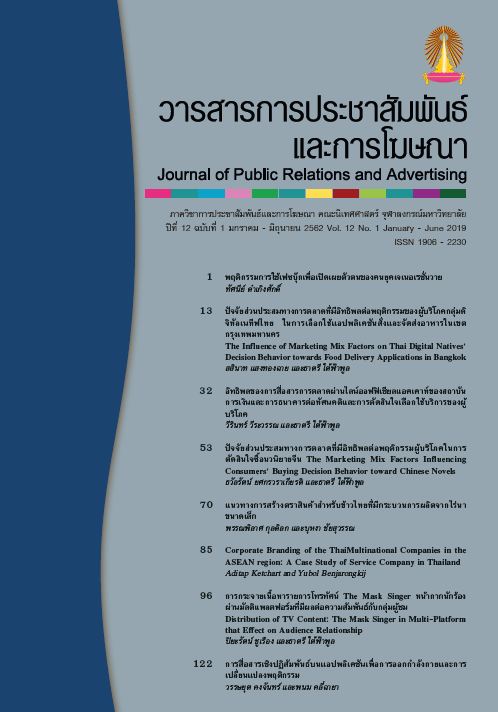
การสื่อสารเชิงปฏิสัมพันธ์บนแอปพลิเคชันเพื่อการออกกำลังกายและการเปลี่ยนแปลงพฤติกรรม
Article Sidebar
Main Article Content
บทคัดย่อ
การวิจัยนี้มีวัตถุประสงค์เพื่อสำรวจการสื่อสารเชิงปฏิสัมพันธ์บนแอปพลิเคชันเพื่อการออกกำลังกาย การกำกับพฤติกรรมและการเปลี่ยนแปลงพฤติกรรมการออกกำลังกาย และเพื่ออธิบายความสัมพันธ์ของการสื่อสารเชิงปฏิสัมพันธ์บนแอปพลิเคชันเพื่อการออกกำลังกาย กับการกำกับพฤติกรรมและการแสดงพฤติกรรมในแต่ละลำดับขั้นของการเปลี่ยนแปลงพฤติกรรมการออกกำลังกาย โดยใช้ระเบียบวิธีวิจัยแบบผสมผสาน ด้วยการวิเคราะห์เนื้อหา จำนวน 80 แอปพลิเคชัน และการวิจัยเชิงสำรวจโดยใช้แบบสอบถาม เก็บข้อมูลจากกลุ่มตัวอย่างอายุ 25-34 ปี ในเขตกรุงเทพมหานครและปริมณฑล จำนวน 400 ตัวอย่าง ที่เคยดาวน์โหลดและใช้แอปพลิเคชันเพื่อการออกกำลังกายอย่างน้อย 1 ครั้ง ในรอบ 3 เดือน
ผลการวิเคราะห์เนื้อหาแอปพลิเคชันเพื่อการออกกำลังกายพบว่า มีคุณลักษณะเชิงปฏิสัมพันธ์ 8 คุณลักษณะ จำแนกได้เป็น 30 วิธีการย่อย ผลการสำรวจพบว่า กลุ่มตัวอย่างใช้คุณลักษณะเชิงปฏิสัมพันธ์ด้านคำแนะนำการใช้งาน และคุณลักษณะด้านการเก็บข้อมูลสุขภาพของผู้ใช้มากที่สุด ทั้งนี้ กลุ่มตัวอย่างมีการกำกับตนเองโดยรวมอยู่ในระดับ มาก โดยมีการกำกับตนเองด้านการประเมินข้อมูลที่ได้และเปรียบเทียบกับมาตรฐานมากที่สุด และพบว่ากลุ่มตัวอย่างแสดงพฤติกรรมในขั้นตั้งใจเปลี่ยนแปลงพฤติกรรมมากที่สุด
ผลการทดสอบสมมติฐาน สรุปได้ว่า 1. ความถี่ในการใช้การสื่อสารเชิงปฏิสัมพันธ์ มีความสัมพันธ์กับการกำกับพฤติกรรมการออกกำลังกายในระดับต่ำ โดยมีทิศทางแปรตามกัน 2. ระดับการกำกับพฤติกรรมการออกกำลังกาย มีความสัมพันธ์กับพฤติกรรมในขั้นตั้งใจเปลี่ยนแปลงพฤติกรรม ขั้นเตรียมการเปลี่ยนการพฤติกรรม และขั้นเปลี่ยนแปลงพฤติกรรม ในระดับปานกลาง และมีความสัมพันธ์กับขั้นรักษาระดับพฤติกรรมในระดับต่ำ โดยมีทิศทางแปรตามกัน 3. ความถี่ในการใช้การสื่อสารเชิงปฏิสัมพันธ์ มีความสัมพันธ์เฉพาะขั้นเปลี่ยนแปลงพฤติกรรมและขั้น รักษาระดับพฤติกรรมในระดับต่ำ โดยมีทิศทางแปรตามกัน
Article Details
เอกสารอ้างอิง
กุลธิดา พานิชกุล, อติพร สำราญบัว. (2556). การประยุกต์ใช้โมเดลการปรับเปลี่ยนพฤติกรรม (Transtheoretical Model) เพื่อส่งเสริมพฤติกรรมการออกกำลังกาย. วารสารวิทยาลัยพยาบาลบรมราชชนนี นครราชสีมา, 19(1), 66-76.
สำนักงานสถิติแห่งชาติ. (2555). การสำรวจพฤติกรรมการเล่นกีฬาหรือออกกำลังกายของประชากรและสุขภาพจิต พ.ศ. 2554. Retrieved from http://service.nso.go.th/nso/nsopublish/themes/files/exerFull54.pdf:
Anderson-Bill, E. S., Winett, R. A., & Wojcik, J. R. (2011). Social Cognitive Determinants of Nutrition and Physical Activity Among Web-Health Users Enrolling in an Online Intervention: The Influence of Social Support, Self-Efficacy, Outcome Expectations, and Self-Regulation. Journal of Medical Internet Research, 13(1), e28. doi:10.2196/jmir.1551
Anderson, E. S., Wojcik, J. R., Winett, R. A., & Williams, D. M. (2006). Social-cognitive determinants of physical activity: the influence of social support, self-efficacy, outcome expectations, and self-regulation among participants in a church-based health promotion study. Health Psychol, 25(4), 510-520. doi:10.1037/0278-6133.25.4.510
Bandura, A. (1986). Social foundations of thought and action: a social cognitive theory: Prentice-Hall.
Baumeister, R. F. (2005). The Cultural Animal: Human Nature, Meaning, and Social Life: Oxford University Press.
Brown, J. M. (1998). Self-regulation and the addictive behaviors. In W. R. M. N. Heather (Ed.), Treating addictive behaviors, 2nd ed (pp. 61-73). New York, NY, US: Plenum Press.
Brown, J. M., Miller, W. R., &Lawendowski, L. A. (1999). The self-regulation questionnaire. In L. V. T. L. Jackson (Ed.), Innovations in clinical practice: A source book, Vol. 17 (pp. 281-292). Sarasota, FL, US: Professional Resource Press/Professional Resource Exchange.
Carey, K. B., Neal, D. J., & Collins, S. E. (2004). A psychometric analysis of the self-regulation questionnaire. Addictive Behaviors, 29(2), 253-260. doi: http://dx.doi.org/10.1016/j.addbeh.2003.08.001
Conroy, D. E., Yang, C. H., & Maher, J. P. (2014). Behavior change techniques in top-ranked mobile apps for physical activity. Am J Prev Med, 46(6), 649-652. doi:10.1016/j.amepre.2014.01.010
De Ridder, D., & de Wit, J. (2006). Self-Regulation in Health Behavior: Wiley.
Heeter, C. (1989). Implications of new interactive technologies for conceptualizing communication. Media use in the information age: Emerging patterns of adoption and consumer use, 217-235.
IMS Institute for Healthcare Informatics. (2015). Patient Adoption of mHealth : Use, Evidence and Remaining Barriers to Mainstream Acceptance. Retrieved from http://www.imshealth.com/files/web/IMSH%20Institute/Reports/Patient%20Adoption%20of%20mHealth/IIHI_Patient_Adoption_of_mHealth.pdf:
Lee, I. M., Shiroma, E. J., Lobelo, F., Puska, P., Blair, S. N., &Katzmarzyk, P. T. (2012). Effect of physical inactivity on major non-communicable diseases worldwide: an analysis of burden of disease and life expectancy. The Lancet, 380(9838), 219-229. doi:10.1016/S0140-6736(12)61031-9
Miller, C. H. (2008). Digital Storytelling: A Creator's Guide to Interactive Entertainment: Taylor & Francis.
Prochaska, J. O., &Velicer, W. F. (1997). The transtheoretical model of health behavior change. Am J Health Promot, 12(1), 38-48.
Rengert, J. (2011). Development and Evaluation of a Social Cognitive Theory-Based Exercise Intervention in Firefighters: 5-ALARM Fitness Program. (Doctor of Philosophy), Ohio State University, http://docplayer.net/31693289-Development-and-evaluation-of-a-social-cognitive-theory-based-exercise-intervention-in-firefighters-5-alarm-fitness-program.html.
Rovniak, L. S., Anderson, E. S., Winett, R. A., & Stephens, R. S. (2002). Social cognitive determinants of physical activity in young adults: A prospective structural equation analysis. Annals of Behavioral Medicine, 24(2), 149-156. doi:10.1207/S15324796ABM2402_12
Schunk, D. H. (1991). Self-Efficacy and Academic Motivation. Educational Psychologist, 26(3-4), 207-231. doi:10.1080/00461520.1991.9653133
Statista. (2016). Mobile health app categories that will offer the highest global market potential in the next five years (Vol. 2016). https://www.statista.com/statistics/625181/mobile-health-app-category-market-potential-worldwide/: Statista.
Stout, P. A., Villegas, J., & Kim, H. (2001). Enhancing learning through use of interactive tools on health-related websites. Health Education Research, 16(6), 721-733. doi:10.1093/her/16.6.721
Subramanian, R. (2015). Diet, exercise, and smartphones - A content analysis of mobile health application for weight loss. Southern Illinois University Carbondale. (1075)
Zimmerman, B. J., & Schunk, D. H. (1989). Self-regulated learning and academic achievement: theory, research, and practice: Springer-Verlag.
