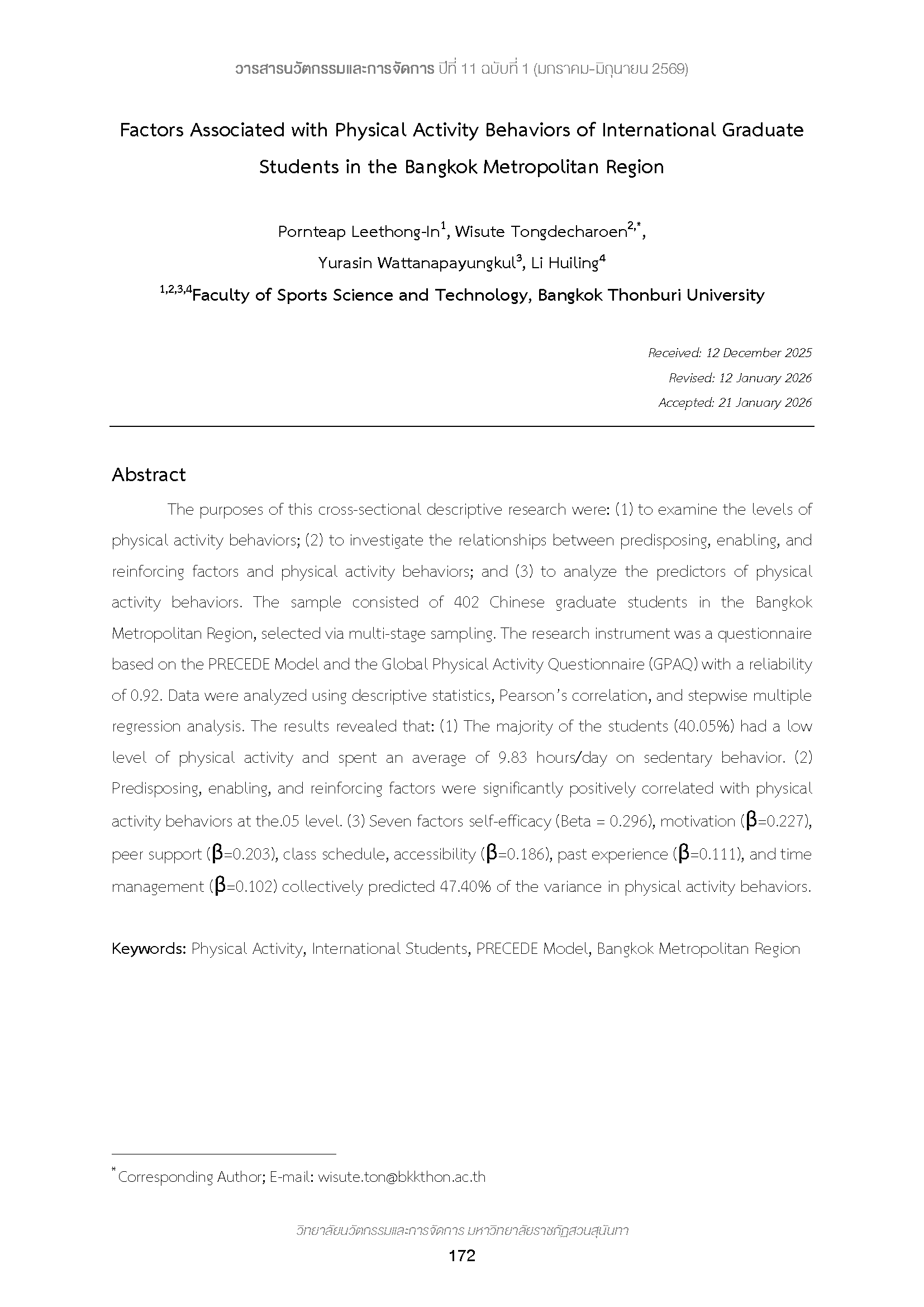
Factors Associated with Physical Activity Behaviors of International Graduate Students in the Bangkok Metropolitan Region
Keywords:
Physical Activity, International Students, PRECEDE Model, Bangkok Metropolitan RegionAbstract
The purposes of this cross-sectional descriptive research were: (1) to examine the levels of physical activity behaviors; (2) to investigate the relationships between predisposing, enabling, and reinforcing factors and physical activity behaviors; and (3) to analyze the predictors of physical activity behaviors. The sample consisted of 402 Chinese graduate students in the Bangkok Metropolitan Region, selected via multi-stage sampling. The research instrument was a questionnaire based on the PRECEDE Model and the Global Physical Activity Questionnaire (GPAQ) with a reliability of 0.92. Data were analyzed using descriptive statistics, Pearson’s correlation, and stepwise multiple regression analysis. The results revealed that: (1) The majority of the students (40.05%) had a low level of physical activity and spent an average of 9.83 hours/day on sedentary behavior. (2) Predisposing, enabling, and reinforcing factors were significantly positively correlated with physical activity behaviors at the.05 level. (3) Seven factors self-efficacy (Beta = 0.296), motivation (β=0.227), peer support (β=0.203), class schedule, accessibility (β=0.186), past experience (β=0.111), and time management (β=0.102) collectively predicted 47.40% of the variance in physical activity behaviors.
References
Asian Disaster Preparedness Center [ADPC]. (2025). Urban heat resilience: Bridging science, policy, and sustainable design. Asian Disaster Preparedness Center.
Bandura, A. (1997). Self-efficacy: The exercise of control. W.H. Freeman.
Bauman, A. E., Reis, R. S., Sallis, J. F., Wells, J. C., Loos, R. J., and Martin, B. W. (2012). Correlates of physical activity: Why are some people physically active and others not? The Lancet, 380(9838), 258-271.
Berry, J. W. (2006). Stress perspectives on acculturation. In D. L. Sam and J. W. Berry (Eds.), The Cambridge handbook of acculturation psychology (pp. 43-56). Cambridge University Press.
Borș, D., Matei, D., Niculescu, G., Popescu, A. M., and Zainea, I. (2021). Testing the Youth Physical Activity Promotion Model during the COVID-19 pandemic, with partial least squares second-order latent constructs. International Journal of Environmental Research and Public Health, 18(14), 7315.
Brown, C. E. B., Richardson, K., Halil-Pizzirani, B., Atkins, L., Yücel, M., and Segrave, R. A. (2024). Key influences on university students' physical activity: A systematic review using the Theoretical Domains Framework and the COM-B model. BMC Public Health, 24, 418.
Bull FC, Al-Ansari SS, Biddle S, Borodulin K, Buman MP, Cardon G, Carty C, Chaput JP, Chastin S, Chou R, Dempsey PC, DiPietro L, Ekelund U, Firth J, Friedenreich CM, Garcia L, Gichu M, Jago R, Katzmarzyk PT, Lambert E, Leitzmann M, Milton K, Ortega FB, Ranasinghe C, Stamatakis E, Tiedemann A, Troiano RP, van der Ploeg HP, Wari V, and Willumsen JF. (2020). World Health Organization 2020 guidelines on physical activity and sedentary behaviour. Br J Sports Med. 2020 Dec; 54(24): 1451-1462.
Carballo-Fazanes, A., Rico-Díaz, J., Barcala-Furelos, R., Rey, E., Rodríguez-Fernández, J. E., Varela-Casal, C., and Abelairas-Gómez, C. (2020). Physical activity habits and determinants, sedentary behaviour and lifestyle in university students. International Journal of Environmental Research and Public Health, 17(9), 3272.
Chen, R., Li, C., Kang, H., and Liang, W. (2025). Investigating the youth physical activity promotion model among Chinese middle school students. BMC Public Health, 25, 1046.
Daramola, M. A., and Aribasoye, R. M. (2023). Effect of Physical Activity, Exercise and Sedentary Behaviour on Academic Performance of Students in Higher Institutions. European Journal of Theoretical and Applied Sciences, 1(6), 547-556.
Deci, E. L., and Ryan, R. M. (2000). The "what" and "why" of goal pursuits: Human needs and the self-determination of behavior. Psychological Inquiry, 11(4), 227-268.
Ding, R., and Jiang, M. (2023). Mental well-being of Chinese international students in Thai universities throughout the post-pandemic era. European Journal of Education Studies, 10(8), 1-15.
Dong, H., Hu, Y., Li, S., Zhao, X., and Shen, X. (2019). The association between physical fitness and physical activity among Chinese college students. ResearchGate.
Doshmangir, P., Shirzadi, S., and Tagdisi, M. H. (2015). The effect of educational intervention according to PRECEDE model on the regular physical activity among elderly people. Journal of Research and Health, 5(2), 172-177.
Ferreira Silva, R. M., Mendonça, C. R., Azevedo, V. D., Raoof Memon, A., Noll, P. R. E. S., and Noll, M. (2022). Barriers to high school and university students' physical activity: A systematic review. PloS One, 17(4), e0265913.
Green, L. W., and Kreuter, M. W. (1991). Health promotion planning: An educational and environmental approach. Mayfield Publishing Company.
Intarakumnerd, P., and Liu, P. (2022). Internationalization of higher education in Thailand: Challenges and opportunities for Chinese students. Journal of Asian Public Policy, 15(2), 234-250.
Yin, G., Kim, J., and Lee, S. (2024). Factors associated with changes in physical activity levels among Chinese international students in South Korea. Physical Activity and Nutrition. Advance online publication.
Li, J. (2016). The indispensable role of culture in shaping children's learning beliefs. In R. B. King and A. B. I. Bernardo (Eds.), The Psychology of Asian learners: A Festschrift in Honor of David Watkins (pp. 37-51). Springer.
Li, J., Cui, J., and Li, C. (2022). Status and influencing factors of physical exercise among college students in China: A systematic review. International Journal of Environmental Research and Public Health, 19(20), 13465.
McLeroy, K. R., Bibeau, D., Steckler, A., and Glanz, K. (1988). An ecological perspective on health promotion programs. Health Education Quarterly, 15(4), 351-377.
McNeill, L. H., Kreuter, M. W., and Subramanian, S. V. (2006). Social environment and physical activity: A review of concepts and evidence. Social Science and Medicine, 63(4), 1011-1022.
Ministry of Higher Education, Science, Research and Innovation [MHESI]. (2024). Higher education statistics: International students in Thailand 2023-2024. Office of the Permanent Secretary.
O'Loughlin, E., Rados, E., Lück, M., Nienaber, A., and Kanning, M. (2021). PRECEDE-PROCEED model: A systematic framework for developing and applying an intervention to promote physical activity in older adults. Journal of Exercise Science and Fitness, 19(2), 115-123.
Office of Higher Education, Science, Research and Innovation Policy and Strategic Data Management. (2025). Number of international students in the second semester of academic year 2024, classified by nationality, institution group, institution, faculty, degree program, level of education, year of study, and gender. [Online]. Retrieved from: https://info.mhesi.go.th/svanswer.php (in Thai)
Peng, B., Ng, J. Y. Y., and Ha, A. S. (2023). Barriers and facilitators to physical activity for young adult women: A systematic review and thematic synthesis of qualitative literature. International Journal of Behavioral Nutrition and Physical Activity, 20.
Rauff, E. L., and Kumazawa, M. (2024). Physical activity motives and self-efficacy to overcome physical activity barriers in first-year undergraduates: Do they differ based on physical activity levels? Journal of American College Health, 72(7), 2242–2249.
Sallis, J. F., Cerin, E., Conway, T. L., Adams, M. A., Frank, L. D., Pratt, M., Salvo, D., Schipperijn, J., Smith, G., Cain, K. L., Davey, R., Kerr, J., Lai, P.-C., Mitáš, J., Reis, R., Sarmiento, O. L., Schofield, G., Troelsen, J., Van Dyck, D., De Bourdeaudhuij, I., and Owen, N. (2016). Physical activity in relation to urban environments in 14 cities worldwide: A cross-sectional study. The Lancet, 387(10034), 2207-2217.
Smith, R. A., and Khawaja, N. G. (2011). A review of the acculturation experiences of international students. International Journal of Intercultural Relations, 35(6), 699-713.
Teixeira, P. J., Carraça, E. V., Markland, D., Silva, M. N., and Ryan, R. M. (2012). Exercise, physical activity, and self-determination theory: A systematic review. International Journal of Behavioral Nutrition and Physical Activity, 9(1), 78.
Vasilopoulos, T., Drozda, D., and Vincent, H.K. (2024). Physical activity positively impacts disability outcomes during transition from midlife to early older age irrespective of body mass index. Arch Gerontol Geriatr. 2024;120: 105339.
Wang, J., Zong, B., and Long, B. (2020). Physical activity and influencing factors of international students in China. In The Second International Symposium on Management and Social Sciences (ISMSS 2020) (pp. 281-287). Atlantis Press.
World Bank. (2024). Shaping a cooler Bangkok: Tackling urban heat for a more livable city. World Bank Group.
World Health Organization. (2020). WHO guidelines on physical activity and sedentary behaviour. World Health Organization.
World Health Organization. (2024). Physical activity: Key facts.
Yamane, T. (1967). Statistics: An Introductory Analysis (2nd ed.). New York: Harper and Row.
Yan, Z., Li, S., and Li, J. (2021). The meaning of physical activity in Chinese female graduate students. Qualitative Research in Sport, Exercise and Health, 13(2), 188-201.
Zeng, Z., Li, J., and Li, C. (2019). The status and influencing factors of physical exercise among college students in China: A systematic review. International Journal of Environmental Research and Public Health, 16(12), 2211.
Zhai, Y., and Du, X. (2020). Mental health care for international Chinese students affected by the COVID-19 outbreak. The Lancet Psychiatry, 7(4), e22.
Downloads
Published
How to Cite
Issue
Section
License
Copyright (c) 2026 Journal of Innovation and Management

This work is licensed under a Creative Commons Attribution-NonCommercial-NoDerivatives 4.0 International License.
See Publication Ethics https://so03.tci-thaijo.org/index.php/journalcim/Ethics



