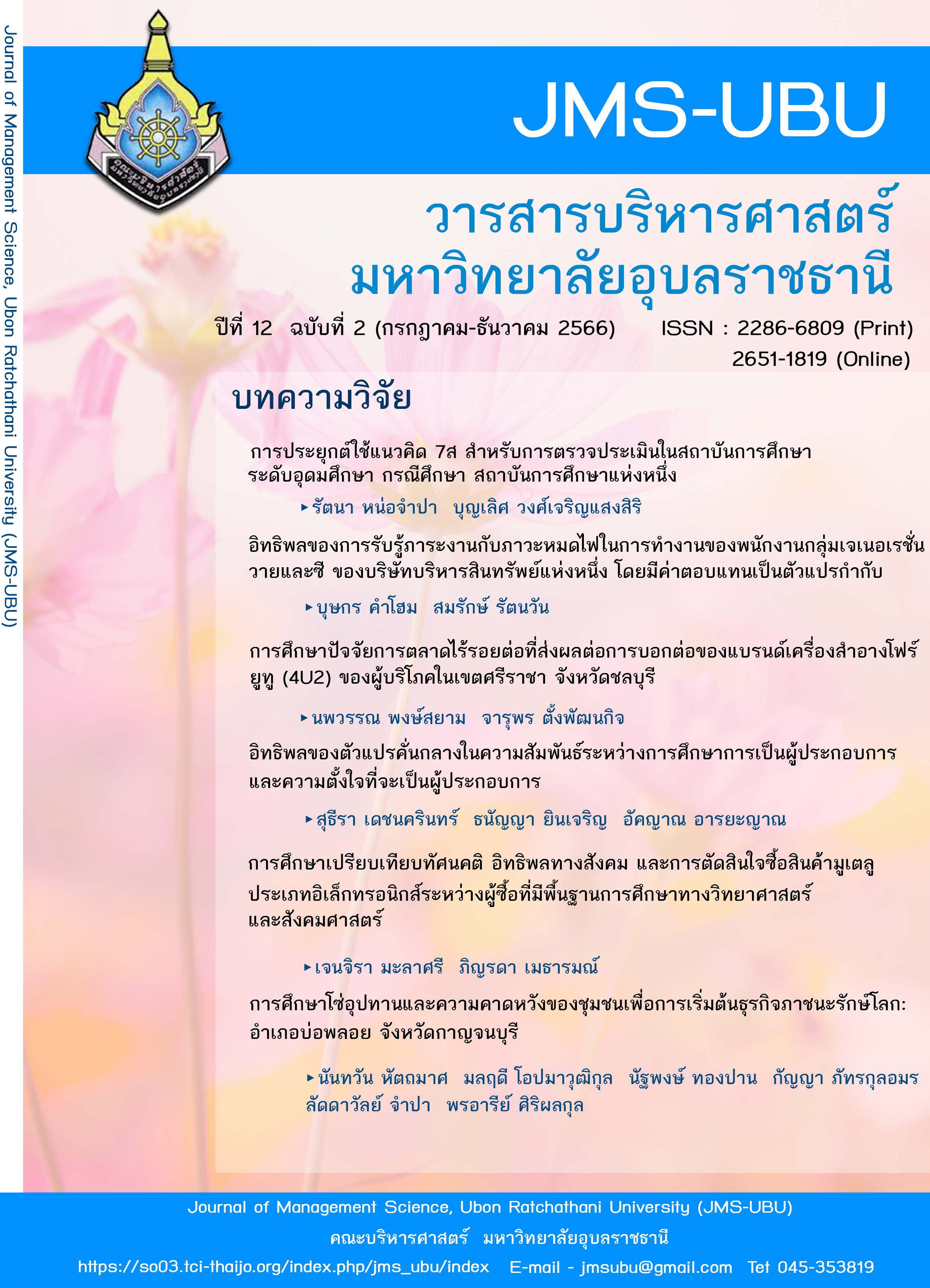
A Study of Factors of the Seamless Market Affecting the Word-of-Mouth of the 4U2 (4U2) Cosmetic Brands among Consumers in Sriracha, Chonburi
Article Sidebar
Main Article Content
Abstract
This quantitative research has purposed to study the factors of the omni-channel market affected the word-of-mouth of the 4U2 (4U2) cosmetic brands among consumers in Sriracha, Chonburi. The data were collected using questionnaires from a sample of 424 people who are customers or must know the 4U2 Cosmetics brand and lived in Sriracha District, Chonburi Province. The accuracy of the questionnaires was approved by 3 experts, and the data were analyzed by means of evaluating Item Objective Congruence (IOC) value is 0.811. Then, the questionnaire was used to collect data and using the SPSS statistical program to analyze including mean, frequency, percentage, errors, standard deviation. Hypothesis testing using multiple linear regression were conducted. The results showed that the prediction efficiency of the model was 0.654 (R2= 65.4%). The omni-channel market factors affecting the 4U2 cosmetic brands on the consumers as significantly level at 0.05 included the integrating factors (β = 0.194; Sig. = 0.000), the maximizing factors (β = 0.111; Sig. = 0.017), (β = 0.105; Sig. = 0.018), the delivering factors (β = 0.105; Sig. = 0.018), and the engaging factors (β = 0.508; Sig. = 0.000).
Downloads
Article Details

This work is licensed under a Creative Commons Attribution-NonCommercial-NoDerivatives 4.0 International License.
All articles published in the Journal of Management Science, Ubon Ratchathani University are copyrighted by the journal. The views and opinions expressed in each article are those of the authors and do not necessarily reflect the views of the Faculty of Management Science, Ubon Ratchathani University. The authors are solely responsible for the content of their articles.
References
เกสรา กิจศุภสิน. (2564). ปัจจัยของการตลาดแบบไร้รอยต่อ (Omni Channel Marketing) ที่ส่งผลต่อการตัดสินใจซื้อสินค้าจากเซ็นทรัลดีพาร์ทเม้นต์สโตร์ของผู้บริโภคในเขตกรุงเทพมหานคร. (การค้นคว้าอิสระปริญญามหาบัณฑิต). มหาวิทยาลัยกรุงเทพ, คณะบริหารธุรกิจ.
คอสเมเน็ต. (ม.ป.ป.). ข้อมูลเครื่องสำอาง 4U2 (ออนไลน์). สืบค้นเมื่อ 21 มิถุนายน 2564, จาก https://www.cosmenet.in.th/brand/2778/4u2
ชัชฌาพร กลางโฉม. (2564). การตลาดไร้รอยต่อที่ส่งผลต่อการตัดสินใจซื้อผลิตภัณฑ์จากสวนดุสิตโฮมเบเกอรี่. (วิทยานิพนธ์ปริญญามหาบัณฑิต). มหาวิทยาลัยศิลปากร, คณะบริหารธุรกิจ.
บุริม โอทกานนท์. (2554). โอกาสของธนาคารธนชาต. จุฬาลงกรณ์วารสาร, (23), 91.
ปัทมวรรณ อินยิ้ม. (2562). กระบวนการตัดสินใจซื้อผลิตภัณฑ์บำรุงผิวหน้า (Facial Skincare) ของผู้บริโภคที่อาศัยในกรุงเทพมหานคร. (วิทยานิพนธ์ปริญญามหาบัณฑิต). มหาวิทยาลัยรามคำแหง, คณะบริหารธุรกิจ.
พชร อารยะการกุล. (2562). สร้างธุรกิจอย่างเหนือชั้นด้วยประสบการณ์แบบ Omni-channel. สืบค้นเมื่อ 21 มิถุนายน 2564, จาก https://forbesthailand.com/commentaries/insights/เพิ่มมูลค่าและสร้างฐาน.html
พัลลภา ปีติสันต์. (2563). รอดอย่างไรจากวิกฤต…จากธุรกิจติดหนี้ 40 ล้าน. สืบค้นเมื่อ 21 มิถุนายน 2564, จาก https://shorturl.asia/MEho7
พิษณุ ลาภชัยเจริญกิจ, ภาศิริ เขตปิยรัตน์, และกัลยรัตน์ คำพรม. (2565). การตลาดแบบผสานทุกช่องทางที่มีอิทธิพลต่อการตัดสินใจซื้อสินค้าไอที ของผู้บริโภคในประเทศไทย. วารสารวิชาการการจัดการภาครัฐและเอกชน, 4(3), 31-46.
มีเมทาปรียา. (2557). Omni Channel Marketing อนาคตของร้านค้าปลีก. สืบค้นเมื่อ 21 มิถุนายน 2564, จากhttps://blog.lnw.co.th/2014/05/20/omni-channel-marketing/
ศรัญญู ทิยะมุข. (2565). ปัจจัยการตลาดแบบไร้รอยต่อ (Omni Channel Marketing) ที่ส่งผลต่อการตัดสินใจซื้อสินค้าของผู้บริโภคร้าน Watsons ในประเทศไทย. (การค้นคว้าอิสระปริญญามหาบัณฑิต). มหาวิทยาลัยกรุงเทพ, คณะบริหารธุรกิจ.
ศิริวรรณ เสรีรัตน์ และ ศุภร เสรีรัตน์. (2560). การบริหารตลาดยุคใหม่. กรุงเทพฯ: พัฒนาศึกษา.
อรรัมภา หัวใจ, จิดาภา หิรัญวงศ์สว่าง, ศรุต ชินประพินพร, ธีราพร เมฆอาภรณ์, ธนวรรณ ธนพรวิริยะกุล, ตปนีย์ ทิพย์ผ่อง,… พิชญา รัศมีจันทร์. (2557). Omni-channel marketing (ตอนที่ 2). For Quality Management, 21(203), 65-67.
อสมาภรณ์ เขียวมีส่วน. (2561). การศึกษาถึงความมีอิทธิพลของการตลาดแบบไร้รอยต่อ (Omni Channel Marketing) ที่ส่งผลต่อความภักดีของลูกค้าอิเกียในประเทศไทย. (การค้นคว้าอิสระปริญญามหาบัณฑิต). มหาวิทยาลัยกรุงเทพ คณะบริหารธุรกิจ.
ไอแพลน ดิจิทัล. (2564). Unified Commerce คืออะไร? ซอฟต์แวร์ที่จำเป็นสำหรับอีคอมเมิร์ซ? สืบค้นเมื่อ 21 มิถุนายน 2564, จาก https://www.iplandigital.co.th/ecommerce/unified-commerce/
Assael, H. (2004). Consumer Behavior: A Strategic Approach. Boston: Houghton Mifflin.
Beck, N., & Rygl, D. (2015). Categorization of multiple channel retailing in multi-, cross-, and omni-channel retailing for retailers and retailing. Journal of Retailing and Consumer Services, 27, 170-178.
Bilro, R. G., Loureiro, S. M. C., & Guerreiro, J. (2019). Exploring online customer engagement with hospitality products and its relationship with involvement, emotional states, experience and brand advocacy. Journal of Hospitality Marketing & Management, 28(2), 147-171.
Cetin, G., & Dincer, F. I. (2014). Influence of customer experience on loyalty and word-of-mouth in hospitality operations. Anatolia, 25(2), 181-194.
Cochran, W. G. (1977). Sampling Techniques (3rd ed.). New York: John Wiley & Sons
Hennig-Thurau, T., Gwinner, K. P., Walsh, G., & Gremler, D. D. (2004). Electronic word-of- mouth via consumer-opinion platforms: What motivates consumers to articulate themselves on the internet? Journal of Interactive Marketing, 18(1), 38-52.
Hennig-Thurau, T., Henning, V., & Sattler, H. (2007). Consumer file sharing of motion pictures. Journal of Marketing, 71(4), 1-18.
Kim, J., Naylor, G., Sivadas, E., & Sugumaran, V. (2015). The unrealized value of incentivized eWOM recommendations. Marketing Letters, 27, 411-421.
Kotler, P. (2003). Marketing Insights from A to Z: 80 Concepts Every Manager Needs to Know. New York: John Wiley & Sons.
Kotler, P., & Keller, K. (2006). Marketing Management (12th ed.). Upper Saddle River, NJ: Prentice Hall.
Lee, J., & Lee, J. N. (2009). Understanding the product information inference process in electronic word-of-mouth: An objectivity-subjectivity dichotomy perspective. Information and Management, 46(5), 302-311.
Linden, D. J. (1994). Long-term synaptic depression in the mammalian brain. Neuron, 12(3), 457-472.
Litvin, S. W., Goldsmith, R. E., & Pan, B. (2008). Electronic word-of-mouth in hospitality and tourism management. Tourism Management, 29(3), 458-468.
Lusch, R. F., Vargo, S. L., & O’brien, M. (2007). Competing through service: Insights from service-dominant logic. Journal of Retailing, 83(1), 5-18.
Nyilasy, G. (2006). Practitioner theories at the advertising agency: Evidence on the academician-practitioner gap and the professional status of advertising. (Doctoral dissertation). The University of Georgia, Graduate School.
Richins, M. L., & Root-Shaffer, T. (1988). The role of evolvement and opinion leadership in consumer word-of-mouth: An implicit model made explicit. ACR North American Advances, 15(1), 32-36.
Rigby, D. (2011). The future of shopping. Harvard Business Review, 89(12), 65-76.
Rosen, E. (2000). The Anatomy of Buzz: How to Create Word of Mouth Marketing. New York: Doubleday.
Sallam, M. A. (2014). The effects of brand image and brand identification on brand love and purchase decision making: The role of WOM. International Business Research, 7(10), 187-193.
Silverman, G. (1997). How to harness the awesome power of word of mouth. Direct Marketing, 60(7), 32–37.
Verhoef, P. C., Kannan, P. K., & Inman, J. J. (2015). From multi-channel retailing to omni-channel retailing: Introduction to the special issue on multi-channel retailing. Journal of Retailing, 91(2), 174-181.
