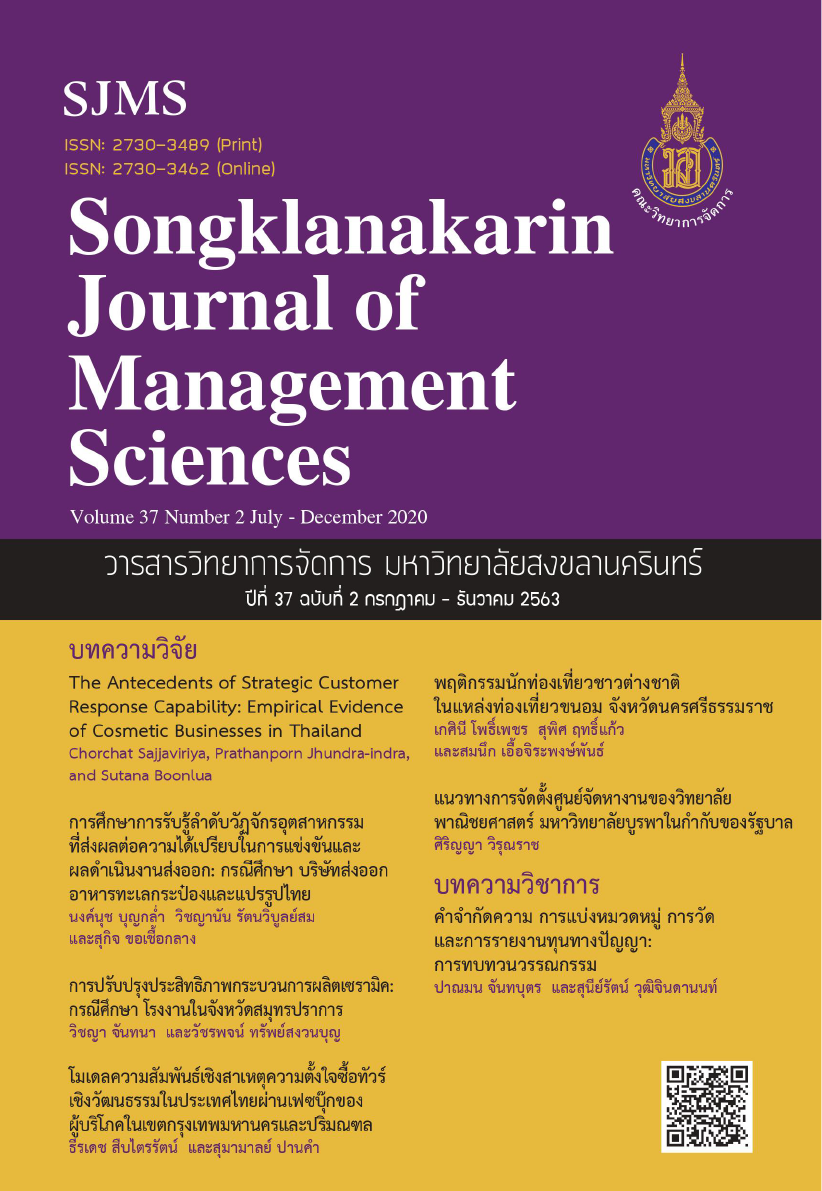
การศึกษาการรับรู้ลำดับวัฏจักรอุตสาหกรรมที่ส่งผลต่อความได้เปรียบในการแข่งขันและผลดำเนินงานส่งออก: กรณีศึกษา บริษัทส่งออกอาหารทะเลกระป๋องและแปรรูปไทย
Article Sidebar
Main Article Content
บทคัดย่อ
ความได้เปรียบในการแข่งขันและผลดำเนินงานส่งออกเป็นหัวข้อที่สำคัญของการวิจัยการส่งออกและการจัดการกลยุทธ์ การส่งออกไม่เพียงแต่มีความสำคัญในการสร้างประโยชน์จากการทำกำไร การเติบโตและการอยู่รอดของบริษัทผู้ส่งออก แต่ยังส่งผลต่อความมั่นคงทางเศรษฐกิจของประเทศ งานวิจัยนี้มีวัตถุประสงค์เพื่อศึกษาอิทธิพลการรับรู้ลำดับวัฏจักรอุตสาหกรรมที่ส่งผลต่อความสัมพันธ์ระหว่างความได้เปรียบในการแข่งขันและผลดำเนินงานส่งออก ประชากรที่ใช้ในการวิจัยนี้คือ กลุ่มผู้ประกอบการส่งออกอาหารทะเลกระป๋องและแปรรูปไทยจํานวน 154 บริษัท ใช้แบบสอบถามเป็นเครื่องมือในการรวบรวมข้อมูล มีผู้ตอบแบบสอบถามจำนวน 48 บริษัท สถิติที่ใช้ในการวิเคราะห์ข้อมูลใช้โมเดลสมการโครงสร้าง (SEM) แบบเส้นทางกำลังสองน้อยที่สุดบางส่วน (PLS-SEM) ด้วยการตรวจสอบสัมประสิทธิ์เส้นทางระหว่างตัวแปรความได้เปรียบในการแข่งขัน ผลดำเนินงานส่งออก การรับรู้วัฏจักรอุตสาหกรรม โดยขนาดของธุรกิจเป็นตัวแปรควบคุม ทดสอบนัยสำคัญทางสถิติด้วยกระบวนการ Bootstrapping ผลการวิจัยพบว่า ความได้เปรียบในการแข่งขันมีอิทธิพลทางลบต่อผลดำเนินงานส่งออก และการรับรู้ลำดับวัฏจักรอุตสาหกรรมมีอิทธิพลสมบูรณ์ส่งผ่านความสัมพันธ์ระหว่างความได้เปรียบในการแข่งขันกับผลดำเนินงานส่งออก
ผลวิจัยนี้ยังยังเป็นการบูรณาการทฤษฎีความได้เปรียบในการแข่งขันและทฤษฎีการรับรู้ลำดับวัฏจักรอุตสาหกรรม และลดช่องว่างงานวิจัยในทฤษฎีความได้เปรียบในการแข่งขัน จากแนวคิดทฤษฎีฐานทรัพยากร (RBV) ที่ว่าการรับรู้ลำดับวัฏจักรอุตสาหกรรมมีอิทธิพลต่อความได้เปรียบในการแข่งขันซึ่งส่งผลต่อผลการดำเนินงานส่งออก และการศึกษานี้โดยเฉพาะอย่างยิ่งต่อผู้ประกอบการและผู้นำขององค์กรต่อปัจจัยด้านการรับรู้ที่ส่งผลต่อผลดำเนินงานส่งออก
Article Details

อนุญาตภายใต้เงื่อนไข Creative Commons Attribution-NonCommercial-NoDerivatives 4.0 International License.
บทความที่ตีพิมพ์ถือเป็นลิขสิทธิ์ของวารสารวิทยาการจัดการ มหาวิทยาลัยสงขลานครินทร์ อย่างไรก็ตาม กองบรรณาธิการไม่สงวนลิขสิทธิ์ในการทำซ้ำ คัดลอก หรือเผยแพร่ แต่จะต้องอ้างอิงให้ถูกต้องตามหลักวิชาการ
เอกสารอ้างอิง
Aaby, N. E., & Slater, S. F. (1989). Management influences on export performance: A review of the empirical literature. International Marketing Review, 6(4), 7–26.
Al-Khalifa, A., & Morgan, N. A. (1995). Export performance measurement: a review and suggested directions. Marketing theory and Applications, 6, 313-318.
Bamiatzi, V. C., & Kirchmaier, T. (2014). Strategies for superior performance under adverse conditions: A focus on small and medium-sized high-growth firms. International Small Business Journal, 32(3), 259–284.
Barney, J. B. (1991). Firm resources and sustained competitive advantage. Journal of Management, 17(1), 99–120.
Bourgeois, L. J. (1980). Strategy and environment: A conceptual integration. The Academy of Management Review, 5(1), 25–39.
Brush, T. H., Bromiley, P., & Hendrickx, M. (1999). The relative influence of industry and corporation on business segment performance: An alternative estimate. Strategic Management Journal, 20(6), 519–547.
Chin, W. W., Marcolin, B., & Newsted, P. R. (2003). A partial least squares latent variable modeling approach for measuring interaction effects: Results from a monte carlo simulation study and an electronic-mail emotion/adoption study. Information Systems Research, 14(2), 189–217.
Cohen, J. (1988). Statistical power analysis of behavioral sciences (2nd ed). Eribaum, Hillsdale, USA.
Combs, J. G., Crook, T. R., & Shook, C. L. (2005). The dimensionality of organizational performance and its implication for strategic management research. In D. J. Ketchen & D. D. Bergh (Eds.). Research methodology in strategy and management (pp. 259-286). Bingley: Emerald Group Publishing Limited.
Department of International Trade Promotion, Ministry of commerce. (2018). Foreign Trade Statistics of Thailand. Retrieved October 15, 2018, from http://www.moc.go.th/index.php/trade-information/2015-11-16-12-08-59.html
Durand, R. (2002). Competitive advantages exist: A critique of powell. Strategic Management Journal, 23(9), 867–872.
Flavian C., Haberbeng A., & Poro, Y. (2002). Food retailing strategies in the European Union. A comparative analysis in the UK and Spain. Journal of Retailing and Consumer Services, 9(3), 125–138.
Food and Agriculture Organization of the United Nations (FAO). (October, 2017). Globefish Highlights: A quarterly updated on world seafood market (Jan-Jun, Statistics). Retrieved May 10, 2018, from http://www.fao.org/3/a-i8204e.pdf
Gencturk, E. F., & Kotabe, M. (2001). The effect of export assistance program usage on export performance: A contingency explanation. Journal of International Marketing, 9(2), 51–72.
Grant, R. M. (1991). The resource-based theory of competitive advantage: implications for strategy formulation. California Management Review, 33(3), 114–135.
Hair, J. F., Anderson, R. E., Tatham, R. L., & Black, W. C. (1995). Multivariate data analysis. Englewood Cliffs, NJ: Prentice-Hall.
Hair, J. F., Ringle, C. M., & Sarstedt, M. (2011). PLS-SEM: indeed a silver bullet. Journal of Marketing Theory and Practice, 19(2), 139–151.
Hair, J. F., Hopkins, L., Sarstedt, M., & Kuppelwieser, V. (2014). Partial Least Squares Structural Equation Modeling (PLS-SEM): An emerging tool for business research. European Business Review, 26(2), 106–121.
Harrigan, K. R. (1980). The effect of exit barriers upon strategic flexibility. Strategic Management Journal, 1(2), 165-176.
Hill, C. W., & Jones, G. R. (2012). Strategic management theory: An integrated approach (10th ed). South-Western: Cengage Learning.
Information Communication and Technology Center, Ministry of Commerce. (2018). Export statistics report. Retrieved Feburary 15, 2019, From http://www.ops.moc.go.th/infor/menucomth/stru1_export/export_topn_country/
Kaleka, A. (2002). Resources and capabilities driving competitive advantage in export markets: guidelines for industrial exporters. Industrial Marketing Management, 31(3), 273–283.
Karniouchina, E. V., Carson, S. J., Short, J. C., & Ketchen, D. J. (2013). Extending the firm vs. Industry debate: Does industry life cycle stage matter?. Strategic Management Journal, 34(8), 1010–1018.
Katsikeas, C. S., Leonidou, L. C., & Morgan, N. A. (2000). Firm-level export performance assessment: Review, evaluation, and development. Journal of the Academy of Marketing Science, 28(4), 493–511.
McGahan, A. M. (2000). How industries evolve. Business Strategy Review, 11(3), 1–16.
Miranda, S. M., & Saunders, C. S. (2003). The social construction of meaning: An alternative perspective on information sharin. Information systems research, 14(1), 87–106.
Morgan, N. A., Kaleka, A., & Katsikeas, C. S. (2004). Antecedents of export venture performance: A theoretical model and empirical assessment. Journal of Marketing, 68(1), 90–108.
Murmann, J. P., & Frenken, K. (2006). Toward a systematic framework for research on dominant designs, technological innovations, and industrial change. Research policy, 35(7), 925-952.
Newbert, S. L. (2008). Value, rareness, competitive advantage, and performance: A conceptual-level empirical investigation of the resource-based view of the firm. Strategic Management Journal, 29(7), 745–768.
Pearson, J. A., Robinson, R. B., Mital, A. (2008). Strategic Management: Formulation, Implementation, and Control. Tata: McGraw-Hill.
Piercy, N. F., Kaleka, A., & Katsikeas, C. S. (1998). Sources of competitive advantage in high performing exporting firms. Journal of World Business, 33(4), 378–393.
Porter, M. E. (1980). Competitive strategy: techniques for analyzing industries and competitors. New York: Free Press.
Porter, M. E. (1985). Competitive Advantage. New York: Free Press.
Porter, M. E. (1990). The Competitive Advantage of Nations. New York: Free Press.
Porter, M. E. (1998). Clusters and the New Economics of Competition. Harvard Business Review, 76(6), 77-90.
Powell, W. W. (2001). Competitive advantage: logical and philosophical considerations. Strategic Management Journal, 22(9), 875–888.
Powell, T. C. (2003). Varieties of competitive parity. Strategic Management Journal, 24(1), 61-86.
Rumelt, R. (1991). How much does industry matter?. Strategic Management Journal, 12(3), 167–185.
Sabol, A., Šander, M., & Fuckan, D. (2013). The concept of industry life cycle and development of business srategies. In Active Citizenship by Knowledge Management & Innovation: Proceedings of the Management, Knowledge and Learning International Conference 2013 (pp. 635–642).
Tuan, N. P., & Yoshi, T. (2010). Organisational capabilities, competitive advantage and performance in supporting industries in Vietnam. Asian Academy of Management Journal, 15(1), 1–21.
Verreynne, M. (2006). Strategy-making process and firm performance in small firms. Journal of Management and Organisation, 12(3), 209–222.
Yuli, S. B. C. (2006). Analysis of environmental change of business competence: A study on food and beverage entrepreneurs small and medium scale in Malang and Pasuruan Regency. Journal of Humanity, 1(2), 106–116.
Zou, S., Fang, E., & Zhao, S. (2003). The effect of export marketing capabilities on export performance: An investigation of Chinese exporters. Journal of International Marketing, 11(4), 32–55.
