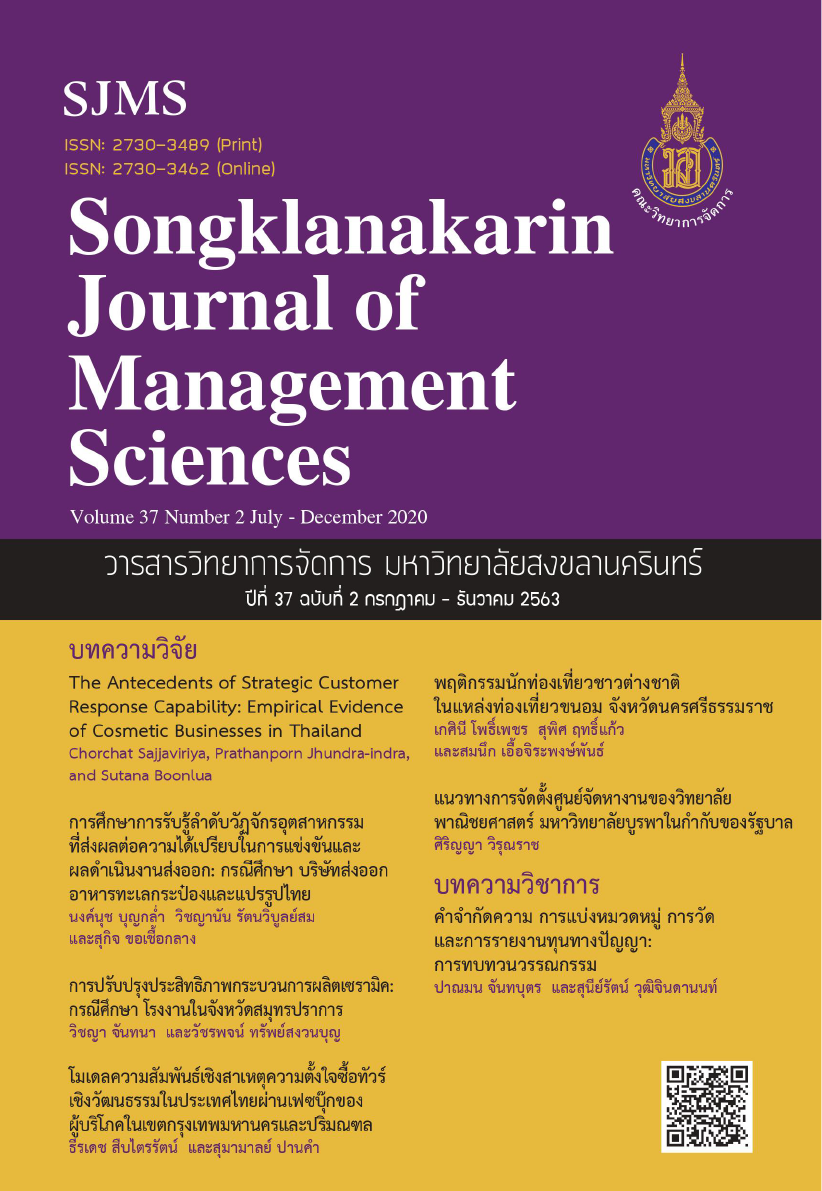
แนวทางการจัดตั้งศูนย์จัดหางานของวิทยาลัยพาณิชยศาสตร์ มหาวิทยาลัยบูรพาในกำกับของรัฐบาล
Article Sidebar
Main Article Content
บทคัดย่อ
การวิจัยครั้งนี้มีวัตถุประสงค์เพื่อศึกษาขั้นตอนและรูปแบบการจัดตั้งศูนย์จัดหางาน ของศูนย์จัดหางานวิทยาลัยพาณิชยศาสตร์ มหาวิทยาลัยบูรพา และเพื่อศึกษาความสัมพันธ์ระหว่างปัจจัยกระบวนการผลิต การตลาด การขาย ปัจจัยกลุ่มอุตสาหกรรม และปัจจัยกลุ่มผู้บริหารกับความต้องการใช้บริการศูนย์จัดหางานวิทยาลัยพาณิชยศาสตร์ มหาวิทยาลัยบูรพา ของโรงงานอุตสาหกรรม จังหวัดชลบุรี การวิจัยนี้เป็นการวิจัยแบบผสมผสาน จำแนกเป็นการวิจัยเชิงคุณภาพ สัมภาษณ์เชิงลึกกับกลุ่มผู้ให้ข้อมูลหลัก จำนวน 12 คน และการวิจัยเชิงปริมาณ สอบถามกับกลุ่มตัวอย่างผู้บริหารโรงงานอุตสาหกรรมและพาณิชยกรรมอื่น ๆ จังหวัดชลบุรี จำนวน 400 คน วิเคราะห์ข้อมูลสถิติด้วยการทดสอบแบบไคสแควร์ ผลการวิจัยพบว่า วิทยาลัยพาณิชยศาสตร์ สามารถดำเนินการจัดตั้งศูนย์จัดหางานได้ตามกฎหมายภายใต้บริษัทจำกัดที่จดทะเบียนบริษัทโดยมหาวิทยาลัยบูรพา มี 6 ขั้นตอน และผลการทดสอบสมมติฐาน พบว่า ปัจจัยกระบวนการผลิต การตลาด การขายมีความสัมพันธ์เชิงบวกในระดับสูงกับความต้องการใช้บริการศูนย์จัดหางานด้านการตัดสินใจ ปัจจัยกลุ่มอุตสาหกรรมมีความสัมพันธ์เชิงบวกในระดับต่ำกับความต้องการใช้บริการศูนย์จัดหางานด้านค่าจ้างที่พร้อมจ่ายตำแหน่งเจ้าหน้าที่วิจัยและพัฒนา วิศวกรรมวิทยาศาสตร์ และปัจจัยกลุ่มผู้บริหารมีความสัมพันธ์เชิงบวกในระดับต่ำกับความต้องการใช้บริการศูนย์จัดหางานด้านสาเหตุและค่าจ้างที่พร้อมจ่ายตำแหน่งงานด้านการตลาด การขาย การค้นพบครั้งนี้เป็นการค้นพบใหม่ สามารถใช้เป็นแนวทางปฏิบัติให้กับสถาบันอุดมศึกษา เพิ่มช่องทางการมีงานทำมากขึ้นของนักศึกษา และเพิ่มรายได้ของสถาบันอุดมศึกษาอีกด้วย
Article Details

อนุญาตภายใต้เงื่อนไข Creative Commons Attribution-NonCommercial-NoDerivatives 4.0 International License.
บทความที่ตีพิมพ์ถือเป็นลิขสิทธิ์ของวารสารวิทยาการจัดการ มหาวิทยาลัยสงขลานครินทร์ อย่างไรก็ตาม กองบรรณาธิการไม่สงวนลิขสิทธิ์ในการทำซ้ำ คัดลอก หรือเผยแพร่ แต่จะต้องอ้างอิงให้ถูกต้องตามหลักวิชาการ
เอกสารอ้างอิง
Burapha University Act 2007. (2008). Government Gazette. Page 8-34.
Chamaram, S. (2017). New ways of working with mobile technology: new challenges in recruitment and selection of personnel in Thailand 4.0. Journal of Business Administration Economics and Communications, 12(2), 9-22.
Chuaebangkaew, P. (2007). Human resource management. Bangkok: Bangkok University.
Clark, B. R. (1998). Creating entrepreneurial universities; Organisational pathways of transformation. Oxford: Pergamon for IAU.
Cochiran, W. G. (1953). Sampling techniques. New York: John Wiley & Sons.
Faculty of Political Science and Law. (2010). Minutes of the committee meeting of the Faculty of Political Science and Law no. 2/2010, Thursday 18 February 2010 at the meeting room QS2-602. Retrieved March 20, 2019, from http://www.polsci-law.buu.ac.th/
French, W. L. (2007). Human resource management (6th ed.). Boston: Houghton Mifflin.
Hair, J. F., Black, W. C., Babin, B. J., & Anderson, R. E. (2010). Multivariate data analysis: A global perspective (7th ed.). New Jersey: Pearson Prentice Hall.
Ivancevich, J. M. (2010). Human resource management (11th ed.). Boston: McGraw-Hill.
Kheanchanan, N. (2011). Human resource management. Bangkok: SE-EDUCATION.
Kiatwatcharachaiyaphon, K., & KengThanomsak (2011) Removal a person holding political positions from office by the people. Bangkok: Thammasat University.
Kornkew, V. (2017). HR manager. Interview.
Luis, R. G., David, B. B., & Robert, L. C. (2004). Management human resources. Boston: Prentice Hall.
Lumb, M. (2012). Lists of members-Uom Commercial/ Ltd. n.p.
Macmillan, T. T. (1971). The delphi technique. In Paper Presented at The Annual Meeting of the California Junior Colleges Associations Committee on Research and Development. Ca: Monterey, May 3-5.
Morse, N. C. (1958). Satisfaction in the white clollar job. Michigan: University of Michigan.
National Education Act 1999. (1999). Bangkok: Sweet pepper graphic.
Orkadashvill, M. (2007). Higher Education Funding Issue: U.S./ UK Comparision. Retrieved March 18, 2019, from mpre.ub.uni-muenchen.de/16417/MPRA_Paper_16417.pdf
Photisita, C. (2007). Science and Art Qualitative Research. Bangkok: Amarin Printing Company And Publishing.
Porter, M. E. (1985). Competitive advantage: Creating and sustaining superior performance. New York: Free Press.
Rovinelli, R. J., & Hambleton, R. K. (1977). On the use of content specialist in the assessment of criterion-referenced test item validity. Dutch Journal of Educational Research, 2(2), 49-60.
Senge, P. M. (1990). The fifth discipline: the art and practice of the learning organization. New York: Doubleday.
Werther, W. B., & Davis, K. (1999). Human resources and personnel management (5thed.). New York: McGraw-Hill.
Wiroonratch, B. (2017). Guidelines for human resource management. Chachoengsao: MN Computer Offset.
