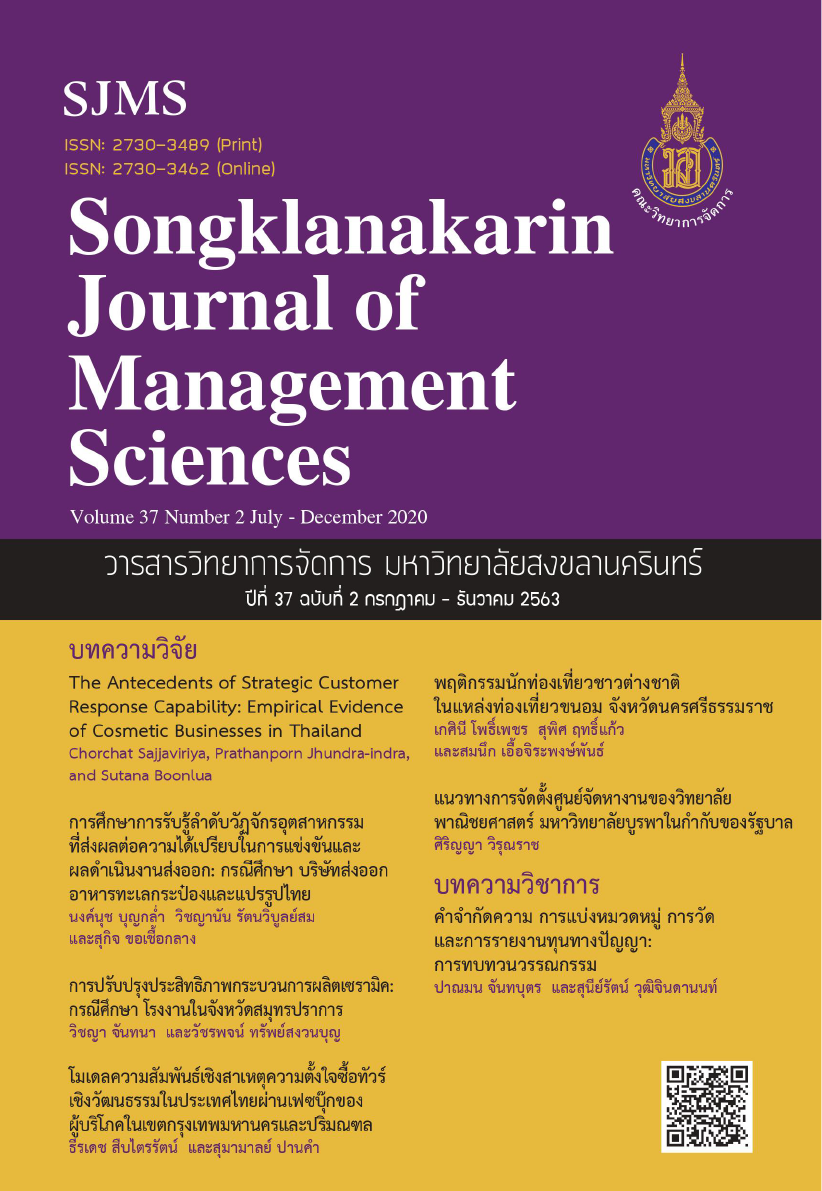
ตัวแปรต้นเหตุของความสามารถในการตอบสนองลูกค้าเชิงกลยุทธ์: หลักฐานเชิงประจักษ์จากธุรกิจเครื่องสำอางในประเทศไทย
Article Sidebar
Main Article Content
บทคัดย่อ
การศึกษานี้มีวัตถุประสงค์เพื่อตรวจสอบอิทธิพลของตัวแปรอิสระ ซึ่งประกอบไปด้วย วิสัยทัศน์เพื่อความอยู่รอด วัฒนธรรมองค์กรมุ่งเน้นลูกค้า และความหลากหลายของลูกค้าที่มีอิทธิพลต่อความสามารถในการตอบสนองลูกค้าเชิงกลยุทธ์ โดยใช้วิธีวิจัยเชิงปริมาณ ทฤษฎีเชิงสถานการณ์นั้นสามารถประยุกต์ใช้ในการอธิบายงานชิ้นนี้ ทฤษฎีนี้สามารถอธิบายความสัมพันธ์ระหว่างปัจจัยภายในปัจจัยภายนอกและกลยุทธ์ทางการตลาด ข้อมูลประชากรนำมาจากกรมพัฒนาธุรกิจการค้า นอกจากนี้ การเก็บข้อมูลจากกลุ่มตัวอย่างของธุรกิจเครื่องสำอางในประเทศไทยจำนวน 162 คน โดยใช้แบบสอบถาม และใช้การวิเคราะห์สมการถดถอยในการทดสอบสมมติฐาน การมุ่งเน้นความสามารถในการตอบสนองลูกค้าเชิงกลยุทธ์เป็นหนึ่งในเครื่องมือที่สำคัญการที่ใช้ในการดำเนินงานโดยเฉพาะอย่างยิ่งกิจการที่เกี่ยวข้องด้านแฟชั่นอย่างมาก ซึ่งมีลักษณะการเปลี่ยนแปลงที่รวดเร็วและสามารถสร้างค่านิยมใหม่ ๆ ทางด้านการตลาด ซึ่งผลการศึกษาพบว่า วิสัยทัศน์เพื่อความอยู่รอด วัฒนธรรมองค์กรมุ่งเน้นลูกค้า และความหลากหลายของลูกค้า มีอิทธิพลเชิงบวกต่อการมุ่งเน้นความสามารถในการตอบสนองลูกค้าเชิงกลยุทธ์อย่างมีนัยสำคัญทางสถิติ นอกจากนี้ กิจการเครื่องสำอางที่ต้องการเติบโตอย่างยั่งยืนควรจะพิจารณา ตัวแปรอิสระทั้งสามตัวแปรนี้ และกิจการควรจะมุ่งเน้นในการพัฒนากิจการเพื่อรักษาและยืดอายุของตำแหน่งทางการตลาดที่แข่งขันได้ ในทำนองเดียวกัน ผลการศึกษาที่พบสามารถนำไปใช้ในการกำหนดความสามารถในการตอบสนองลูกค้าเชิงกลยุทธ์ อีกทั้งยังช่วยพัฒนาด้านการตลาดของกิจการเครื่องสำอางอีกด้วย
Article Details

อนุญาตภายใต้เงื่อนไข Creative Commons Attribution-NonCommercial-NoDerivatives 4.0 International License.
บทความที่ตีพิมพ์ถือเป็นลิขสิทธิ์ของวารสารวิทยาการจัดการ มหาวิทยาลัยสงขลานครินทร์ อย่างไรก็ตาม กองบรรณาธิการไม่สงวนลิขสิทธิ์ในการทำซ้ำ คัดลอก หรือเผยแพร่ แต่จะต้องอ้างอิงให้ถูกต้องตามหลักวิชาการ
เอกสารอ้างอิง
Aaker, D. A., Kumar, V., & Day, G. S. (2001). Marketing research. New York: John Wiley and Sons.
Abdel-Kader, M., & Luther, R. (2008). The impact of firm characteristics on management accounting practices: A UK-based empirical analysis. The British Accounting Review, 40(1), 2-27.
Anderson, S. W., & Lanen, W. N. (1999). Economic transition, strategy and the evolution of management accounting practices: the case of India. Accounting, Organizations and Society, 24(5-6), 379-412.
Armstrong, J. S., & Overton, T. S. (1977). Estimating nonresponse bias in mail surveys. Journal of Marketing Research, 14(3), 396-402.
Baines, Annette, & Langfield-Smith, Kim. (2003). Antecedents to management accounting change: a structural equation approach. Accounting, Organizations and Society, 28(7-8), 675-698.
Barnard, C. I. (1947). The functions of the Executive. Cambridge, MA: Harvard University Press.
Bell, G. G., Lai, F., & Li, D. (2012). Firm orientation, community of practice, and Internet-enabled interfirm communication: Evidence from Chinese firms. The Journal of Strategic Information Systems, 21(3), 201-215.
Bernardes, E., & Hanna, M. (2009). A Theoretical Review of Flexibility, Agility and Responsiveness in the Operations Management Literature. International Journal of Operations & Production Management, 29(1), 30-53.
Berry, L. L. (1983). Relationship marketing. In Emerging Perspectives in Service Marketing. Chicago: American Marketing Association.
Berson, Y., Shamir, B., Avolio, J. B., & Popper, M. (2001). The relationship between vision strength, leadership style, and context. The Leadership Quarterly, 12(1), 53-73.
Beugelsdijk, S., Koen, C., & Noorderhaven, N. (2009). A dynamic approach to the impact of differences in organizational culture on relationship performance. Industrial Marketing Management, 38(3), 312-323.
Bowman, C., & Ambrosini, V. (2000). Value creation versus value capture: towards a coherent definition of value in strategy. British Journal of Management 2, 11(1), 1-15.
Breznik, L., & Lahovnik, M. (2016). Dynamic capabilities and competitive advantage: Findings from case studies. Management: Journal of Contemporary Management Issues, 21(special), 167-185.
Carr, J. C., & Lopez, T. B. (2007). Examining market orientation as both culture and conduct: Modeling the relationship between market orientation and employee responses. Journal of Marketing Theory and Practice, 15(2), 113-123.
Chitmun, S., Ussahawanitchakit, P., & Boonlua, S. (2012). Best modern managerial accounting practice of corporate governance awarded firms in Thailand: An empirical investigation of the antecedents and consequences. Journal of Academy of Business and Economics, 12(5), 125-152.
Davenport, T., Harris, J., & Kohli, A. (2001). How do they know their customers so well. Sloan Management Review, 42(2), 63-73.
Day, G. S. (1994). The capabilities of market-driven organizations. Journal of Marketing, 58(4), 37-52.
Deighton, J. (1997). Commentary on exploring the implications of marketing on the internet. Journal of the Academy of Marketing Science, 25(4), 347-351.
Dutton, J. E. (1993). The making of opportunity: an interpretative pathway to organizational change. Research in Organizational Behavior, 15(Greenwich, Conn: JAI Press), 195-226.
Eisenhardt, K. M., & J. A. Martin. (2000). Dynamic capabilities: What are they?. Strategy Management Journal, 21(10-11), 1105-1121.
Engelen, A., & Brettel, M. (2011). A cross-cultural perspective of marketing departments’ influence tactics. Journal of International Marketing, 19(2), 73-94.
Ensley, M. D., Pearce, C. L., & Hmieleski, K. M. (2006). Environmental dynamism: A moderator of the entrepreneur leadership behavior—new venture performance linkage. Journal of Business Venturing, 21(2), 243-263.
Fiedler, F. E., & Garcia, J. E. (1987). New approaches to effective leadership. New York: John Wiley & Sons.
Filstad, C., & Gottschalk, P. (2010). Creating a learning organization in law enforcement: Maturity levels for police oversight agencies. The Learning Organization, 17(5), 404-418.
Foley, A., & Fahy, J. (2009). Seeing market orientation through a capabilities lens. Journal of Marketing, 43(1/2), 13-20.
Grönoos, C. (1994). From marketing mix to relationship marketing: Towards a paradigm shift in marketing. Management Decision, 32(2), 4-20.
Gummesson, E. (1994). Making relationship marketing operational. International Journal of Service Industry Management, 5(5), 5-20.
Haimes, Y. Y. (2009). Risk modelling, assessment, and management. (3rd). A John Wiley: Sons.
Hair, J. F., Black, W. C., Babin, B. J., & Anderson, R. E. (2010). Multivariate data analysis: A global perspective. Upper Saddle River, NJ: Pearson.
Hawkins, D., & Mothersbaugh, D. (2007). Consumer behavior: Building marketing strategy. (10thed.). Boston: McGraw-Hill/Irwin.
Homburg, C., Krohmer, H., & Workman, J.P. (2004). A strategy implementation perspective of market orientation. Journal of Business Research, 57(12), 1331-1340.
Homburg, Christian, Sabine, K., & Harley, K. (2009). Marketing Management: A Contemporary Perspective. (1sted.). London.
Hooley, G. J., Greenley, G. E., Cadogan, J. W., & Fahy, J. (2005). The performance impact of marketing resources. Journal of Business Research, 58(1), 18-27.
Hunt, S. D., & Morgan, R. M. (1995). The comparative advantage theory of competition. Journal of Marketing, 59(2), 1-15.
Jarratt, D., & O’Neil, G. (2002). The effect of organizational culture on business-to-business relationship management practice and performance. Australian Marketing Journal, 10(3), 21-40.
Judge, W., & Zeithaml, C. (1992). Institutional and Strategic Choice Perspectives on Board Involvement in the Strategic Decision Process. The Academy of Management Journal, 35(4), 766-794.
Kaur, J., Chahal, H., & Gupta, M. (2019). Re-investigating Market Orientation and Environmental Turbulence in Marketing Capability and Business Performance Linkage: A Structural Approach. In: Chahal H., Jyoti J., Wirtz J. (eds) Understanding the Role of Business Analytics. Springer, Singapore.
Kotler, P., & Armstrong, G. (2012). Principles of marketing Upper Saddle River. New York: NJ: Pearson Prentice Hall.
Kouzes, J. M., & Posner, B. Z. (1987). The Leadership Challenge: How to get Extraordinary Things done in Organizations. San Francisco: Jersey-Bass.
Krejcie, R. V., & Morgan, D. W. (1970). Determining sample size for research activities. Psycholological Measurement, 30(3), 607-610.
Kumar, V., Jones, E., Venkatesan, R., & Leone, R. P. (2011). Is market orientation a source of sustainable competitive advantage or simply the cost of competing. Journal of Marketing, 75(1), 16-30.
Lado, A. A., Boyd, N. G., Wright, P., & Kroll, M. (2006). Paradox and theorizing within the resource-based view. Academy of Management Review, 31(1), 115-131.
Lau, C., & Ngo, H. (2004). The HR system, organizational culture, and product innovation. International Business Review, 13(6), 685-703.
Maklan, S., & S. Knox. (2009). Dynamic capabilities: the missing link in CRM Investments. European Journal of Marketing, 43(11-12), 1392-1410.
Morgan, R. M., & Hunt, S. D. (1994). The commitment-trust theory of relationship marketing. Journal of Marketing, 58(3), 20-38.
Mu, J., Peng G., & MacLachlan D. L. (2009). Effect of risk management strategy on NPD Performance. Technovation, 29(3), 170-180.
Narver, J. C., & Slater, S. F. (1990). The effect of a market orientation on business profitability. Journal of Marketing, 54(4), 20-35.
Nunnally, J. C., & Bernstein, I. H. (1994). The Assessment of Reliability. Psychometric Theory, 3(1), 248-292.
Nurittamont, W., & Ussahawanitchakit. P. (2008). The Influences of Brand Equity in Competitive Advantage and Performance of SPA Business in Thailand. International Journal of Business Strategy, 8(2), 14-25.
Pearce, J. A., & Robinson Jr, R. B. (2007). Strategic management: Formulation, implementation, and control. New York: MaGraw-Hill.
Piller, F. T., & Müller M. (2004). A New Marketing Approach to Mass customization. International Journal of Computer Integrated Manufacturing, 17(7), 583-593.
Prahalad, C. K., & Hamel, G. (1990). The core competence of the corporation. Harvard Business Review, 68(3), 79-87.
Rodenbach, M., & Brettel, M. (2012). CEO experience as micro-level origin of dynamic capabilities. Management Decision, 50(4), 611-634.
Ruekert, R. W. (1992). Developing a market orientation: an organizational strategy perspective. International Journal of Marketing, 9(3), 225-45.
Sakkasem, P., Ussahawanitchakit, P. & Nantana, O. (2001). Service Innovation Capability of Tour Operator Businesses in Thailand. The American Academy of Business Journal, 21(1), 92-104.
Schwartz, M. (2009). Beyond incubation: an analysis of firm survival and exit dynamics in the post-graduation period. Journal of Technology Transfer, 34(4), 403-421.
Shenhar, A. J. (2001). One size does not fit all projects: Exploring classical contingency domains. Management Science, 47(3), 394-414.
Sherwin, N. D. (2010). The global impact of customer relationship marketing. Journal of Global Business Issues, 4(2), 65-75.
Sigala, M. (2006). Mass Customization Implementation Models and Customer Value in Mobile Phones Services: Preliminary Findings from Greece. Managing Service Quality: An International Journal, 16(4), 395-420.
Tungbunyasiri, S. & Ussahawanitchakit, P. (2013). Strategic marketing flexibility and marketing performance: An empirical investigation of beverage businesses in Thailand. International Journal of Business Research, 13(3), 45-62.
Tuominen, M., Rajala, A., & Möller, K. (2004). Market-driving versus market-driven: Divergent roles of market orientation in business relationships. Industrial Marketing Management, 33(3), 207-217.
Ussahawanitchakit, P. (2011). Organizational Innovation of Electronics Businesses in Thailand: How Does It Affect Firm Performance?. International Journal of Business Strategy, 11(1), 130-137.
Walsh, S. (2007). Establishing and Developing Alliances as a Key to Success in an Ever More Complex Marketing Environment. Philadelphia, PA: Association of Marketing Educators, 45(1), 25-44.
Wang, Q., Zhao, X., & Voss, C. (2016). Customer orientation and innovation: A comparative study of manufacturing and service firms. International Journal of Production Economics, 171(2), 221-230.
Wernerfelt, B. (1984). A resource-based view of the firm. Strategic Management Journal, 5(2), 171-180.
Zott, C. (2003). Dynamic capabilities and the emergence of intra industry differential firm performance: insights from a simulation study. Strategic Management Journal, 24(2), 97-125.
