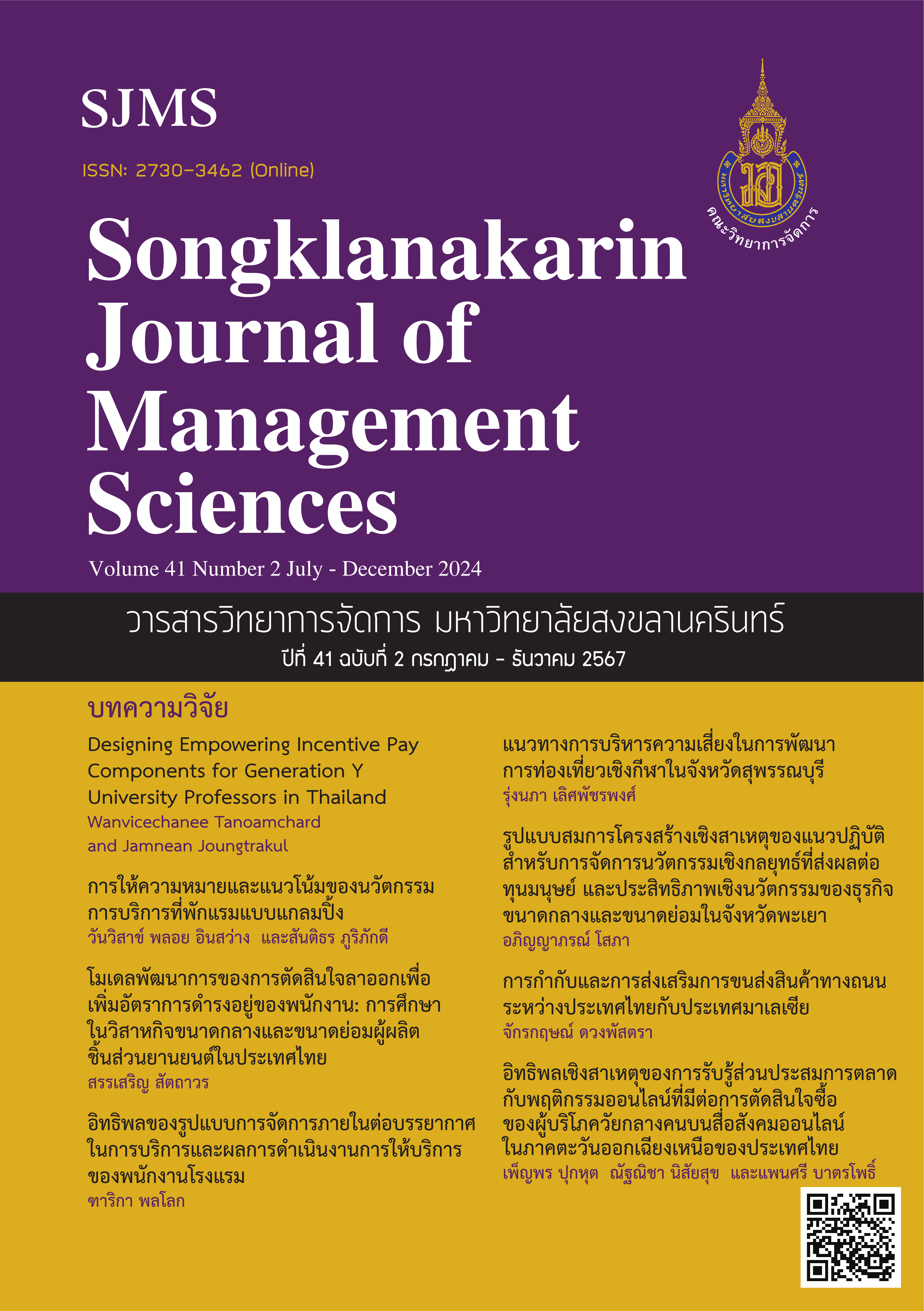
การให้ความหมายและแนวโน้มของนวัตกรรมการบริการที่พักแรมแบบแกลมปิ้ง
Article Sidebar
Main Article Content
บทคัดย่อ
การวิจัยนี้มีวัตถุประสงค์เพื่อศึกษาการให้ความหมายของนวัตกรรมการบริการที่พักแรมแบบแกลมปิ้ง และศึกษาแนวโน้มของธุรกิจที่พักแรมแบบแกลมปิ้งในประเทศไทย โดยใช้ระเบียบวิธีวิจัยเชิงคุณภาพด้วยวิธีปรากฏการณ์วิทยา (Phenomenology) กับผู้ให้ข้อมูลหลักจำนวน 16 คน ที่มีความครอบคลุมกับพฤติกรรมและความรู้สึกนึกคิดของผู้ที่เป็นตัวจริงทั้งผู้ให้บริการและผู้รับบริการในที่พักแรมแบบแกลมปิ้ง ได้แก่ กลุ่มนักท่องเที่ยวแบบแกลมปิ้ง (Glamper) และผู้ประกอบการแกลมปิ้ง (Glamping) ด้วยวิธีการเลือกแบบเฉพาะเจาะจง ผ่านการวิเคราะห์ข้อมูลโดยการวิเคราะห์เชิงเนื้อหา (Content Analysis)
ผลการศึกษาพบว่า แกลมปิ้ง คือ การพักผ่อนท่ามกลางธรรมชาติที่มีความเป็นส่วนตัวในรูปแบบของเต็นท์กระโจม โดมใส รถบ้าน หรืออาคารที่มีลักษณะคล้ายเต็นท์ที่กลมกลืนไปกับธรรมชาติ มีการตกแต่งที่สวยงาม หรูหราและมีสิ่งอำนวยความสะดวกครบครัน ดังคำจำกัดความที่ว่า “กินดี นอนหรู อยู่สบาย ท่ามกลางธรรมชาติรอบตัว” แต่ในบริบทของประเทศไทย พบประเด็นความแตกต่างที่น่าสนใจ คือ ต้องจัดให้มีมุมถ่ายรูปที่สวยงามเพื่อสามารถตอบสนองพฤติกรรมของนักท่องเที่ยวยุคใหม่ที่เน้นการถ่ายรูปเพื่ออัพโหลดในสื่อโซเชียลมีเดียของตนเอง นอกจากนี้ แนวโน้มของที่พักแรมแบบแกลมปิ้งนับว่าจะเติบโตมากขึ้นในอนาคต ถือเป็นอีกหนึ่งรูปแบบของที่พักแรมทางเลือกที่ได้รับความสนใจจากนักท่องเที่ยวทั่วโลก อย่างไรก็ตาม ผู้วิจัยได้วิเคราะห์ให้เห็นถึงปัจจัยที่สนับสนุนให้ธุรกิจดังกล่าวเป็นที่นิยม อันได้แก่ พฤติกรรมของนักท่องเที่ยวที่เปลี่ยนแปลงไป ลักษณะการลงทุนทางธุรกิจ แนวโน้มการท่องเที่ยวในอนาคตที่เน้นการท่องเที่ยวอย่างมีคุณภาพมากขึ้น รวมทั้งชี้ให้เห็นถึงปัจจัยสำคัญในการดำเนินธุรกิจที่พักแรมแบบแกลมปิ้ง ทั้งการออกแบบรูปลักษณ์ของแกลมปิ้งให้มีความสวยงามและทันสมัย ตลอดจนการสร้างความแตกต่างให้กับธุรกิจแกลมปิ้งของตนเอง เพื่อให้สามารถตอบโจทย์ความต้องการของนักท่องเที่ยวในยุคปัจจุบัน
Article Details

อนุญาตภายใต้เงื่อนไข Creative Commons Attribution-NonCommercial-NoDerivatives 4.0 International License.
บทความที่ตีพิมพ์ถือเป็นลิขสิทธิ์ของวารสารวิทยาการจัดการ มหาวิทยาลัยสงขลานครินทร์ อย่างไรก็ตาม กองบรรณาธิการไม่สงวนลิขสิทธิ์ในการทำซ้ำ คัดลอก หรือเผยแพร่ แต่จะต้องอ้างอิงให้ถูกต้องตามหลักวิชาการ
เอกสารอ้างอิง
Adamovich, V., Kot, M., Nadda, V., & Haque, A. U. (2021). Camping Vs. Glamping Tourism: Providers' Perspective. Journal of Environmental Management and Tourism, 12(6), 1431-1442.
Bangkok Business. (2023). The value of the global 'camping' market jumped 11.2%. How do you want to catch this business? Retrieved April 3, 2023, from https://www.bangkokbiznews.com/business/986538
Bhalla, R., Chowdhary, N., & Ranjan, A. (2021). Spiritual tourism for psychotherapeutic healing post COVID-19. Journal of Travel & Tourism Marketing, 38(8), 769-781.
Brochado, A., & Brochado, F. (2019). What makes a glamping experience great? Journal of Hospitality and Tourism Technology, 10(1), 15-27.
Çetin, I., Baran, G. G., & Yuksel, S. (2022). Innovation and Service Design in Brand Resort Hotels. Journal of Gastronomy and Travel Research, 6(3), 519-534.
Colaizzi, P. (1987). Psychological research as the Phenomenologist views it. In Existential -Phenomenological Alternatives for Psychology (Valle R. & King M. eds). Oxford University Press, London, 48-71.
Craig, C. A., & Karabas, I. (2021). Glamping after the coronavirus pandemic. Tourism and Hospitality Research, 21(2), 251-256.
Diwyarthi, N. D. M. S., Sukerti, N. N., Pramana, I. D. H., & Jata, I. W. (2022). Empowering Employees with Glamping as An Alternative Accommodation in The New Normal Era in Kembang Merta Village, Tabanan Regency, Bali Province. Community Development Journal, 6(2), 48-51.
Fernandes, S., Ferreira, D., Alves, T., & Sousa, B. (2021). Glamping and the Development of Sustainable Tourism: A Preliminary Approach in the Portuguese. In Handbook of Sustainable Development and Leisure Services. 201-222.
Granstrand, O., & Holgersson, M. (2020). Innovation Ecosystems: A Conceptual Review and a New Definition. Journal of Technovation, 90(2), 1-12.
Kiryakova, D. T., Vasenska, I., & Koyundzhiyska, D. B. (2022). Glamping: An Active Back to Nature Trend in the Post-Pandemic Tourism Reality. Proceedings of the 5th International Conference on Tourism Research. 183-190.
Liberato, P., Coelho, J., & Liberato, D. (2023). Attributes Associated with the Glamping Concept. An Empirical Study. Journal of Tourism & Development, 40(2), 9-21.
MacLeod, C., (2023). Glamping Industry Forecast 2023 - Will Glamping continue to grow? Retrieved April 25, 2023, from https://www.glampitect.com/blog/glamping-industry-forecast-2023-uk
Macmillan, T. (1971). The Delphi Technique, Paper presented at the annual meeting of the California Junior Colleges Associations Committee on Research and Development. Monterey: California.
Miao, L., Im, J., So, K. K. F., & Cao, Y. (2022). Post-pandemic and Post-traumatic Tourism Behavior. Annals of Tourism Research, 92(2022), 1-4.
Milohnić, I., Bonifačić, J. C., & Licul, I. (2019). Transformation of Camping into Glamping–Trends and Perspectives. Tourism in Southern and Eastern Europe Journal, 5, 457-473.
Muangjaroen, J., & Phasunon. P. (2019). Creative innovation in the work process affecting the performance effectiveness of employees at convenience stores in the Bangkok metropolitan area. Journal of Economics and Management Strategy. 6(2), 73-88.
Opasbut, T., & Ponvasurat, P. (2021). Customer Experience Management on the “New Normal”. Siam Communication Review. 19(2), 169-180.
Pattanapokinsakul, K., Sangthong, S., & Soonsan, N. (2022). The Glamping Development for Tourism. Journal of Sustainable Tourism Development, 4(2), 94-109.
Rana, A., & Kaithwas, A. (2023). The Shifting Landscape of Digital Marketing: Trends and Predictions for the Future. UGC Care Listed Journal, 18(2), 35-42.
Samani, S. A., & Alavi, S. M. S. Z. (2020). Are Open-Plan Office Designs Still Popular After Coronavirus Pandemic? Performance Improvement Journal. 59(8), 24-32.
Shin, H., Nicolau, J. L., Kang, J., Sharma, A., & Lee, H. (2022). Travel Decision Determinants During and After COVID-19: The Role of Tourist Trust, Travel Constraints, and Attitudinal Factors. Tourism Management, 88(3), 1-48. https://doi.org/10.1016/j.tourman.2021.104428
Sookkong, P. (2023). Travel Trend 2023: What will happen in the tourism industry in 2023? Retrieved May 10, 2023, from https://thestandard.co/travel-trend-2023/
Sun, T., & Huang, T. (2023). Research of Glamping Tourism Based on the Aesthetics of Atmosphere. Sustainability 2023, 15(1), 1-15. https://doi.org/10.3390/su15010581
TAT Intelligence Center. (2023). 3rd Quarter Report, a survey of travel behavior of Thai people in 2022. Tourism Authority of Thailand.
Thanatakul, N. (2022). Glamping, sleeping in luxury and comfortable, trends and business during COVID. Retrieved April 3, 2023, from https://www.creativethailand.org/view/article-readarticle_id=33628&lang=th
The Business Research Company. (2023). Glamping Global Market Report 2023. Retrieved April 23, 2023, from https://www.thebusinessresearchcompany.com/report/glamping-global-market-report
Tianphu, P., & Wetprasit, W. (2022). Strategies’ Competitive Advantage of Entrepreneur in Floating Market, Central of Thailand. Valaya Alongkorn Review (Humanities and Social Science), 12(1), 162-177.
Watt, G. (2021). Glamping space evolution & appropriation. Retrieved April 25, 2023, from https://watt.nz/2021/01/glamping-space-evolution-appropriation/
Watthanabut, B. (2021). Qualitative Research. Training program "Create a new generation of researchers". National Research Council of Thailand and Mahachulalongkornrajavidyalaya University.
White, M. P., Alcock, I., Grellier, J., Wheeler, B. W., Hartig, T., Warber, S. L., Bone, A., Depledge, M. H., & Fleming, L. E. (2019). Spending at least 120 minutes a week in nature is associated with good health and well-being. Scientific Reports, https://doi.org/10.1038/s41598-019-44097-3
