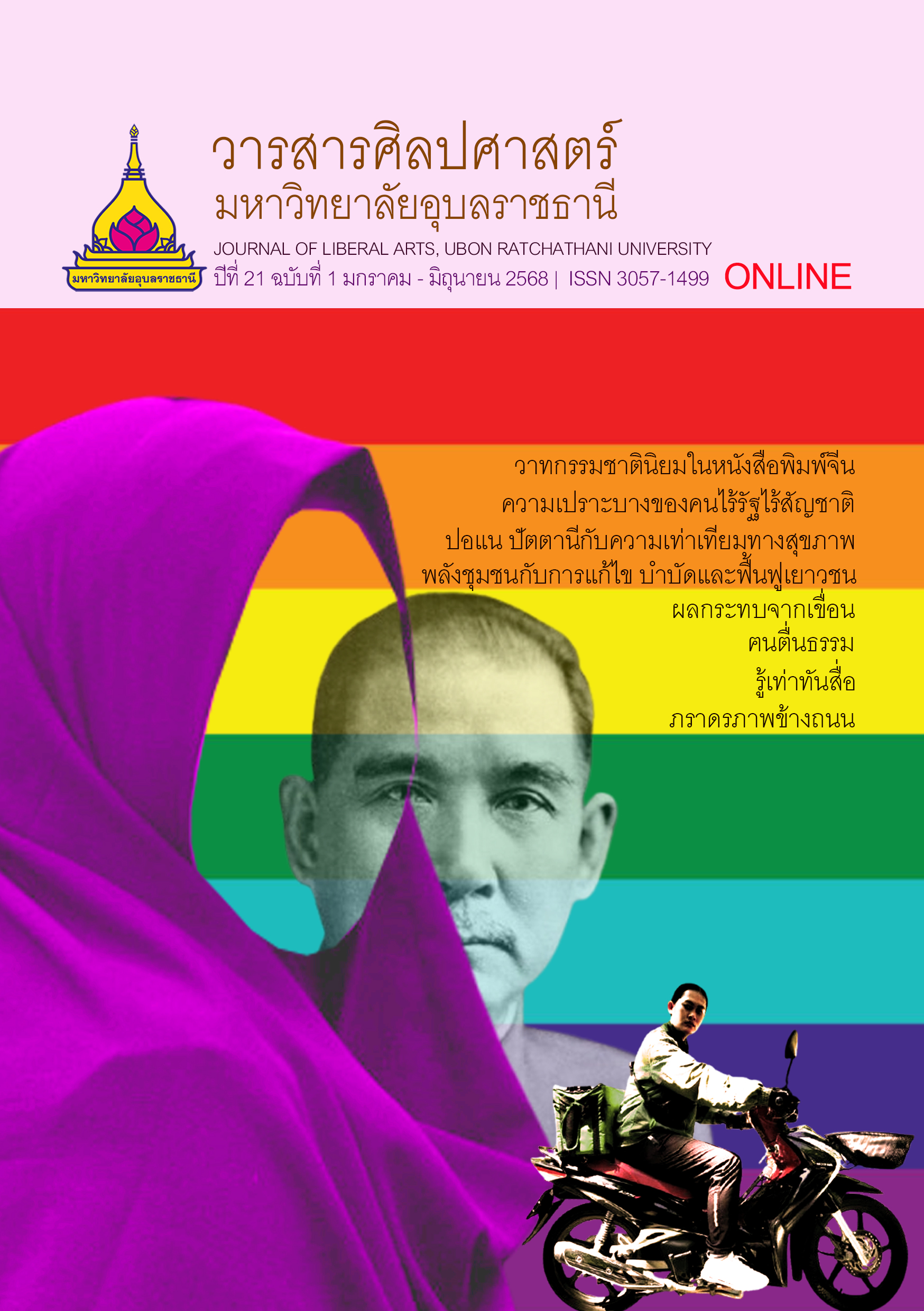
ภราดรภาพข้างถนน: ที่มาและข้อจำกัดการกระทำรวมหมู่ ของแรงงานแพลตฟอร์มส่งอาหาร
Article Sidebar
Main Article Content
บทคัดย่อ
จากปรากฏการณ์การรวมกลุ่มและการประท้วงของแรงงานแพลตฟอร์มส่งอาหาร (ไรเดอร์) ซึ่งเกิดขึ้นแพร่หลาย บทความวิจัยนี้ต้องการตอบคำถามว่า ความเป็นหนึ่งเดียวกันของไรเดอร์เกิดขึ้นได้อย่างไร มีความสัมพันธ์กับการกระทำรวมหมู่อย่างไร และความเป็นหนึ่งเดียวกันและการกระทำรวมหมู่ของไรเดอร์มีข้อจำกัดอย่างไร บทความมีที่มาจากการวิจัยเชิงคุณภาพ ซึ่งใช้เทคนิคการเก็บข้อมูลหลายแบบ ได้แก่ การสัมภาษณ์เชิงลึก การใช้แบบสอบถาม การประชุมกลุ่มย่อย และการติดตามข้อมูลในเพจเฟสบุ๊คของกลุ่ม ไรเดอร์ การวิเคราะห์ข้อมูลใช้แนวคิดความเป็นหนึ่งเดี่ยวกันที่พัฒนาขึ้นในสายมาร์กซิสต์ บทความเสนอข้อถกเถียงว่า ความเป็นหนึ่งเดียวกันของชนชั้นแรงงาน ไม่จำเป็นต้องเกิดจากการจัดตั้งทางอุดมการณ์ของพรรคปฏิวัติหรือสหภาพแรงงานในลักษณะการปลูกฝังความคิดจากบนลงล่าง แต่สามารถเกิดขึ้นท่ามกลางการทำงานประจำวัน ดังที่การทำงานบนท้องถนนของไรเดอร์ก่อให้เกิด “ภราดรภาพข้างถนน” อย่างไรก็ตาม ความเป็นหนึ่งเดียวกันของไรเดอร์มีข้อจำกัด ทั้งข้อจำกัดเชิงปัจเจกบุคคลและข้อจำกัดเชิงโครงสร้าง บทความเสนอให้วงวิชาการแรงงานศึกษาไทย ให้ความสำคัญกับประเด็นความเป็นหนึ่งเดียวกันมากขึ้น เพื่อจะได้แลกเปลี่ยนเรียนรู้ประเด็นที่สำคัญนี้กับวงวิชาการต่างประเทศ และเพื่อเข้าใจขบวนการเคลื่อนไหวทางสังคมของชนชั้นแรงงานไทยได้ดีขึ้น
Downloads
Article Details

อนุญาตภายใต้เงื่อนไข Creative Commons Attribution-NonCommercial-NoDerivatives 4.0 International License.
เอกสารอ้างอิง
Ativanichayapong, N. (2024a). History of the Thai labor movement to the decade of disunity, 1977–1987 A.D. In N. Ativanichayapong (Ed.), The labor movement and its social and political role: A collection of contemporary labor movement articles (pp. 1–64). [in Thai]. Bangkok: Puey Ungphakorn School of Development Studies.
Ativanichayapong, N. (2024b). Social movement trade unionism: A global debate. In N. Ativanichayapong (Ed.), The labor movement and its social and political role: A collection of contemporary labor movement articles (pp. 65–102). [in Thai]. Bangkok: Puey Ungphakorn School of Development Studies.
Atzeni, M. (2010). Workplace conflict: Mobilization and solidarity in Argentina. Palgrave Macmillan.
Atzeni, M. (2021). Workers’ organizations and the fetishism of the trade union form: Toward new pathways for research on the labour movement? Globalizations, 18(8), 1349–1362. https://doi.org/10.1080/14747731.2021.1910993
Basualdo, V., Dias, H., Herberg, M., Schmalz, S., Serrano, M., & Vandaele, K. (2021). Building workers' power in digital capitalism: Old and new labour struggles. FES.
Brown, A. (2002). Locating working-class power. In K. Hewison (Ed.), Political change in Thailand: Democracy and participation (2nd ed., pp. 163–178). Routledge.
Cant, C., & Woodcock, J. (2020). The fast food shutdown: From disorganisation to action in the service sector. Capital & Class, 44(4), 513–521. https://doi.org/10.1177/0309816820934641
Chatrakul Na Ayudhaya, S. (2012). Problems and obstacles in building strength and unity of the Thai labor movement. [in Thai]. In Ativanichayapong, N. et al. (Eds.), Labor and injustice, problems and solutions: Final research report (pp. 7–1 – 7–144). Social Research Institute, Chulalongkorn University.
Cini, L., & Goldmann, B. (2020). The worker capabilities approach: Insights from worker mobilisations in Italian logistics and food delivery. Work, Employment and Society, 35(5), 948–967.
Cini, L., Maccarrone, V., & Tassinari, A. (2021). With or without U(nions)? Understanding the diversity of gig workers’ organizing practices in Italy and the UK. European Journal of Industrial Relations, 28(3), 341–362. https://doi.org/10.1177/09596801211014674
De Stefano, V. (2016). The rise of the "just-in-time workforce": On-demand work, crowd work, and labor protection in the "gig economy." Comparative Labor Law & Policy Journal, 37(3), 471–504.
Defossez, D. (2022). The employment status of food delivery riders in Europe and the UK: Self-employed or worker? Maastricht Journal of European and Comparative Law, 29(1), 25–46. https://doi.org/10.1177/1023263X211065726
della Porta, D., et al. (2022). Mobilizing against the odds: Solidarity in action in the platform economy. Berliner Journal für Soziologie, 32(2), 213–241. https://doi.org/10.1007/s11609-022-00471-z
Fantasia, R. (1988). Cultures of solidarity: Consciousness, action, and contemporary American workers. University of California Press.
Ford, M., & Honan, V. (2019). The limits of mutual aid: Emerging forms of collectivity among app-based transport workers in Indonesia. Journal of Industrial Relations, 61(4), 528–548.
Klatookwan, N. (2013). Work and lives of female laborers in Nava Nakorn industrial zone: Time management and self-making through women’s meaning of times [Master’s thesis, Thammasat University]. [in Thai].
Kumnak, P. (2005). Everyday forms of struggle of Thai workers: A case study of a factory in Samutprakan Province [Master’s thesis, Chulalongkorn University]. [in Thai].
Lei, Y.-W. (2021). Delivering solidarity: Platform architecture and collective contention in China’s platform economy. American Sociological Review, 86(2), 279–309. https://doi.org/10.1177/0003122421996749
Maffie, M. D. (2020). The role of digital communities in organizing gig workers. Industrial Relations: A Journal of Economy and Society, 59(1), 123–149.
Marx, K. (1976). Capital: A critique of political economy (Vol. 1, B. Fowkes, Trans.). Penguin Books. (Original work published 1867)
Mieruch, Y., & McFarlane, D. (2023). Gig economy riders on social media in Thailand: Contested identities and emergent civil society organisations. Voluntas, 34, 1232–1242.
Mills, M. B. (1999). Thai women in the global labor force: Consuming desires, contested selves. Rutgers University Press.
Morgan, G., & Pulignano, V. (2020). Solidarity at work: Concepts, levels and challenges. Work, Employment and Society, 34(1), 18–34.
Panimbang, F., Arifin, S., Riyadi, S., & Septi Utami, D. (2020). Resisting exploitation by algorithms: Drivers’ contestation of app-based transport in Indonesia. Friedrich-Ebert-Stiftung.
Pangsapa, P. (2007). Textures of struggle: The emergence of resistance among garment workers in Thailand. ILR Press/Cornell University Press.
Pasquier, V., & Wood, A. (2018). The power of social media as a labour campaigning tool: Lessons from OUR Walmart and the Fight for 15. ETUI Policy Brief. European Trade Union Institute.
Polletta, F. (1999). “Free spaces” in collective action. Theory and Society, 28(1), 1–38.
Qadri, R. (2023). Algorithmized not atomized: The distributed solidarity of Jakarta's gig workers. International Journal of Communication, 17, 3899–3918.
Rocket Media Lab. (2024, January 22). In 5 years, what issues rides fight with platform. [in Thai]. https://rocketmedialab.co/rider-protest/
Schmalz, S., Ludwig, C., & Webster, E. (2018). The power resources approach: Developments and challenges. Global Labour Journal, 9(2), 113–134.
Soonthornwipart, P. (2015). The development and role of labor union in the eastern region of Thailand [Doctoral dissertation, Burapha University]. [in Thai].
Stewart, P., Shanahan, G., & Smith, M. (2020). Individualism and collectivism at work in an era of deindustrialization: Work narratives of food delivery couriers in the platform economy. Frontiers in Sociology, 5, 1–14. https://doi.org/10.3389/fsoc.2020.00034
Sun, P., & Chen, J. Y. (2021). Platform labour and contingent agency in China. China Perspectives, 2021(1), 19–27.
Taotawin, P., & Tularak, W. (2023a). Accidents and health of motorcycle drivers delivering food under the control of the platform. [in Thai]. Local Development Institute Foundation.
Tassinari, A., & Maccarrone, V. (2020). Riders on the storm: Workplace solidarity among gig economy couriers in Italy and the UK. Work, Employment and Society, 34(1), 35–54.
Teerakowitkajorn, K. (2019). Masculinized labor activism and geographies of household reproduction in Thailand’s ‘Detroit’ [Doctoral dissertation, Syracuse University].
Wantanasombat, A., & Pitaktharnin, A. (2021). Rider-hero-shackles: Working conditions and social security of food delivery workers on platform economy in the situation of COVID-19 epidemic. [in Thai]. Institute of Asian Studies, Chulalongkorn University.
Woodcock, J., & Cant, C. (2022). Platform worker organising at Deliveroo in the UK: From wildcat strikes to building power. Journal of Labor and Society, 25(2), 220–236. https://doi.org/10.1163/24714607-bja10041
