
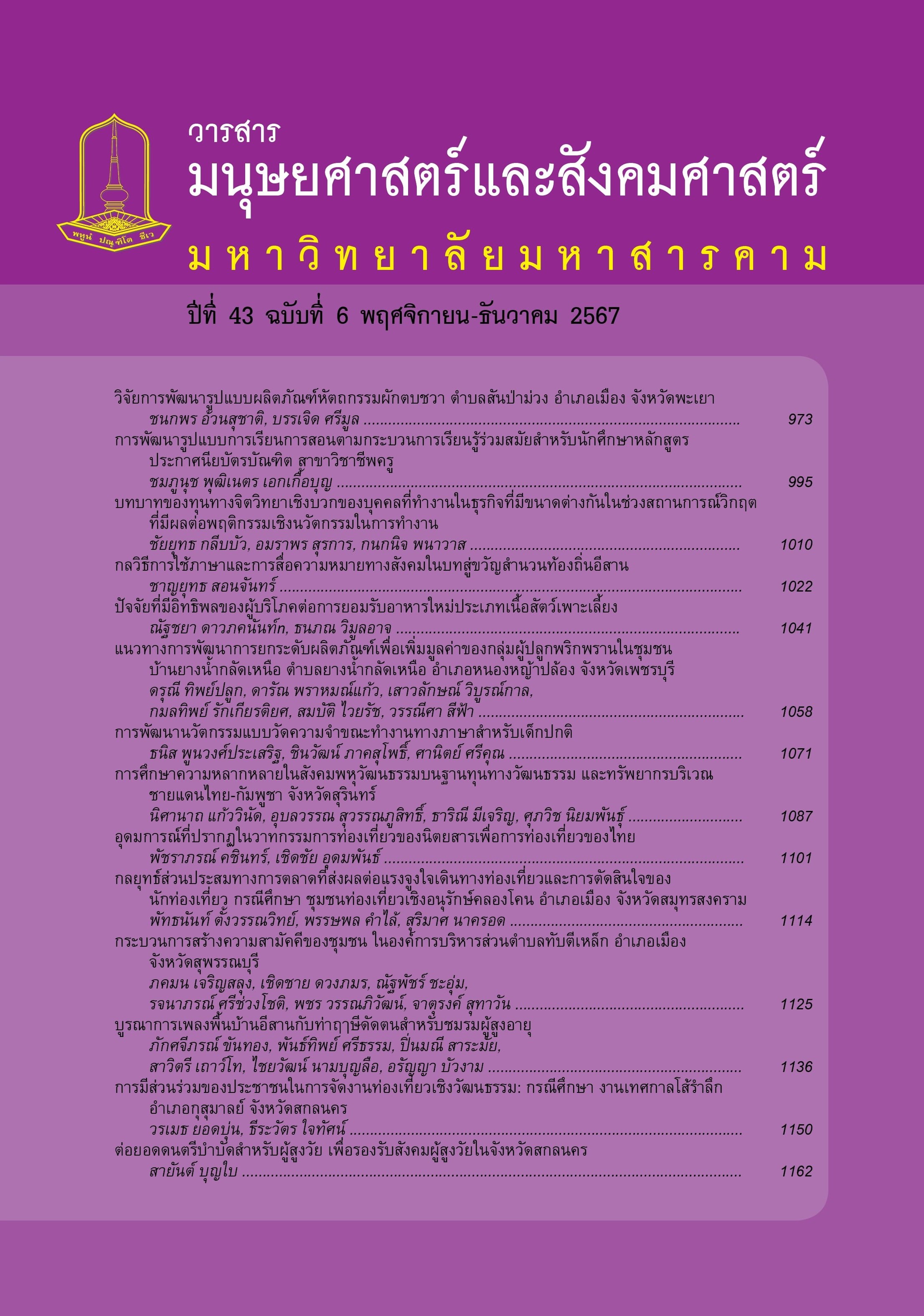
การพัฒนานวัตกรรมแบบวัดความจำขณะทำงานทางภาษาสำหรับเด็กปกติ The Developments of The Verbal Working Memory Innovation Test for Healthy Children
Article Sidebar
Main Article Content
บทคัดย่อ
การวิจัยนี้มีวัตถุประสงค์ (1) เพื่อพัฒนานวัตกรรมแบบวัดความจำขณะทำงานทางภาษาสำหรับเด็กปกติ โดยใช้รูปแบบการวิจัยเชิงพัฒนา (2) เพื่อทดลองใช้นวัตกรรมแบบวัดความจำขณะทำงานทางภาษาสำหรับเด็กปกติ ดำเนินการเก็บข้อมูลจากแบบวัดความจำและแบบประเมินความพึงพอใจในการทดลองใช้นวัตกรรม แบบวัดความจำประกอบด้วยแบบทดสอบจำนวน 4 แบบทดสอบ ได้แก่ แบบวัดฟังเสียงประโยค แบบวัดการอ่านประโยค แบบวัดการฟังคำสุดท้ายของประโยค แบบวัดการจำตัวอักษรเดี่ยวหลังการบวกลบเลข แต่ละแบบทดสอบมีสิ่งเร้าเป็นเสียงของประโยค ข้อความ ตัวอักษร และภาพแสดงปัญหาทางคณิตศาสตร์ ซึ่งวัดได้ทั้งมิติความถูกต้องและมิติเวลา กลุ่มตัวอย่างคือนักเรียนชั้นมัธยมศึกษาตอนต้นอายุระหว่าง 13-15 ปี จำนวน 127 คน ซึ่งได้มาโดยการเลือกตัวอย่างแบบเจาะจง ผลการศึกษาพบว่า (1) นวัตกรรมแบบวัดความจำขณะทำงานทางภาษามีความตรงเชิงเนื้อหา (2) คะแนนเฉลี่ยของแบบทดสอบคือ 27.30, 26.70, 28.21 และ 29.03 ส่วนเวลาเฉลี่ยในแต่ละแบบทดสอบคือ 251.23, 194.28, 349.29 และ 403.54 วินาที กลุ่มตัวอย่างมีความพึงพอใจในการทดลองใช้นวัตกรรมอยู่ในระดับพึงพอใจมากที่สุด
Article Details
เอกสารอ้างอิง
ชินวัฒน์ ภาคสุโพธิ์ และศานิตย์ ศรีคุณ. (2566). การพัฒนานวัตกรรมแบบวัดความจำผัสสะด้านการได้ยิน สำหรับเด็กปกติ. วารสารศึกษาศาสตร์ มหาวิทยาลัยขอนแก่น, 46(1), 92-103.
ทัศนีย์ บุญเติม, จตุภูมิ เขตจัตุรัส, จักรกฤษณ์ สําราญใจ, จุติมา เมทนีธร, จินตนาภรณ์ วัฒนธร, สถภาพร มัชฌิมะปุระ และคณะ. (2557). การพัฒนาเครื่องมือวัดทางพุทธิปัญญา (ฉบับภาษาไทย). กรุงเทพฯ: สํานักงานคณะกรรมการวิจัยแห่งชาติ.
ศานิตย์ ศรีคุณ และเกศราพรรณ พันธุ์ศรีเกตุ คงเจริญ (2563). การศึกษาอิทธิพลของความจำขณะทำงานที่ส่งผลต่อผลสัมฤทธิ์ทางการเรียนคณิตศาสตร์. วารสารศิลปการจัดการ, 4(1), 140-151.
ศานิตย์ ศรีคุณ. (2562). การตรวจสอบความตรงเชิงทฤษฎีของซอฟต์แวร์แบบวัดความสามารถเชิงพุทธิปัญญาในมิติความถูกต้อง. วารสารศึกษาศาสตร์ มหาวิทยาลัยขอนแก่น, 42(4), 103-117.
ศานิตย์ ศรีคุณ. (2563). การตรวจสอบความตรงเชิงโครงสร้างของซอฟต์แวร์แบบวัดความสามารถเชิงพุทธิปัญญาในมิติเวลาของนักเรียนระดับชั้นมัธยมศึกษาปีที่ 3. วารสารปัญญาภิวัฒน์, 12(3), 229 - 243.
ศานิตย์ ศรีคุณ. (2564). การศึกษาอิทธิพลของความจําขณะทํางานที่ส่งผลต่อทักษะการแก้ปัญหาทางคณิตศาสตร์. วารสารศึกษาศาสตร์มหาวิทยาลัยขอนแก่น, 44(1), 77-88.
ศานิตย์ ศรีคุณ. (2567). ประสาทวิทยาการศึกษา: ความหมาย ขอบข่าย และเทคโนโลยีภาพถ่ายทางประสาท. วารสารมนุษย์ศาสตร์และสังคมศาสตร์ มหาวิทยาลัยพะเยา, 12(1), (กำลังตีพิมพ์)
สถิต วงศ์สวรรค์ (2525). จิตวิทยาการศึกษา. กรุงเทพฯ: สำนักพิมพ์บำรุงสาส์น.
อุบลรัตน์ เพ็งสถิตย์. (2535). ความจำของมนุษย์. กรุงเทพฯ: มหาวิทยาลัยรามคำแหง.
Baddeley, A. D., & Hitch, G. J. (1974). Working Memory. In G. A. Bower (Ed.), Recent Advances in
Learning and Motivation (pp. 47-89). New York: Academic Press.
Bower, G. H. & Hilgard, E. R. (1981). Theories of learning (5th ed). New Jersey: Prentice Hall.
Fellman, D., Lincke, A., & Jonsson, B. (2020). Do Individual Differences in Cognition and Personality
Predict Retrieval Practice Activities on MOOCs?. Frontiers in Psychology, 11, 1-10
Gao, Y. (2016). The Influence of Working Memory on Second Language Learning. Theory and Practice
in Language Studies, 6(9), 1819-1826
Isaki, E., Spaulding T. J., & Plante E. (2008). Contributions of language and memory demands to
verbal memory performance in language-learning disabilities. Journal of Communication
Disorders, 41(6), 512 - 530.
Passolunghi, M. C., & Siegel, L, S. (2001). Short-Term Memory, Working Memory, and Inhibitory
Control in Children with Difficulties in Arithmetic Problem Solving. Journal of Experimental
Child Psychology, 80(1), 44-57.
Pazzaglia, F., Toso, C., & Cacciamani, S. (2008). The specific involvement of verbal and visuospatial
working memory in hypermedia learning. British Journal of Educational Technology, 39(1),
-124.
Shelton, J. T., Elliott, E. M., Hill, B.D., Calamia, M. R., & Gouvier, W. D. (2009). A comparison of
laboratory and clinical working memory tests and their prediction of fluid intelligence.
Intelligence, 37(3), 283-293.
Sweatt J. D. (2003). Mechanisms of Memory: Introduction the Basic of Psychological Learning and
Memory Theory. United Kingdom: Elsevier.
Van der Elst, W., Van Boxtel, M. P.J., Van Breukelen, J. J.P., & Jolles, J. (2007). Assessment of
information processing in working memory in applied settings: The paper & pencil memory
scanning test. Psychological Medicine, (37)9, 1335-1344.
Vock, M., & Holling, H. (2008). The measurement of visuo–spatial and verbal–numerical working
memory: Development of IRT-based scales. Intelligence, 36(2), 161-182.
Wiley, J & Jarosz, A. F. (2012). Chapter Six - How Working Memory Capacity Affects Problem Solving.
Psychology of Learning and Motivation, 56, 185-227.