
INTEGRATION OF BUDDHIST MINDFULNESS PSYCHOLOGY TO DEVELOP THE MENTAL POTENTIAL OF VOLUNTEER CAREGIVERS FOR THE ELDERLY IN RAI KHING URBAN COMMUNITY, NAKHON PATHOM PROVINCE
Article Sidebar
Main Article Content
Abstract
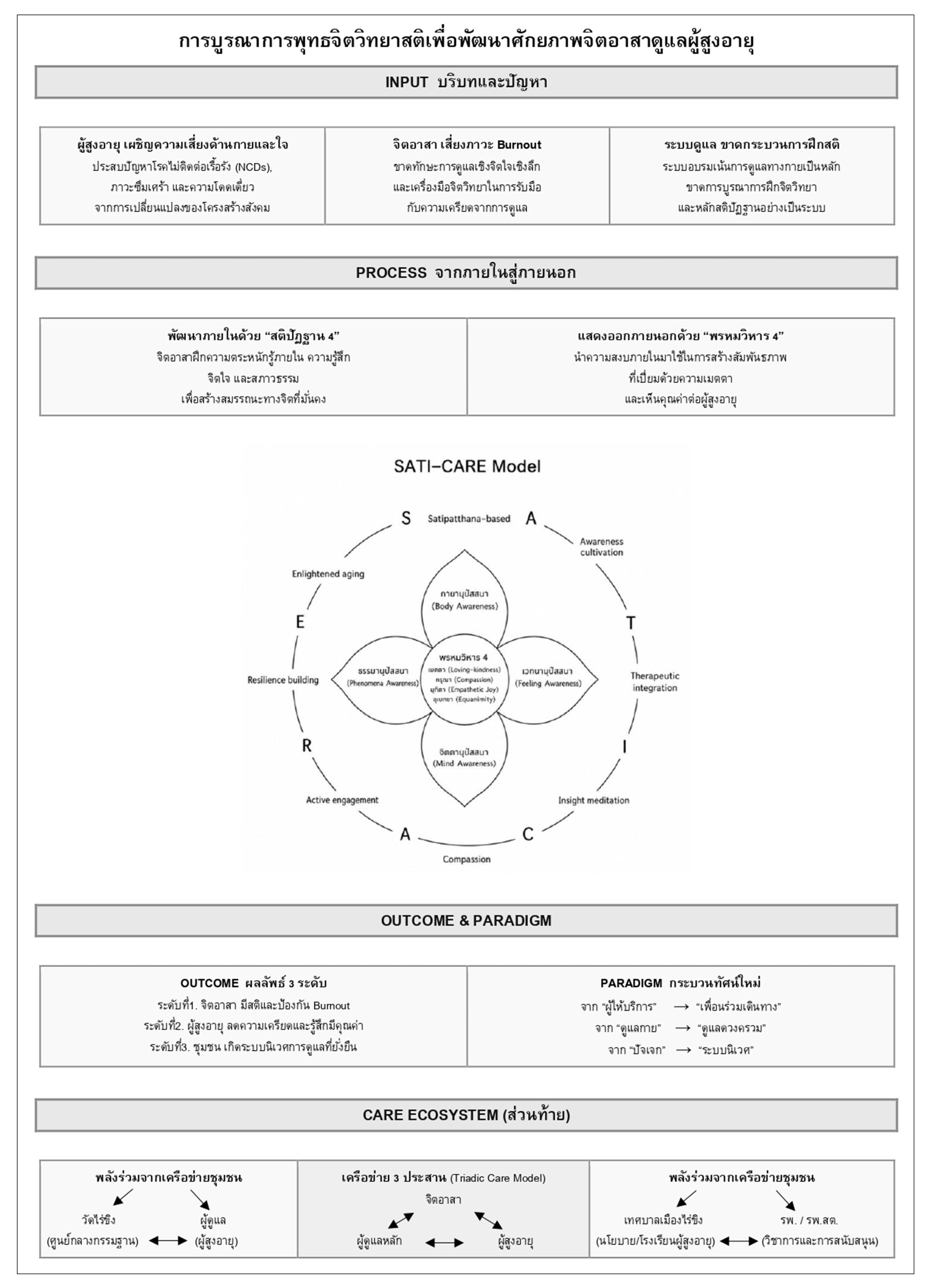
This study aimed to 1) examine the integration of Buddhist mindfulness psychology to develop the potential of volunteer caregivers for the elderly in Rai Khing Urban Community, Nakhon Pathom Province; 2) develop a knowledge package for volunteer caregivers capacity grounded in Buddhist mindfulness psychology; and 3) implement the integrated approach within the Rai Khing Urban Community. A qualitative research design was employed to investigate Buddhist mindfulness psychology and its integration into the development of volunteer caregivers, with the aim of creating a practical framework that is both accessible and applicable to volunteers caregivers providing care for elderly people. Data were collected from 20 key informants drawn from four groups volunteer caregivers, community-dwelling elderly, community leaders and local government officials, and representatives of relevant organizations. Data were collected through in-depth interviews, focus group discussions, and documentary analysis and were analyzed using content analysis in accordance with the research objectives. The findings revealed that 1) the integration of the Four Foundations of Mindfulness (Satipatthana 4) which serve as a mechanism for developing the internal competency of volunteer caregivers, with the Four Divine Abodes (Brahmavihara 4), which constitute the virtuous core guiding volunteer–elderly relationships, together with contemporary mindfulness psychology, was appropriate for the social and cultural context of Rai Khing Urban Community, 2) a knowledge package entitled “Buddhist Mindfulness Psychology for Elderly Care Using the SATI-CARE MODEL”, was developed. The model was employed a four-petalled lotus as its symbol, in which each petal represents one of the Four Foundations of Mindfulness and the central core represents the Four Divine Abodes. The package comprised a two-day practical training programme structured around seven core topics covering meditation and mindfulness in daily life, awareness of feelings and mental states, the cultivation of loving-kindness and forgiveness, the development of psychological resilience, and application of these principles to the elderly care; and 3) following the implementation of the knowledge package, volunteer caregivers demonstrated clear improvements in mindfulness, interpersonal relationships, and compassionate ways of living, as evidenced by the evaluation result and informants’ reflections. This research presents the SATI-CARE MODEL as an innovative model grounded in Buddhist philosophy and supported by empirical evidence, with strong potential for sustainable replication across other Buddhist communities.
Downloads
Article Details
References
ณภิตา พุทธรักษา. (2567). โมเดลสมการโครงสร้างพุทธานุสสติในการพัฒนาคุณภาพชีวิตตามแนวพุทธจิตวิทยา. [ดุษฎีนิพนธ์ปริญญาพุทธศาสตรดุษฎีบัณฑิต, มหาวิทยาลัยมหาจุฬาลงกรณราชวิทยาลัย]. https://e-thesis.mcu.ac.th/thesis/5134
ณัฐชยานันทน์ ทองสาริ. (2565). รูปแบบการเสริมสร้างสติและการเห็นคุณค่าในตนเองเพื่อความสุขของผู้สูงอายุในสังคมไทย. [ดุษฎีนิพนธ์ปริญญาพุทธศาสตรดุษฎีบัณฑิต, มหาวิทยาลัยมหาจุฬาลงกรณราชวิทยาลัย]. https://e-thesis.mcu.ac.th/thesis/5216
นนทิวัต ไล้เลิศ. (2564). การเสริมสร้างความสุขในบริบทของการปฏิบัติธรรมตามแนวมหาสติปัฏฐานสูตร. [ดุษฎีนิพนธ์ปริญญาพุทธศาสตรดุษฎีบัณฑิต, มหาวิทยาลัยมหาจุฬาลงกรณราชวิทยาลัย]. https://e-thesis.mcu.ac.th/items/2387.
ป้าสมศรี นามสมมติ. (2569, 18 เมษายน). ผู้สูงอายุในชุมชนเมืองไร่ขิง จังหวัดนครปฐม. สัมภาษณ์.
พระครูปลัดสุวัฒนพุทธคุณ (ประมวน พานิช). (2566). การศึกษาวิเคราะห์พุทธญาณวิทยาในสติปัฏฐาน 4. [ดุษฎีนิพนธ์ปริญญาพุทธศาสตรดุษฎีบัณฑิต, มหาวิทยาลัยมหาจุฬาลงกรณราชวิทยาลัย วิทยาเขตขอนแก่น]. https://e-thesis.mcu.ac.th/thesis/260
ริญญารัตน์ วรจินตนาลักษณ์. (2565). โปรแกรมส่งเสริมสุขภาพผู้สูงอายุที่อาศัยอยู่ตามลำพังตามหลักพุทธจิตวิทยา. [ดุษฎีนิพนธ์ปริญญาพุทธศาสตรดุษฎีบัณฑิต, มหาวิทยาลัยมหาจุฬาลงกรณราชวิทยาลัย]. https://e-thesis.mcu.ac.th/thesis/7758
วิชัย เอกพลากร, ขวัญใจ วงศ์กิตติรักษ์, นพวรรณ เปียซื่อ, วิชช์ เกษมทรัพย์, อำนาจ ศรีรัตนบัลล์, และศรีเพ็ญ ตันติเวสส. (2564). รายงานการสำรวจสุขภาพประชาชนไทยโดยการตรวจร่างกาย ครั้งที่ 6 พ.ศ. 2562–2563. สถาบันวิจัยระบบสาธารณสุข.
สมเด็จพระพุทธโฆษาจารย์ (ป. อ. ปยุตฺโต). (2560). ถ้าสูงอายุเป็น ก็น่าจะเป็นผู้สูงอายุ. สำนักพิมพ์ผลิธัมม์.
สำนักงานสถิติแห่งชาติ. (2567). การสำรวจประชากรสูงอายุในประเทศไทย พ.ศ. 2567. สำนักงานสถิติแห่งชาติ.
Carstensen, L. L. (2021). Socioemotional Selectivity Theory: The Role of Perceived Endings in Human Motivation. The Gerontologist, 61(8), 1188 – 1196. doi: https://doi.org/10.1093/geront/gnab116
Erikson, E. H. (1998). The Life Cycle Completed (extended ed.). W. W. Norton & Company.
Gilbert, P. (2009). The Compassionate Mind: A New Approach to Life's Challenges. Constable and Robinson.
Kabat-Zinn, J. (2013). Full Catastrophe Living: Using the Wisdom of Your Body and Mind to Face Stress, Pain, and Illness (Rev. ed.). Bantam Books.
Kelly, B. D. (2023). Beyond Mindfulness: Buddhist Psychology and the Abhidharma. Journal of Spirituality in Mental Health, 25(1), 71 – 82. doi: https://doi.org/10.1080/19349637.2021.1980083
Langgapin, S., Boonchieng, W., Chautrakarn, S. & Maneeton, N. (2024). Senior Mental Health Scenarios in Thai Buddhist Contexts: A Qualitative Study. Religions, 15(4), 440. doi: https://doi.org/10.3390/rel15040440
Lincoln, Y. S. & Guba, E. G. (1985). Naturalistic Inquiry. SAGE Publications.
Peltzer, K. (2025). Religiosity and Mental and Behavioural Health Among Community-Dwelling Middle-Aged and Older Adults in Thailand: Results of a Longitudinal National Survey in 2015–2020. Journal of Religion and Health, 64(3), 2053 – 2068. doi: https://doi.org/10.1007/s10943-025-02280-z.
United Nations. (2023). World Social Report 2023: Leaving No One Behind in an Ageing World. Department of Economic and Social Affairs, United Nations.
Whitebird, R. R., Kreitzer, M., Crain, A. L., Lewis, B. A., Hanson, L. R. & Enstad, C. J. (2013). Mindfulness-based Stress Reduction for Family Caregivers: A Randomized Controlled Trial. The Gerontologist, 53(4), 676 – 686. doi: https://doi.org/10.1093/geront/gns126
WHO. (2022). Working for Health 2022-2030 Action Plan. World Health Organization (WHO).
