
POST-HUMANISM AND INNOCENCE
Article Sidebar
Main Article Content
Abstract
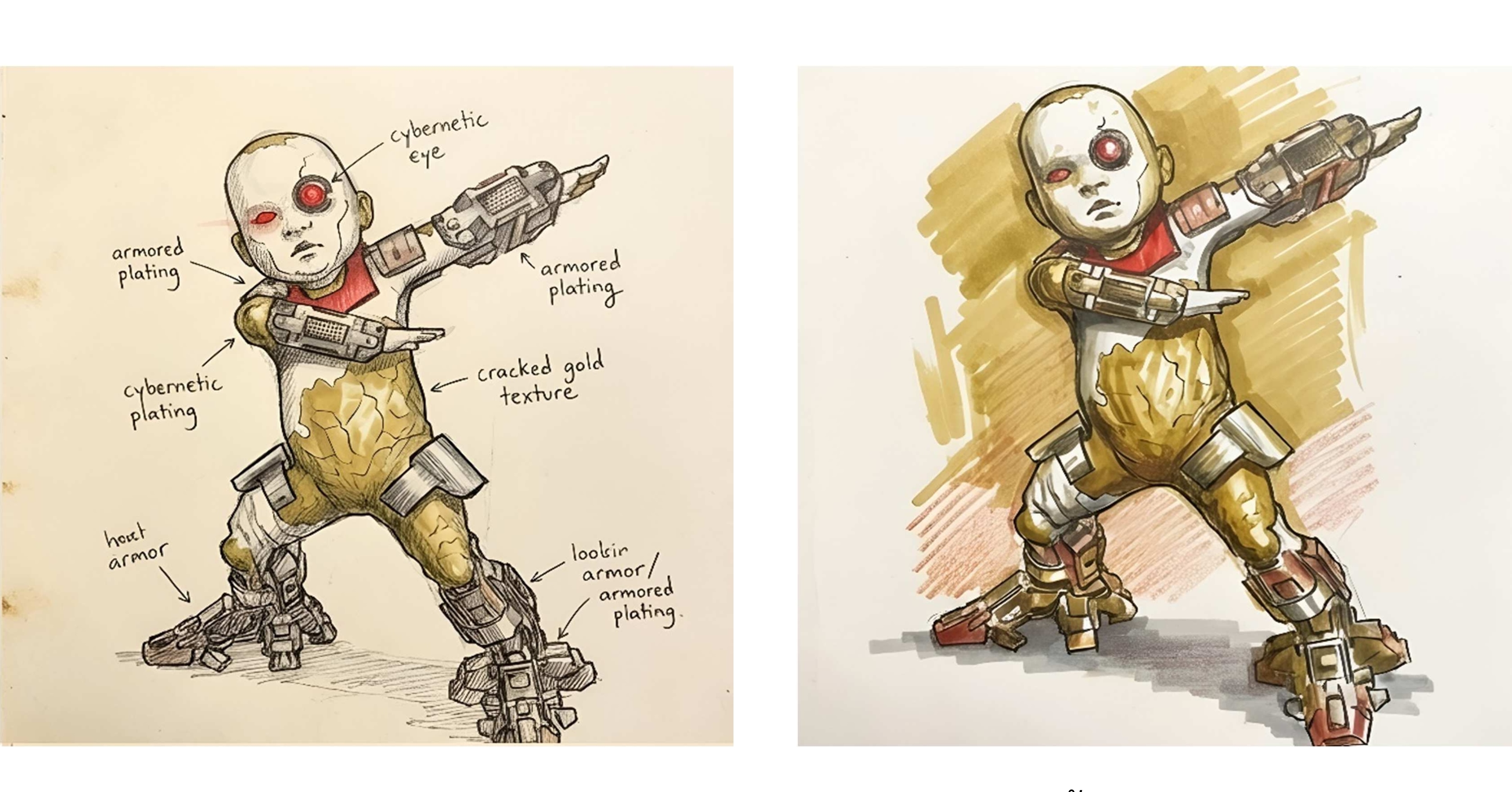
This creative research aimed to explore and design a 3D digital character that embodies the fusion of childhood innocence and technological evolution in the digital era, employing the concepts of Post-humanism and the philosophy of Kintsugi as the principal interpretive frameworks. The researcher used the physical characteristics and gestures of his son as the primary creative model and executed through an advanced digital sculpting workflow, including high-poly sculpting in ZBrush, hard surface mechanical design in Blender, and metaphorical PBR texturing in Substance Painter. The creative process resulted that the character design entitled “Post-humanism and Innocence”, which successfully conveys an aesthetic paradox with unity. The “Dabbing” pose, derived from real-life reference, represents age-appropriate joy, yet is encased in industrial cybernetic armor and a red emissive eye to symbolize adaptation in a future world. The deliberate selection of white ceramic textures combined with "Cracked Gold" reinforces the concept of precious fragility and the restoration of the human spirit amidst mechanical rigidity. Rather than functioning solely as a character designed for entertainment, this work serves as a medium for recording personal emotions and reflecting on the dynamics of the family institution within contemporary technological society.
Downloads
Article Details
References
Barthes, R. (1957). Mythologies. Editions du Seuil.
Baudrillard, J. (1981). Simulacra and Simulation. University of Michigan Press.
Braidotti, R. (2013). The Posthuman. Polity Press.
Giger, H. R. (1977). Necronomicon. Sphinx Verlag.
Gokudabbing, 2016 Do the Dab. สืบค้นเมื่อวันที่ 1 กุมภาพันธ์ 2569 จาก https://en.wikipedia.org/wiki/Dab_(dance)#/media/File:Do_the_Dab.jpg
Haraway, D. (1985). A cyborg Manifesto: Science, Technology, and Socialist-feminism in the Late Twentieth Century. Socialist Review /Routledge.
Manovich, L. (2013). Software Takes Command. Bloomsbury Academic.
Oshii, M. (Director). (1995). Ghost in the Shell. [Film]. Production I.G.
Tanizaki, J. (1933). In Praise of Shadows. Leete's Island Books.

#/media/File:Do_the_Dab.jpg)