
STRATEGIES FOR ENHANCING DIGITAL GOVERNMENT PLATFORM BASED ON THE SMART CITY CONCEPT FOR SUBDISTRICT ADMINISTRATIVE ORGANIZATIONS IN CHIANG RAI PROVINCE
Article Sidebar
Main Article Content
Abstract
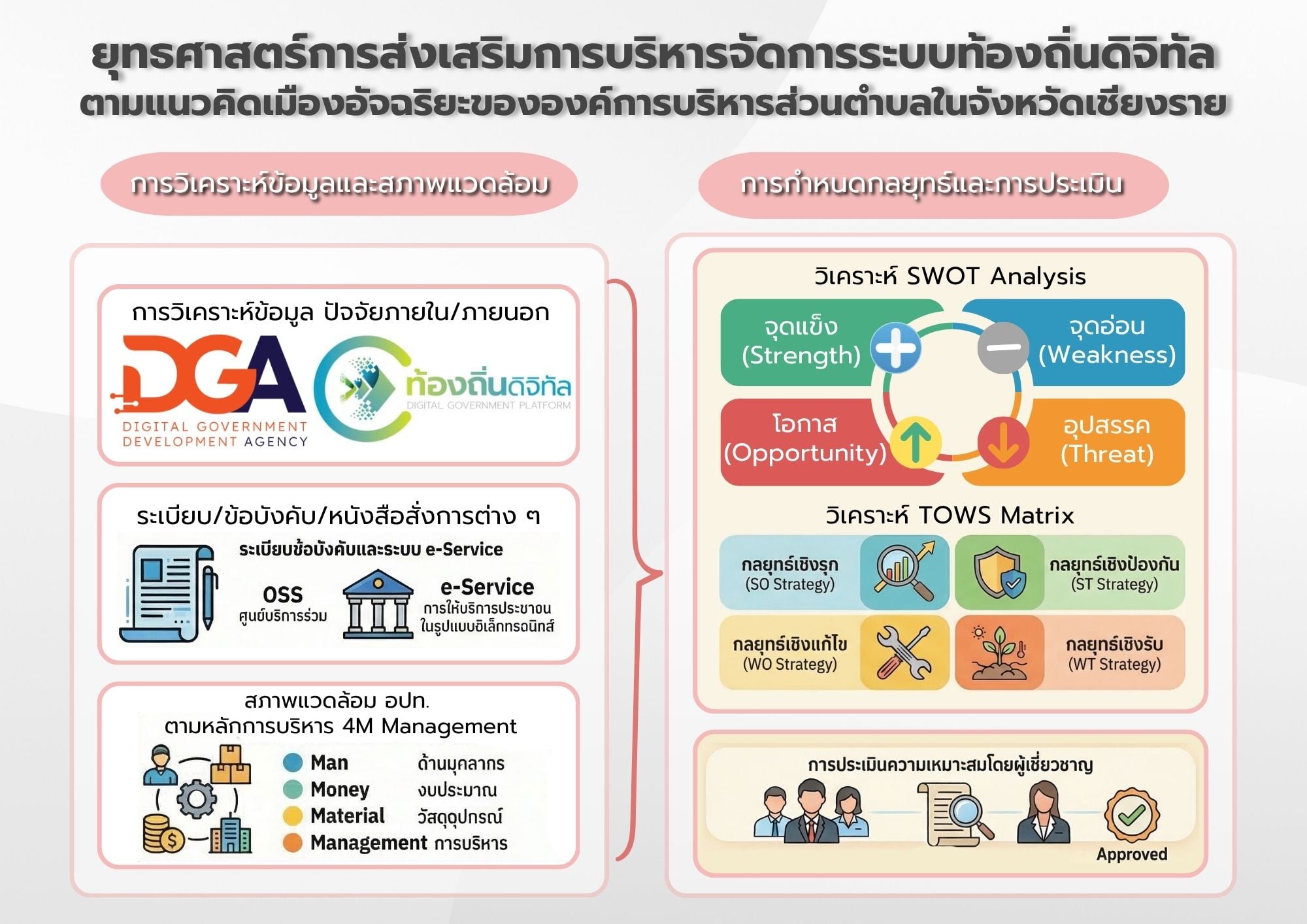
This research aims to 1) study the organizational environment of Subdistrict Administrative Organizations in Chiang Rai Province for implementing the Digital Government Platform 2) assess the consistency of the draft Strategies for enhancing the Digital Government Platform based on the Smart City concept for Subdistrict Administrative Organizations in Chiang Rai Province and 3) evaluate the appropriateness of the Strategies for enhancing the Digital Government Platform based on the Smart City concept for Subdistrict Administrative Organizations in Chiang Rai Province. This research employed a mixed-methods design, collecting data from local administrative organizations in Chiang Rai Province. Data were collected using questionnaires from 70 Subdistrict Administrative Organizations in Chiang Rai Province, targeting agency executives, relevant agency personnel, and agency administrators. Quantitative data were analyzed using mean and standard deviation. In addition, the consistency of the draft strategies was assessed using evaluation forms completed by executives of 6 local government organizations in Chiang Rai Province. Qualitative data were collected from organizations, implementing the Digital Government Platform and were analyzed using content analysis, descriptive statistics, SWOT analysis and TOWS matrix. The appropriateness of the strategies was evaluated using assessment forms complete by executives from 6 local government organizations and 3 strategy experts.
The study results found that 1) the assessment of the environment of local government organizations in Chiang Rai Province for adopting the Digital Government Platform was at a high level overall 2) the draft strategies for enhancing Digital Government Platform based on the Smart City concept for Subdistrict Administrative Organizations in Chiang Rai Province, consisted of 1 strategy, 4 main strategies, 16 sub-strategies. The results of the evaluation of the overall consistency of the draft strategy rated at a very appropriate level and 3) The results of the assessment of the suitability of the strategies for enhancing Digital Government Platform based on the Smart City concept for Subdistrict Administrative Organizations in Chiang Rai Province was rate at the highest level overall.
Downloads
Article Details
References
คณะกรรมการบริหารงานจังหวัดแบบบูรณาการจังหวัดเชียงราย. (2566). แผนพัฒนาจังหวัดเชียงราย (พ.ศ. 2566 - 2570). สำนักงานจังหวัดเชียงราย ศาลากลางจังหวัดเชียงราย.
ณัชชา โคตะ. (2564). Smart Governance ในไทย. สืบค้นเมื่อวันที่ 5 มีนาคม 2567 จาก https://www.depa.or.th/th/article-view/smart-governance
ดวงสมร สุทธิวงศ์กูล. (2562). การพัฒนาทักษะดิจิทัลของบุคลากรภาครัฐไทยสู่การเป็นรัฐบาลดิจิทัล. วารสารการเมืองการบริหารและกฎหมาย, 13(1), 197 - 216.
ธรินด์ เลิศสุขีเกษม. (2565). การปรับตัวขององค์การภาครัฐสู่รัฐบาลดิจิทัล: ศึกษากรณีการปรับตัวของกระทรวงการต่างประเทศสู่การเป็นรัฐบาลดิจิทัลตามกรอบของแผนพัฒนารัฐบาลดิจิทัลของประเทศไทย ปีพ.ศ. 2563 – 2565. [สารนิพนธ์รัฐประศาสนศาสตรมหาบัณฑิต, จุฬาลงกรณ์มหาวิทยาลัย]. https://digital.car.chula.ac.th/chulaetd/8352/
เบญจรัตน์ ภาคภูมิเจริญสุข, นวลนภา จุลสุทธิ, ทับทิม สุขพิน และประยูร อิมิวัตร์. (2567). ระบบท้องถิ่นดิจิทัลภายใต้แนวคิดการส่งเสริมเมืองอัจฉริยะขององค์กรปกครองส่วนท้องถิ่นในจังหวัดเชียงราย. วารสารสมาคมรัฐประศาสนศาสตร์แห่งประเทศไทย, 6(2), 145 – 156.
พระครูปลัดสุวัฒนพุทธิคุณ (สุเทพ) ดีเยี่ยม. (2566). การยกระดับองค์กรภาครัฐสู่ความเป็นรัฐบาลดิจิทัล. วารสารวิชาการแสงอีสาน, 20(1), 122 – 136.
ราชกิจจานุเบกษา. (2565). แผนพัฒนาเศรษฐกิจและสังคมแห่งชาติ ฉบับที่ 13 พ.ศ. 2566 - 2570. เล่มที่ 139 ตอนพิเศษ 258 ง. 1. 1 พฤศจิกายน 2565.
ราชกิจจานุเบกษา. (2566). กฎหมายแผนแม่บทภายใต้ยุทธศาสตร์ชาติ 20 ปี (พ.ศ. 2566 - 2580) (ฉบับแก้ไขเพิ่มเติม). เล่มที่ 140 ตอนพิเศษ 51 ง. 4. 7 มีนาคม 2566.
วัฒนพล ชุมเพชร. (2560). การพัฒนาระบบสารสนเทศเพื่อการร้องเรียนและติดตามปัญหาจากประชาชนในท้องถิ่นสู่ภาครัฐ. วารสารศรีปทุมปริทัศน์ ฉบับวิทยาศาสตร์และเทคโนโลยี, 9(1), 106 – 117.
สุภาภรณ์ สีสุพรรณ์ และอจิรภาส์ เพียรขุนทด. (2565). การปรับตัวเพื่อเข้าสู่การเปลี่ยนแปลงเป็นองค์กรดิจิทัลขององค์กรปกครองส่วนท้องถิ่นในเขตอำเภอเมือง จังหวัดขอนแก่น. Journal of Roi Kaensarn Academi, 7(8), 246 - 264.
สุภารัตน์ แก้ววิสูตร และจักรกฤษณ์ นรนิติผดุงการ. (2566). การปรับเปลี่ยนจากรัฐบาลอิเล็กทรอนิกส์สู่การเป็นรัฐบาลดิจิทัล : กรณีศึกษา กรมสรรพากรกรมการขนส่งทางบก และกรมทางหลวงชนบท. วารสารวิทยาการจัดการ มหาวิทยาลัยราชภัฏนครปฐม, 10(1), 257 – 266.
อัครวินท์ ศาสนพิทักษ์. (2564). เมืองอัจฉริยะ: การสังเคราะห์ความหมาย. วารสารวิชาการวิทยาลัยบริหารศาสตร์ มหาวิทยาลัยแม่โจ้, 5(1), 126 – 141.
Kosorukov, A. A. (2017). Digital Government Model: Theory and Practice of Modern Public Administration. Journal of Legal, Ethnical and Regulatory Issue, 20(3), 1 – 10.
Khan, M. K. (2022). Technology and Telecommunications a Panacea in the COVID-19 Crisis. Telecommunication Systems. Telecommunication Systems, 79, 1 – 2. doi: https://doi.org/10.1007/s11235-022-00880-8
Krejcie, R. V. & Morgan, D. W. (1970). Determining Sample Size for Research Activities. Educational and Psychological Measurement, 30(3), 607 – 610. doi: https://doi.org/10.1177/001316447003000308
