
MOBILIZING SOCIAL SAFETY NETS TOWARDS INTEGRATED WELFARE: A CASE STUDY OF PATTANI PROVINCE
Article Sidebar
Main Article Content
Abstract
This research aimed to examine the mobilizing social safety network toward inclusive welfare in Pattani Province, employing a participatory action research approach within a research and development framework, alongside a mixed-methods design. The research instruments consisted of 1) a poverty household survey, 2) a CIPPEST model evaluation form, 3) semi-structured interviews, and 4) focus group discussion guides. The study involved 250 TPMAP-registered poor households and 38 purposively selected stakeholders involved in welfare mobilization. Quantitative data were analyzed using frequency, percentage, and mean, while qualitative data were analyzed through content analysis.
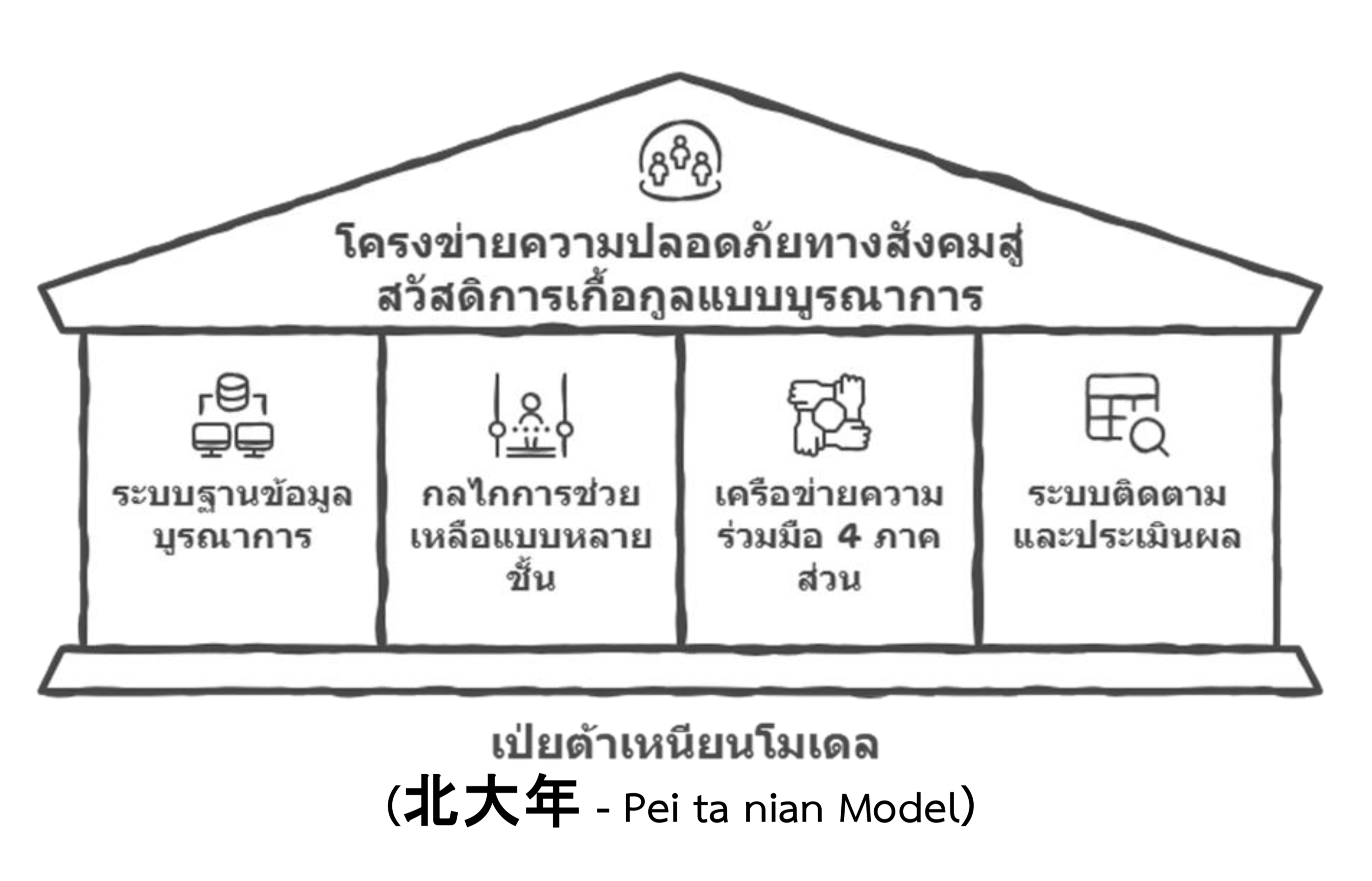
The findings revealed that 1) the social safety net system is shaped by local socio-cultural contexts, encompassing social services, social welfare, social security, and assistance from both private and community sectors. However, significant gaps in access were observed, with only 12.4% of informal workers covered by social security, and 23% of poor households remained incorrectly registered. Marked urban-rural disparities were also evident in education and health services. 2) Welfare provision in Pattani is characterized by diverse sources including state, communities, and religious organizations. Although the state welfare card scheme reached 78.5% of eligible households, over 60% of recipients reported that the support for basic was insufficient living. Community and religious-based welfare systems remained robust, with the Tokeh mutual assistance system active in 73% of communities and 92% of mosques organizing annual assistant programs. 3) Efforts to integrate policies across agencies were evident, however public participation remained limited and resource distribution unequal. The pilot application of the "Pei Ta Nian Model" improved service accessibility and beneficiary satisfaction, indicating its potential for building a sustainable social welfare system in the Southern border context.
Downloads
Article Details
References
กรมพัฒนาสังคมและสวัสดิการ. (2564). รายงานผลการดำเนินงานด้านสวัสดิการสังคม ปี 2564. กรมพัฒนาสังคมและสวัสดิการ กระทรวงพัฒนาสังคมและความมั่นคงของมนุษย์.
จิรัชยา เจียวก๊ก และนวพล แก้วสุวรรณ. (2565). ความยากจนแรงผลักสู่การเป็นชุมชนสวัสดิการ. วารสารวิชาการเครือข่ายบัณฑิตศึกษามหาวิทยาลัยราชภัฏภาคเหนือ, 12(1), 1 - 16.
จิรัชยา เจียวก๊ก. (2568). เทคนิคการพัฒนาชุมชน. ฝ่ายเทคโนโลยีทางการศึกษา สำนักวิทยบริการ มหาวิทยาลัยสงขลานครินทร์.
ฉัตรเกษม ดาศรี. (2566). โครงข่ายการคุ้มครองทางสังคม: โอกาสและความท้าทายของไทยในศตวรรษที่ 21. วารสารวิชาการมหาวิทยาลัยราชภัฏสุรินทร์, 18(6), 1 – 14.
ณรงค์ เพ็ชรประเสริฐ. (2544). โครงข่ายความปลอดภัยทางสังคม (Social Safety Net) เพื่อคนจนและคนด้อยโอกาสในสังคม. วารสารวิจัยสังคม, 24(1), 1 – 45.
บุญชม ศรีสะอาด. (2553). การวิจัยเบื้องต้น . พิมพ์ครั้งที่ 8. สุวีริยาสาส์น.
ทัศนีย์ พรหมไพจิตร. (2524). แนวทางการจัดสวัสดิการแก่ชาวไทยมุสลิมในจังหวัดชายแดนภาคใต้ ศึกษาเฉพาะกรณีหมู่บ้านสามยอด ตำบลโคกโพธิ์ จังหวัดปัตตานี. [วิทยานิพนธ์ปริญญาสังคมสงเคราะห์ศาสตรมหาบัณฑิต, มหาวิทยาลัยธรรมศาสตร์].
สถาบันวิจัยเพื่อการพัฒนาประเทศ. (2549). รายงานการประเมินความเสี่ยงและความเปราะบางทางสังคม: การประเมินความคุ้มครองทางสังคมในระดับองค์การและสถาบันของประเทศไทย. กระทรวงพัฒนาสังคมและความมั่นคงของมนุษย์.
สถาบันวิจัยสังคม. (2560). รายงานสถานการณ์สังคมจังหวัดชายแดนภาคใต้ ปี 2560. สถาบันวิจัยสังคม.
สมพร โกมารทัต, สุชาดา ทวีสิทธิ์ และพัฒนา วรรณแสง. (2561). วิเคราะห์การคุ้มครองทางสังคมของไทยตามเป้าหมายการพัฒนาที่ยั่งยืน. สุทธิปริทัศน์, 32(102), 211 – 222.
สำนักงานคณะกรรมการพัฒนาการเศรษฐกิจและสังคมแห่งชาติ. (2565). รายงานการประเมินสถานการณ์ความยากจนและกระจายรายได้. สำนักงานสภาพัฒนาการเศรษฐกิจและสังคมแห่งชาติ.
สุภางค์ จันทวานิช. (2554). การวิเคราะห์ข้อมูลในการวิจัยเชิงคุณภาพ. สำนักพิมพ์แห่งจุฬาลงกรณ์มหาวิทยาลัย.
อับดุลเลาะ สามะ, สุไลมาน อีซอ และฟาตีเมาะ ยีหมะ. (2563). ซากาตกับสวัสดิการสังคมในชุมชนมุสลิม. ศูนย์ศึกษาอิสลาม.
Bovaird, T. (2007). Beyond Engagement and Participation – user and Community Co-production of Public Services, Public Administration Review, 67(5), 846 - 860.
Creswell, J. W. & Plano Clark, V. L. (2018). Designing and conducting mixed methods research. 3rd edition. Sage.
Ferreira, F. H. G., Prennushi, G. & Ravallion, M. (1999). Protecting the Poor from Macroeconomics Shocks: An Agenda for Action in a Crisis and Beyond. World Bank.
Goodin, R. E., Headey, B., Muffels, R. & Dirven, H. J. (1999). The Real World of Welfare Capitalism. Cambridge University Press.
Hasan, M. (2019). The Role of Religious Institutions in Social Welfare: A Case Study of Islamic Philanthropy. Journal of Social Policy, 48(3), 567 – 585.
International Labor Organization. (2017). World Social Protection Report 2017–19: Universal Social Protection to Achieve the Sustainable Development Goals. ILO.
Kemmis, S. & McTaggart, R. (2005). Participatory Action Research: Communicative Action and the Public Sphere in N. K. Denzin & Y. S. Lincoln (eds.), The Sage Handbook of Qualitative Research. 3rd edition. Sage Publications Ltd.
Lincoln, Y. S. & Guba, E. G. (1985). Naturalistic Inquiry. Sage.
Ostrom, E. (1990). Governing the Commons: The Evolution of Institutions for Collective Action. Cambridge University Press.
Paitoonpong, S., Abe, S. & Puopongsakorn, N. (2008). The Meaning of Social Safety Nets. Journal of Asian Economics, 19(5–6), 467 – 473.
Stiglitz, J. L. (1998). Toward a New Paradigm for Development Strategies, Policies and Process. UNCTAD.
United Nations. (2018). Promoting Inclusion through Social Protection: Report on the World Social Situation 2018. United Nations.
World Bank. (2015). The State of Social Safety Nets 2015. World Bank.
World Bank. (2019). Safety nets. สืบค้นเมื่อวันที่ 4 ตุลาคม 2568 จาก https://www.worldbank.org/
Yamane, T. (1973). Statistics: An Introductory Analysis. 3rd edition. Harper and Row.
Yunus, M. & Jolis, A. (2003). Banker to the Poor: Micro-lending and the Battle Against World Poverty. PublicAffairs.
