The Motivation and Demotivation of Thai EFL Learners in Online Learning during Post-pandemic
แรงจูงใจและแรงจูงใจที่ลดลงของผู้เรียนภาษาอังกฤษในฐานะภาษาต่างประเทศชาวไทยที่เรียนออนไลน์ในยุคหลังการเกิดโรคระบาด
Keywords:
online learning, motivation, demotivation, post-pandemic education, Thai EFLAbstract
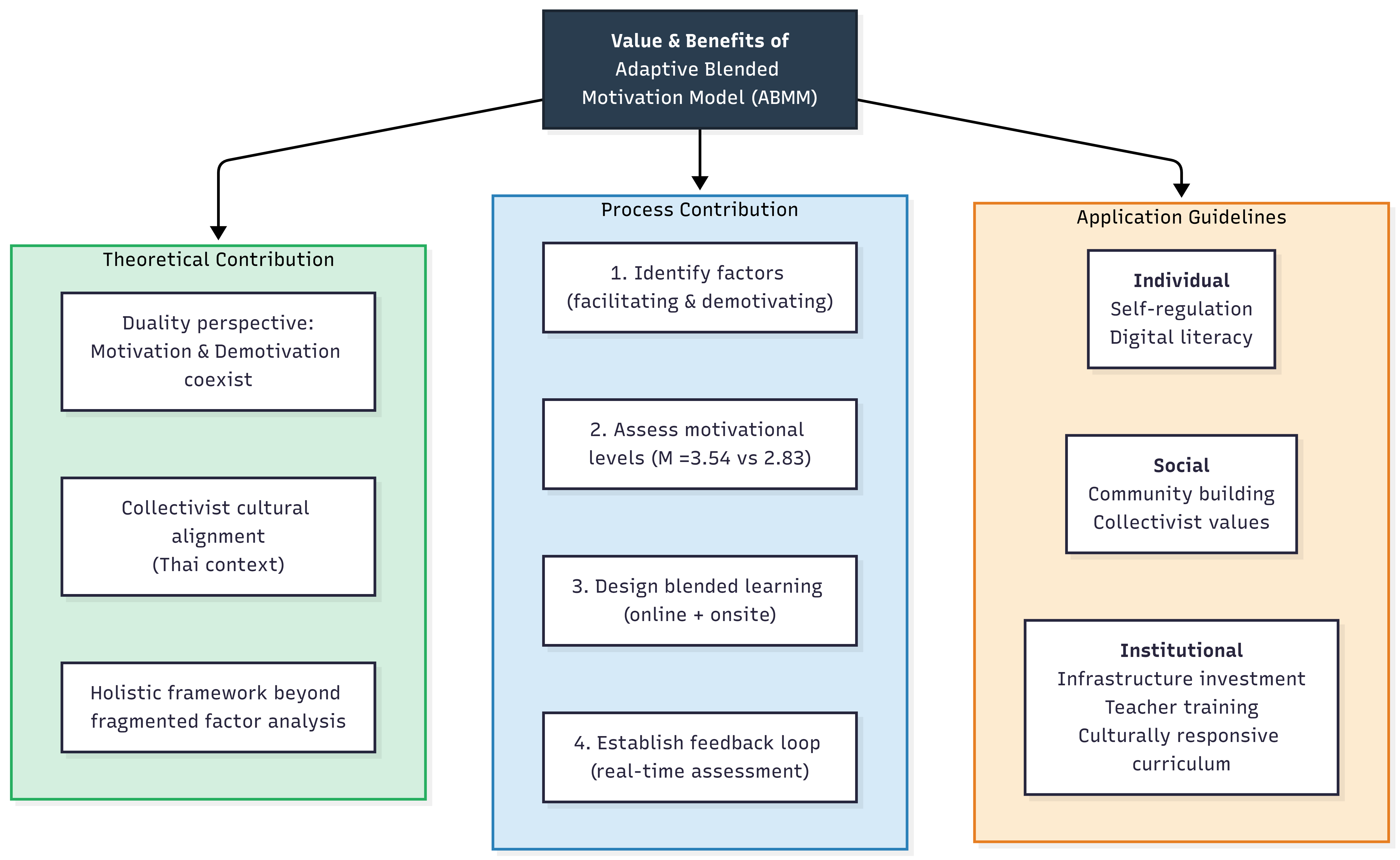
This study investigates the impact of online learning on motivation and demotivation among Thai EFL learners at a university level during the post-pandemic era. The study addresses three core objectives: (1) determining whether online learning motivated or demotivated learners, (2) identifying factors influencing these outcomes, and (3) exploring students’ perspectives on future online education. Employing a mixed-methods design, the research integrated quantitative data from 149 undergraduate students via an online questionnaire and qualitative insights from semi-structured interviews with seven participants. Results revealed moderate levels of both motivation (M = 3.54) and demotivation (M = 2.83), with motivation slightly prevailing. Key motivators included subject-related factors such as engaging class activities and diverse materials (M = 3.71, S.D. = 0.96) and teacher-related factors like supportive attitudes and innovative pedagogy (M = 3.67, S.D. = 1.02). Conversely, home environment challenges—unstable internet, limited interaction, and distractions—emerged as primary demotivators (M = 3.33, S.D. = 1.16). Qualitative findings highlighted students’ preference for blended learning models, valuing onsite interaction for skill development and online flexibility for autonomy. The study underscores the duality of online learning: while technological and pedagogical adaptability sustains engagement, socio-environmental barriers and isolation hinder holistic language acquisition. Recommendations include institutional investments in teacher training, equitable technological access, and culturally responsive curricula. By advocating for hybrid frameworks that balance flexibility with interpersonal engagement, this research contributes to post-pandemic pedagogical strategies, emphasizing the need to align digital education with Thailand’s collectivist values and global competencies.
References
Adara, R. A., & Farid, A. (2022). Investigating demotivation factors of ESP learners during COVID-19 pandemic: A mixed-method study. JEES (Journal of English Educators Society), 7(2), 210–217. https://doi.org/10.21070/jees.v7i2.1661
Ahmad, J. (2016). Technology assisted language learning is a silver bullet for enhancing language competence and performance: A case study. International Journal of Applied Linguistics and English Literature, 5(7), 118–124. http://dx.doi.org/10.7575/aiac.ijalel.v.5n.7p.118
Albalawi, F. (2018). L2 demotivation among Saudi learners of English: The role of the language learning mindsets [Doctoral dissertation, University of Nottingham].
Alyousif, R., & Alsuhaibani, Z. (2021). English language learning demotivating factors for Saudi high school EFL students. English Language Teaching, 14(8), 29–39.
Baticulon, R. E., Sy, J. J., Alberto, N. R. I., Baron, M. B. C., Mabulay, R. E. C., Rizada, L. G. T., Tiu, C. J. S., Clarion, C. A., & Reyes, J. C. B. (2021). Barriers to online learning in the time of COVID-19: A national survey of medical students in the Philippines. Medical Science Educator, 31, 615–626.
Banditvilai, C. (2016). Enhancing students’ language skills through blended learning. Electronic Journal of e-Learning, 14(3), 220-229.
Braun, V., & Clarke, V. (2006). Using thematic analysis in psychology. Qualitative Research in Psychology, 3(2), 77-101.
Çebi, A., & Güyer, T. (2020). Students’ interaction patterns in different online learning activities and their relationship with motivation, self-regulated learning strategy and learning performance. Education and Information Technologies, 25, 3979–3993.
Creswell, J. W. (2003). Research design: Qualitative, quantitative, and mixed methods approaches (2nd ed.). Sage Publications.
Dörnyei, Z. (2001). Teaching and researching motivation. Pearson Education.
Dörnyei, Z., & Ottó, I. (1998). Motivation in action: A process model of L2 motivation. Working Papers in Applied Linguistics, Thames Valley University, London, 4, 43–69.
Dörnyei, Z., & Ushioda, E. (2011). Teaching and researching motivation (2nd ed.). Longman.
Fahad, A. (2018). A comparative analysis of student motivation in online learning and mobile learning. Psychology and Education: An Interdisciplinary Journal, 55(1-2), 62–73.
Gardner, R. C. (1985). Social psychology and second language learning: The role of attitudes and motivation. Edward Arnold.
Graham, C. R. (2006). Blended learning systems: Definition, current trends, and future directions. In C. J. Bonk & C. R. Graham (Eds.), The handbook of blended learning: Global perspectives, local designs (pp. 3-21). Pfeiffer.
Hazaymeh, W. A. (2021). EFL students’ perceptions of online distance learning for enhancing English language learning during COVID-19 pandemic. International Journal of Instruction, 14(3), 501–518.
Hofstede, G. (1986). Cultural differences in teaching and learning. International Journal of Intercultural Relations, 10(3), 301-320.
Hofstede, G., & Hofstede, G. J. (2005). Cultures and organizations: Software of the mind (2nd ed.). McGraw-Hill.
Kadiresan, V., Sujin, J., Ab Rahim, H., & Rasu, F. (2021). Motivating factors influencing online learning among university students: A study of a private university in Malaysia. Journal of Social Science Studies, 8(2), 1–18.
Karaaslan, H., Kilic, N., Guven-Yalcin, G., & Gullu, A. (2018). Students’ reflections on vocabulary learning through synchronous and asynchronous games and activities. Turkish Online Journal of Distance Education, 19(3), 53-70. https://doi.org/10.17718/tojde.444640
Lincoln, Y. S., & Guba, E. G. (1985). Naturalistic inquiry. Sage Publications.
Marsh, D. (2012). Blended learning: Creating learning opportunities for language learners. Cambridge University Press.
Murday, K., Ushida, E., & Chenoweth, N. A. (2008). Learners’ and teachers’ perspectives on language online. Computer Assisted Language Learning, 21(2), 125–142.
Nabila, A., Cahyono, B. Y., & Khoiri, N. E. (2021). Demotivation level and demotivators among EFL students in home online English learning during the pandemic. Journal of English Education and Linguistics Studies, 8(2), 243–271.
Picciano, A. G., & Seaman, J. (2009). K–12 online learning: A 2008 follow-up of the survey of U.S. school district administrators. Sloan Consortium.
Pozza, D. H., & Tavares, I. (2025). Perceptions of students and teachers regarding remote and face-to-face assessments in the evolving higher education landscape. Education Sciences, 15(2), Article 173.
Reyes, G., Moury, S., Seeligmüller, E., Compton-Mcculloch, D., Jagadeesh, N., & Ostermann, T. (2025). Digital learning tools in the classroom: Comparing their impacts on student motivation to learn and academic achievement in post-secondary students from Canada, Germany, and India. Educational Studies, 51(5), 1074-1097. https://doi.org/10.1080/03055698.2024.2405809
Skylar, A. A. (2009). A comparison of asynchronous online text-based lectures and synchronous interactive web conferencing lectures. Issues in Teacher Education, 18(2), 69–84.
Stern, J. (2018). Introduction to online teaching and learning. International Journal of Science Education, 3(1), 1–10.
Sugino, C. (2021). Student perceptions of a synchronous online cooperative learning course in a Japanese women’s university during the COVID-19 pandemic. Education Sciences, 11(5), 231. https://doi.org/10.3390/educsci11050231
Tamm, S. (2020). 10 major advantages of e-learning. E-Student. Retrieved October 1, 2022, from https://e-student.org/advantages-of-e-learning/
Ushida, E. (2005). The role of students’ attitudes and motivation in second language learning in online language courses. CALICO Journal, 23(1), 49–78.
Warschauer, M. (2003). Technology and social inclusion: Rethinking the digital divide. MIT Press.
Wijaya, K. F. (2022). English education master students’ perceptions on online learning during COVID-19 pandemic. IJIET (International Journal of Indonesian Education and Teaching), 6(2), 309–321.
Downloads
Published
How to Cite
Issue
Section
License
Copyright (c) 2026 JOURNAL OF LANGUAGE, RELIGION AND CULTURE

This work is licensed under a Creative Commons Attribution-NonCommercial-NoDerivatives 4.0 International License.