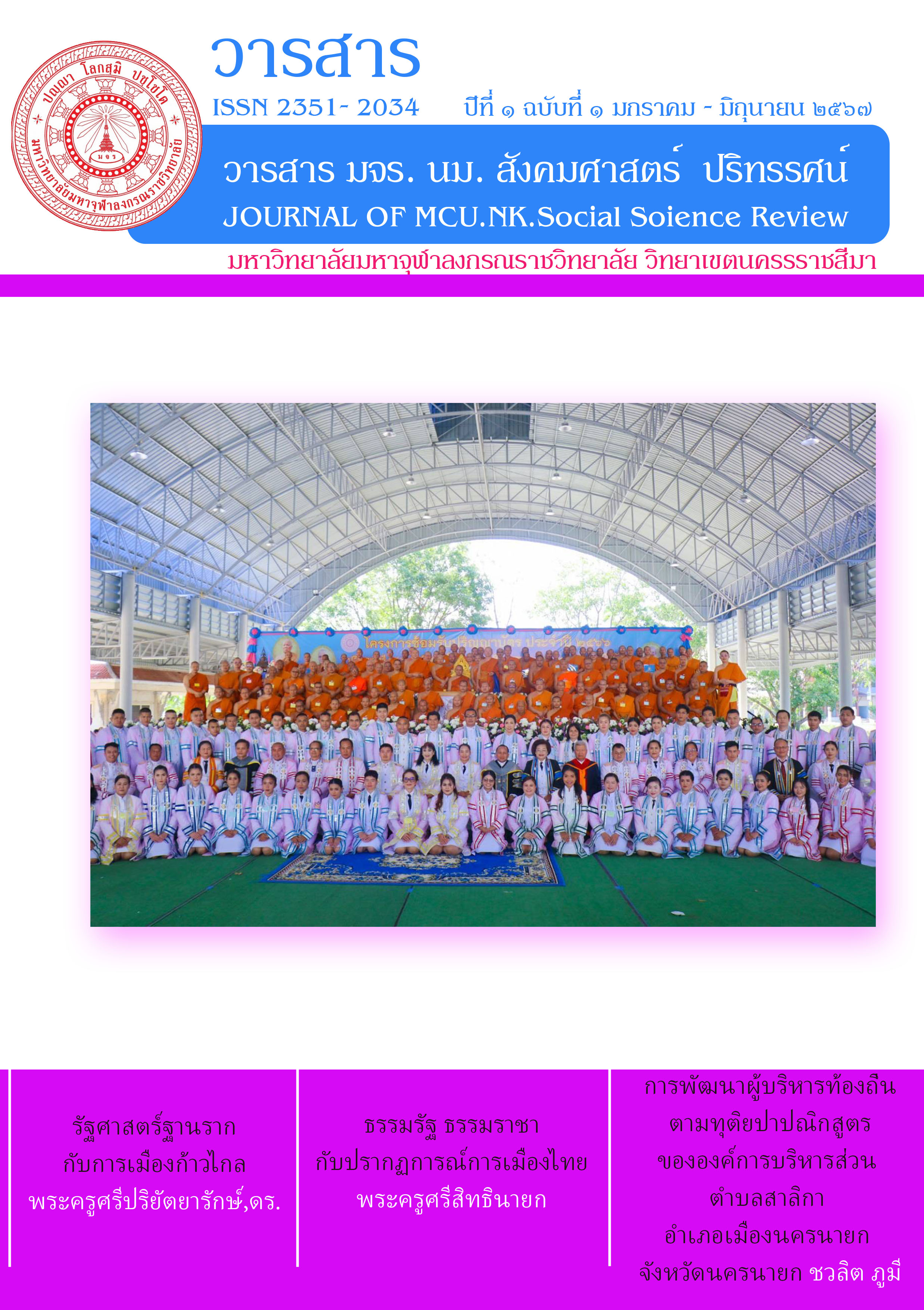
Development of local administrators according to the Dutiyapapanika Sutta of the Salika Subdistrict Administrative Organization, Mueang Nakhon Nayok District Nakhon Nayok Province
Article Sidebar
Main Article Content
Abstract
This research aimed to: 1) study the level of opinions on the development of local administrators based on the Dutiyapapanika Sutta; 2) compare these opinions classified by personal factors; and 3) propose guidelines for applying the Sutta to develop local administrators of the Sarika Subdistrict Administrative Organization, Mueang Nakhon Nayok District, Nakhon Nayok Province. The study employed a mixed-methods research design. Quantitative data were collected via questionnaires from 386 eligible voters and analyzed using percentage, mean, standard deviation, t-test, and F-test. Qualitative data were gathered through in-depth interviews with 9 key informants and analyzed using descriptive content analysis. The research results revealed that:
1) Opinion Levels: Overall opinions were at a moderate level ($\bar{x} = 3.46$). When categorized by aspect, intellectual development received the highest average score ($\bar{x} = 3.55$), followed by physical development, while mental development received the lowest average. 2) Comparison Results: No statistically significant differences (at the 0.05 level) were found in the opinions of people with different genders, ages, education levels, occupations, or monthly incomes. 3) Application Guidelines: The development guidelines follow three principles: (1) Chakkhuma (Vision): Administrators must create transparent development plans that respond to public needs (2) Withuro (Capability): Focus on producing tangible results, implementing economic strategies, and maintaining accountability and (3) Nissayasampanno (Human Relations): Building strong relationships and showing sincerity to all citizens, including those with differing political views.
Article Details
References
กาญจนา แสงสารพันธ์, (2548) “การศึกษากาวะผู้นำกับการบริหารคุณภาพทั้งองค์การของโรงเรียนจุฬาภรณราชวิทยาลัย” วิทยานิพนธ์การศึกษามหาบัณฑิต สาขาการบริหารการศึกษา, บัณฑิตวิทยาลัย : มหาวิทยาลัยบูรพา.
ณัฐชัย อินทรายและอติพร เกิดเรือง. (2562) การบริหารงานคุณภาพของผู้บริหารองค์กรปกครองส่วนท้องถิ่นในจังหวัดลำปาง, วารสารมหาจุฬานาครทรรศน์, 6 (10), 5286-5304.
ปัณณธร เธียรชัยพฤกษ์. (2561). ทิศทางองค์กรปกครองส่วนท้องถิ่นไทยในอนาคต, วารสาร มจร พุทธปัญญาปริทรรศน์ 3 (2), 183-196.
พระมหาวัฒนะชัย ชยวฑฺฒโน. (2565). แนวทางการพัฒนาภาวะผู้นำตามหลักทุติยปาปณิกสูตรของผู้บริหารโรงเรียนพระปริยัติธรรม จังหวัดหนองคาย, วารสารวิจัยศรีล้านช้าง. 8 (2), 1-13.
พิชญ์ณิฐา พรรณศิลปะและคณะ. (2561). บทบาทของผู้บริหารท้องถิ่นในศตวรรษที่ 21, วารสารสันติศึกษาปริทรรศน์ มจร. 3 (2), 146-161.
พิศาล จันทะสงเคราะห์. (2564) ปัจจัยที่สัมพันธ์กับความขัดแย้งในองค์กรปกครองส่วนท้องถิ่น จังหวัดเลย, วารสารวิจัยศรีล้านช้าง. 1 (2), 1-10.
มหาวิทยาลัยมหาจุฬาลงกรณราชวิทยาลัย. (2539). พระไตรปิฎก ภาษาไทย ฉบับมหาจุฬาลงกรณราชวิทยาลัย. กรุงเทพฯ : โรงพิมพ์มหาจุฬาลงกรณราชวิทยาลัย.
เสถียน โพธินันทะ. (2567). เมธีตะวันออก. นนทบุรี : บริษัท สำนักนักพิมพ์ศรีปัญญา จำกัด.
Stogdill, R.M., (1974). Handbook of leadership: A survey of literature. New York: Free press. 1974.
Yamane, T. (1973). Statistic: An Introductory Analysis. New York: Harper and Row.
