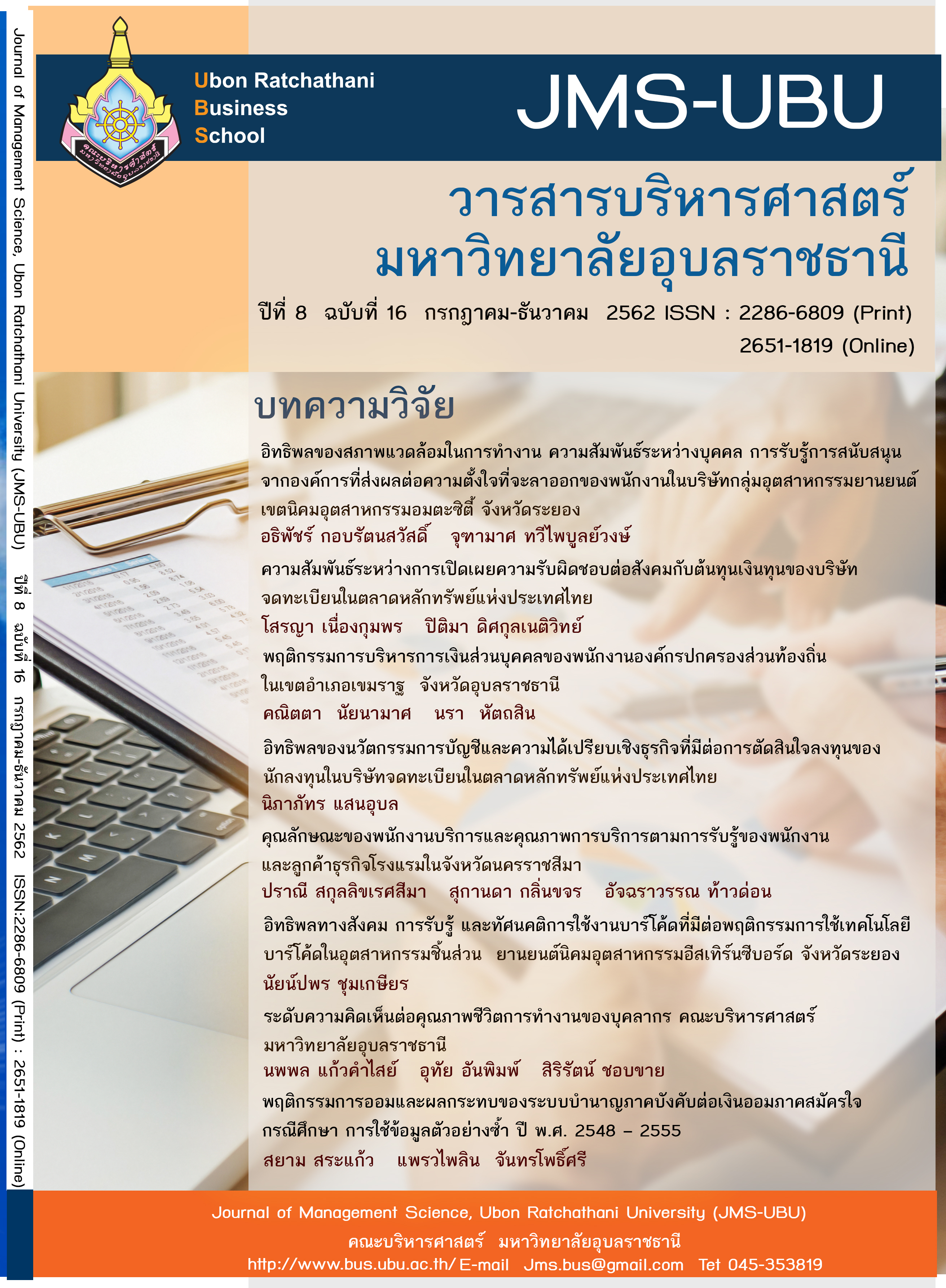
Characteristics and Quality of employees through employees and customers perception in Hotel business in Nakhon Rachasima
Article Sidebar
Main Article Content
Abstract
This research studied on the perception of hotel’s employees and customers in Nakhon Rachasima toward the employees’ characteristics and services quality. The researcher adopted the quantitative method using questionnaire to collect the data from those relevant in hotel business for 400 respondents. Descriptive statistics were used for data analysis such as mean, percentage, standard deviation; and Inferential statistic was used for hypothesis testing by Pearson's correlation coefficient.
The results found that the characteristic of service employees overall from employees and customers’ perspectives were high level aspect, which the Hotel business staff focused in service mind approach. Whereas customer angle emphasized in responsibility aspect. With regarding service quality dimension, the staff and customers’ attitude was high level, which the staffs focused in reliability aspect. Whereas the customer focused in tangibles dimension. For hypothesis result, service provider’s characteristic had positive relationship on service quality, significantly. The relationship between both variables can consider as follows: 1) the characteristics of service employees and service quality as perceived by the employees had correlation coefficient value of 806. Thus, first hypothesis was accepted, which means that characteristics of service employees had the positive relationship with services quality as perceived by the employees. 2) The characteristics of service employees and services quality as perceived by customers had the coefficient value as 837. Thus, the second hypothesis was accepted that characteristics of service employees had the positive relationship with the services quality as perceived by customers.
Downloads
Article Details

This work is licensed under a Creative Commons Attribution-NonCommercial-NoDerivatives 4.0 International License.
All articles published in the Journal of Management Science, Ubon Ratchathani University are copyrighted by the journal. The views and opinions expressed in each article are those of the authors and do not necessarily reflect the views of the Faculty of Management Science, Ubon Ratchathani University. The authors are solely responsible for the content of their articles.
References
กัลยา วาณิชย์บัญชา. (2549). การวิเคราะห์ข้อมูลหลายตัวแปร. กรุงเทพฯ : บริษัทธรรมสาร จำกัด.
กรุงเทพธุรกิจ. (2562). บทความพิเศษ เรื่อง “ธุรกิจโรงแรมแข่งขันรุนแรง คาดปี 60 รายได้ขยายตัว 3.7- 5.5%. ค้นเมื่อ 2 มีนาคม 2562 จาก http://www.bangkokbiznews.com/blog/detail/640668
การท่องเที่ยวแห่งประเทศไทย. (2562). จำนวนที่พักและโรงแรม. ค้นเมื่อ 2 มีนาคม 2562 จาก https://www.hotelscombined.co.th/
บุญชม ศรีสะอาด. (2553). การวิจัยเบื้องต้น. กรุงเทพฯ : ชมรมเด็ก.
สายธาร อุทกนิมิต. (2562). ธุรกิจโรงแรมไทย ในยุค AEC . ค้นเมื่อวันที่ 2 กุมภาพันธ์ 2562 จาก https://www.thailandplus.tv/?p=1781.
Brown, A. (1989). Customer Care Management. Oxford: Butterworth-Heinemann. p.89.
Callan RJ, Kyndt G. (2001). Business travelers’ perception of service quality: a prefatory study of two European city centre hotels. Int J Tourism Res. 3(4):313–323.
Chen FY, Chang YH. (2005). Examining airline service quality from a process perspective. J Air Trans Manag. 11:79–87.
Chuang, P.T. (2010). Incorporating disservice analysis to enhance perceived service quality. Industrial Management & Data Systems, 110 (3): pp. 1-21.
Crego, E.T; Schiffrin, P.D., and Albrecht, F.K. (1995). Customer – Centered Reengineering. New York : IRWIN Professional Publishing.
Dedeoglu BB and Demirer H. (2015). Differences in service quality perceptions of stakeholders in the hotel industry. Int J Contemp Hosp Manag, 27(1):130–146.
Gronroos Christian. (1990). Service Management and Marketing: Managing the Moments of truth In Service Competition. Lexington. Massachusetts, pp. 27 – 37.
Heskett, J.L. (1988). “Less ons in the Service Sector. Managing Services : Marketing, Operations and Human Resources. Prentice Hall, p. 374.
K. Douglas Hoffman and John E.G. Bateson. (2002). Essentials of Services Marketing : Concepts, Strategies and Cases. TX : Harcourt College Publishers, pp. 251 – 256.
Kang H, Bradley G. (2002). Measuring the performance of IT services: an assessment of SERVQUAL. Int J Account Inf Syst, 3:151–164.
Kotler, Philip. (2003). Marketing Management. New Jersey : Prentice – Hall International, Inc, 2003.
Lee YC, Chen JK, Lin SB. (2007). Revised Gap analysis by decomposition of service activities: a case study of information system center. Int J Bus Strategy. 8(2):74–98.
Li-hua Fan, Lei Gao, Xin Liu, Shi-hongZhao, Hui-tong Mu, Zhe Li, Lei Shi, King-lling Wang, Xlao-ll Jia, Min Ha and Feng-ge Lou. (2017). Patients’ perceptions of service quality in China: An investigation using the WERVQUAL model. PLoS ONE, 12(12): e0190123.
Mohsan Khudri and Saida Sultana. (2015). Determinants of service quality and impact of service quality and consumer characteristics on channel selection. British Food Journal, 117(8). pp. 2078-2097.
Nakhai, B. and Neves, J.S. (2009). The challenges of six sigma in improving service quality. International Journal of Quality Reliability Management, 26 (7). pp. 663-684.
Nasution H. (2016). Coaligning service quality attributes and its implication to customer value. In: Colin C, Junzhao JM (eds) Looking forward, looking back: drawing on the past to shape the future of marketing. Springer, pp 751–759.
Nunnally, J.C. (1976). Psychometric methods. New York : McGraw-Hill Book Co.
Nykamp Melinda. (2001). The Customer Differential : The Complete Guide to Implementing Customer Relationship Management. AMACOM. New York.
Parasuraman A, Zeithaml VA, Berry LL. (1985). A conceptual model of service quality and its implications for future research. J Mark 49(4):41–50.
Parasuraman, A., Berry, L. L. & Zeithaml, V. A., (1990). Delivering quality service: Balancing customer
perceptions and expectations. New York: The free press.
Tenner, A.R. and DeToro, I.J. (1992). Total Quality Management :Three Steps to Continuous Improvement. Addison-Wesley Publishing, p. 43.
Torres EN, Adler H, Lehto X, Behnke C, Miao L. (2013). One experience and multiple reviews: the case of upscale US hotels. Tour Rev. 68(3):3–20.
Tsang N, Qu H. (2000). Service quality in China’s hotel industry: a perspective from tourists and hotel managers. Int J Contemp Hosp Manag. 12:316–326.
William Joseph. (1983). Professional Service Management. New York : McGraw-Hill Book Company.
Yu-Cheng Lee, Yu-Che Wang, Chih-Hung Chien, Chia-Huei Wu, Shu-Chiung Lu, San-Bing Tsai and Weiei Dong. (2016). Applying revised gap analysis model in measuring hotel service quality, SpringerPlus Journal , (5):1191.
Zeithaml VA, Parasuraman A, Berry LL. (1990). Delivering quality service balancing customer perceptions and expectations. The Free Press, New York.
