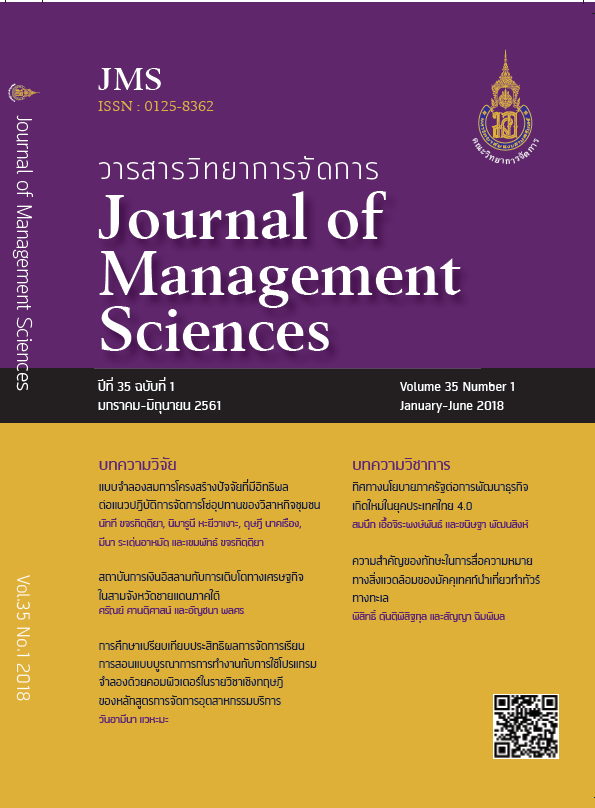
การศึกษาเปรียบเทียบประสิทธิผลการจัดการเรียนการสอนแบบบูรณาการการทำงานกับการใช้โปรแกรมจำลองด้วยคอมพิวเตอร์ในรายวิชาเชิงทฤษฎีของหลักสูตรการจัดการอุตสาหกรรมบริการ
Article Sidebar
Main Article Content
บทคัดย่อ
การเรียนรู้แบบบูรณาการการทำงาน (WIL) ได้เข้ามาเป็นส่วนหนึ่งของการจัดการศึกษาหลักสูตรการบริการมาอย่างช้านาน ซึ่งการจัดการศึกษาลักษณะนี้จะทำให้นักศึกษาสาขาอุตสาหกรรมการบริการได้รับความรู้ที่เป็นหลักการพื้นฐานที่สำคัญในการดำเนินงานขององค์กรที่แท้จริง นอกเหนือจาก WIL แล้ว อีกทางเลือกหนึ่ง คือ การใช้โปรแกรมจำลองด้วยคอมพิวเตอร์ ซึ่งอาจจะสามารถอธิบายทักษะบางอย่างของ WIL ได้ โดยไม่ทำให้ผลการเรียนของนักศึกษาลดลงหรือทำให้นักศึกษาต้องประสบกับความตึงเครียดโดยใช่เหตุ โปรแกรม CESIM Hospitality เป็นหนึ่งตัวอย่างการจำลองแบบออนไลน์ดังกล่าว แต่การศึกษาวิจัยเกี่ยวกับเรื่องนี้ยังอยู่ในระดับที่ค่อนข้างต่ำ ในการศึกษาวิจัยครั้งนี้ได้มีการใช้แบบทดสอบแบบปรนัยเพื่อวัดประสิทธิผลของโปรแกรม WIL และโปรแกรม CESIM Hospitality เพื่อเปรียบเทียบประสิทธิผลของเครื่องมือการสอน พบว่า นักศึกษาที่เคยใช้แบบจำลอง CESIM มีผลการทดสอบดีกว่าผู้ที่เข้าร่วมโครงการ WIL อย่างมีนัยสำคัญ ซึ่งชี้ให้เห็นว่าควรมีการบูรณาการการใช้โปรแกรมจำลองควบคู่กับหลักสูตรการฝึกอบรมด้านการบริการด้วย แต่อย่างไรก็ตาม จากการ ศึกษาพบว่า ไม่มีความสัมพันธ์ระหว่างคะแนนจากโปรแกรมจำลองและผลการทดสอบของนักเรียนที่ใช้การจำลองนี้ จึงทำให้เห็นว่าโปรแกรม CESIM Hospitality ไม่ควรใช้เพื่อวัดความสามารถทางวิชาการของนักศึกษา
Article Details

อนุญาตภายใต้เงื่อนไข Creative Commons Attribution-NonCommercial-NoDerivatives 4.0 International License.
บทความที่ตีพิมพ์ถือเป็นลิขสิทธิ์ของวารสารวิทยาการจัดการ มหาวิทยาลัยสงขลานครินทร์ อย่างไรก็ตาม กองบรรณาธิการไม่สงวนลิขสิทธิ์ในการทำซ้ำ คัดลอก หรือเผยแพร่ แต่จะต้องอ้างอิงให้ถูกต้องตามหลักวิชาการ
เอกสารอ้างอิง
Aggett, M. & Busby, G. (2011) Opting out of internship: perceptions of hospitality, tourism and events management undergraduates at a British university. The Journal of Hospitality Leisure Sport and Tourism. 10(1), 106-113.
Barron, P. & Ananstasiadou, C. (2009) Student part-time employment: implications, challenges and opportunities for higher education. International Journal of Contemporary Hospitality Management. 21(2), 140-153.
Beggs, B., Ross, C.M. & Goodwin, B. (2014) A comparison of student and practitioner perspectives of the travel and tourism internship. Journal of Hospitality, Leisure, Sport and Tourism Education. 7(1), 31-39.
Bowness, A. (2004) Hands-on learning through computer simulations. Canadian HR Reporter, 17(16), 15.
Carney, C., McNeish, S. & McColl, J. (2005) The impact of part time employment on students' health and academic performance: a Scottish perspective. Journal of Further and Higher Education, 29(4), 307-319.
CESIM Business Simulations (2010) Cesim Business Simulations Youtube. Retrieved from https://www.youtube.com/user/CesimFinland
CESIM Hospitality (2016) Hotel and restaurant manager simulation game. Retrieved from https://www.cesim.com/simulations/cesim-hospitality-hotel-restaurant-management-simulation-game
CESIM Business Simulations (2017) Experiential learning with state-of-the-art business simulations. Retrieved from https://www.cesim.com/
Chen, B.T. & Gursoy, D. (2008) Preparing students for careers in the leisure, recreation, and tourism field. Journal of Teaching in Travel & Tourism, 7(3), 21-41.
Chuang, N.K., Goh, B.K., Stout, B.L. & Dellmann-Jenkins, M. (2007) Hospitality undergraduate students' career choices and factors influencing commitment to the profession. Journal of Hospitality & Tourism Education. 19(4), 28-37.
Curtis, S. (2005) Support for working undergraduates: the view of academic staff. Education & training, 47(7), 496-505.
Dahiya, A. (2013) Hospitality and tourism education in India: in search of innovative programmes. Productivity. 53(4), 358-370.
Dickerson, J.P. & Kline, S.F. (2008) The early career impact of the co-op commitment in hospitality curricula. Journal of Teaching in Travel & Tourism. 8(1), 3-22.
Holmes, V. (2008) Working to live: why university students balance full-time study and employment. Education & Training, 50(4), 305-314.
Jackson, J. (2014) Factors influencing job attainment in recent bachelor graduates: evidence from Australia. Higher Education. 68(1), 135-153.
Kikot, T., Costa, G., Magalhães, R. & Fernandes, S. (2013) Simulation games as tools for integrative dynamic learning: The case of the management course at the University of Algarve. Procedia Technology, 9, 11-21.
Kikot, T., Costa, G., Fernandes, S. & Aguas, P. (2014) Why use-centred game-based learning in higher education? The case of CESIM SimBrand. Journal of Spatial and Organizational Dynamics, 2(3), 229-241.
Fengfeng, K. (2009). A qualitative meta-analysis of computer games as learning tools. In R.E. Ferdig (eds.), Handbook of Research on Effective Electronic Gaming in Education. IGI Global, PA: Hershey.
Fournier, H. & Ineson E.M. (2010) Closing the gap between education and industry: skills' and competencies' requirements for food service internships in Switzerland. Journal of Hospitality & Tourism Education. 22(4), 33-42.
Jogaratnam, G. & Buchanan, P. (2004) Balancing the demands of school and work: Stress and employed hospitality students. International Journal of Contemporary Hospitality Management. 16(4), 237-245.
Lee, C. (2013) What curriculum differences exist between hospitality programs: a case study of selected hospitality programs in the U.S. International Journal of Hospitality and Tourism Systems. 6(2), 1-11.
Mohammed, A.A. & Rashid, B. (2016) The moderating influence of internship program on the relationship between undergraduates’ perception and their intention to join tourism and hospitality industry: a theoretical model. International Review of Management and Marketing. 6(2), 317-32.
Nonis, S.A. & Hudson, G.I. (2010) Performance of college students: impact of study time and study habits. Journal of Education for Business, 85(4), 229-238.
Robotham, D. (2009) Combining study and employment: a step too far? Education & Training, 51(4), 322-332.
Sagadin, T.A. (2013) Communicating concepts of hospitality in education: fighting crisis through quality improvement. Paper presented at 2nd International Scientific Conference Tourism in South East Europe 2013, Opatija, Croatia. Retrieved from https://papers.ssrn.com/sol3/papers.cfm?abstract_id=2289301
Selmanovic, S (2016) Online Simulation Game: Inspiring students to actively learn about International Business. Retrieved from http://slideplayer.com/slide/9633141/
Sørensen, M (2011) Learning with simulation games. Masters Thesis. Retrieved from http://studenttheses.cbs.dk/bitstream/handle/ 10417/2966/michael_soerensen.pdf?sequence=1
Tesone, D.V. & Ricci, P. (2005) Job competency expectations for hospitality and tourism employees. Journal of Human Resources in Hospitality & Tourism. 4(2), 53-64.
Tesone, D.V. & Ricci, P. (2012). Hospitality expectations of entry-level college graduates: A preference for attitude over aptitude. European Journal of Business and Social Science. 1(6), 140-149.
Vihakara, A. & Blue, R. (2015) Gamification and E-learning in global adult education case master’s degree program business management and entrepreneurship. The Business and Management Review, 6(5), 128-136.
Wardle, K.M. (2012) Work integrated learning for tertiary hospitality education. Paper presented at the ACEN 2012 Conference, Melbourne, Australia. Retrieved from http://acen.edu.au/2012conference/wp-content/uploads/2012/11/101_ Work-Integrated-Learning-for-Tertiary-Hospitality-Education.pdf
Zaitseva, N.A., Goncharova, I.V. & Androsenko M.E. (2016) Necessity of changes in the system of hospitality industry and tourism training in terms of import substitution. International Journal of Economics and Financial Issues. 6(1), 288-293.
