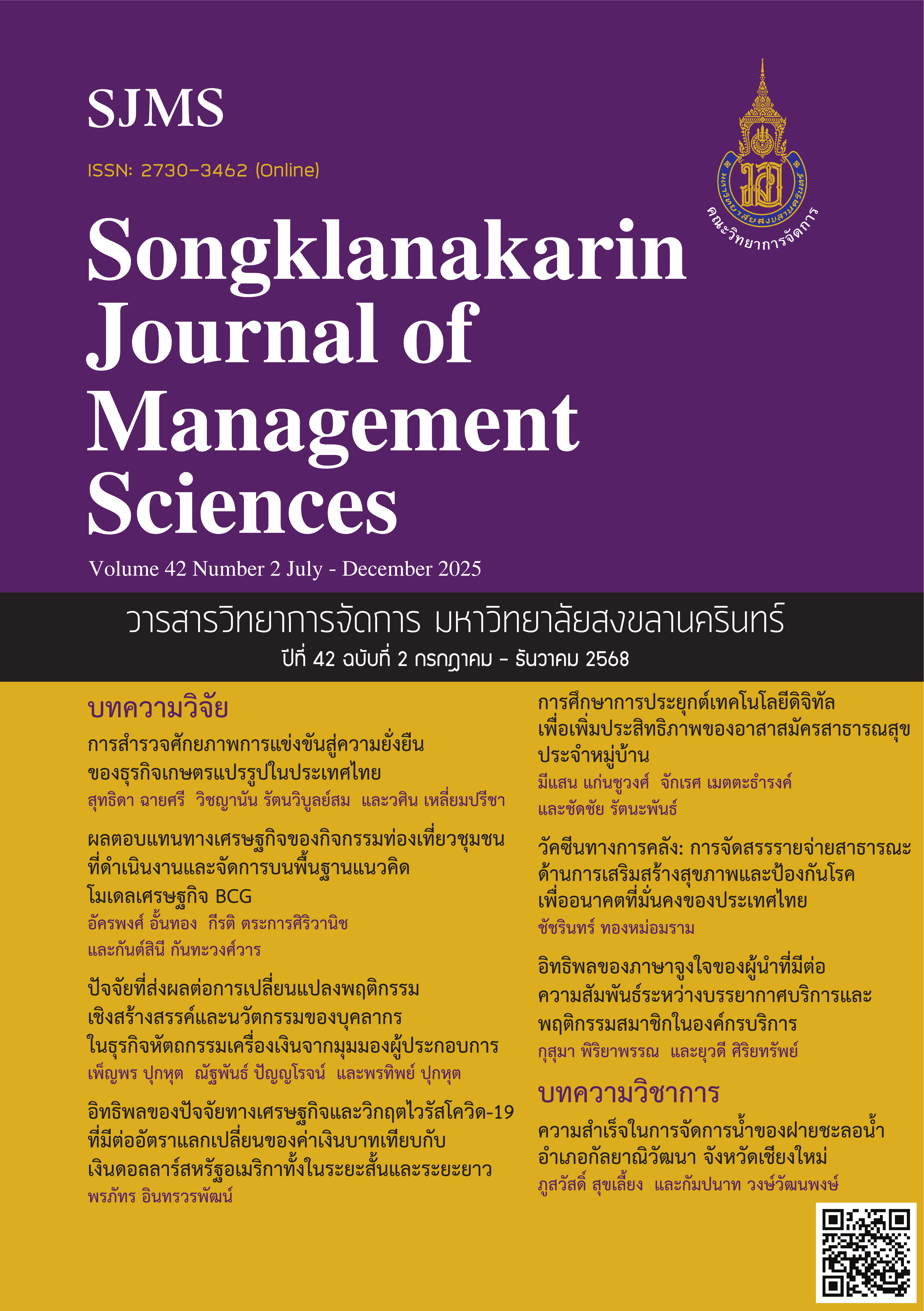
อิทธิพลของปัจจัยทางเศรษฐกิจและวิกฤตไวรัสโควิด-19 ที่มีต่ออัตราแลกเปลี่ยนของค่าเงินบาทเทียบกับเงินดอลลาร์สหรัฐอเมริกาทั้งในระยะสั้นและระยะยาว
Article Sidebar
Main Article Content
บทคัดย่อ
บทความวิจัยนี้ศึกษาอิทธิพลของปัจจัยทางเศรษฐกิจและวิกฤตไวรัสโควิด-19 ที่มีต่อค่าเงินบาทเทียบกับเงินดอลลาร์สหรัฐอเมริกาในระยะสั้นและระยะยาว โดยศึกษาแบ่งเป็น 2 ช่วง คือ (1) ก่อนการระบาดของไวรัสโควิด-19 ในไทย (มกราคม พ.ศ. 2557 - ธันวาคม พ.ศ. 2562) และ (2) ช่วงเกิดการระบาดไวรัสโควิด-19 ในไทย (มกราคม พ.ศ. 2563 – เมษายน พ.ศ. 2566) โดยวิเคราะห์อิทธิพลด้วยการประมาณการแบบจำลองระยะยาว และระยะสั้น
ผลการศึกษา พบว่า (1) ช่วงก่อนการระบาดของไวรัสโควิด-19 ในไทย ส่วนต่างของอัตราดอกเบี้ยของไทยและสหรัฐฯ ปริมาณเงิน เงินทุนสำรองระหว่างประเทศ และหนี้สาธารณะของไทย มีอิทธิพลต่อค่าเงินบาทเทียบกับเงินดอลลาร์สหรัฐฯ ทั้งในระยะสั้นและระยะยาว (2) ช่วงเกิดการระบาดของไวรัสโควิด-19 ในไทยในระยะสั้น ส่วนต่างของอัตราดอกเบี้ยไทยและสหรัฐฯ เงินทุนสำรองระหว่างประเทศของไทย และผู้เสียชีวิตจากไวรัสโควิด-19ในไทยมีอิทธิพลต่อค่าเงินบาทเทียบกับเงินดอลลาร์สหรัฐฯ แต่ในระยะยาวหนี้สาธารณะของรัฐบาลไทยที่เพิ่มขึ้นอย่างมากในช่วงวิกฤตไวรัสโควิด-19 กลับส่งผลให้ค่าเงินบาทอ่อนค่าลงสะท้อนให้เห็นว่า การก่อหนี้สาธารณะในช่วงเกิดวิกฤตนั้น แม้จะมีความจำเป็น แต่รัฐบาลไทยก็ต้องบริหารจัดการการใช้จ่ายภาครัฐให้เกิดความคุ้มค่าสูงสุดต่อการฟื้นฟูเศรษฐกิจ ร่วมไปกับการบริหารจัดการปริมาณเงินทุนสำรองระหว่างประเทศให้สามารถรองรับการเกิดวิกฤตอื่น ๆ ในอนาคต เพื่อเป็นการรักษาเสถียรภาพของค่าเงินบาทได้อย่างยั่งยืน
Article Details

อนุญาตภายใต้เงื่อนไข Creative Commons Attribution-NonCommercial-NoDerivatives 4.0 International License.
บทความที่ตีพิมพ์ถือเป็นลิขสิทธิ์ของวารสารวิทยาการจัดการ มหาวิทยาลัยสงขลานครินทร์ อย่างไรก็ตาม กองบรรณาธิการไม่สงวนลิขสิทธิ์ในการทำซ้ำ คัดลอก หรือเผยแพร่ แต่จะต้องอ้างอิงให้ถูกต้องตามหลักวิชาการ
เอกสารอ้างอิง
Banchuenvijit, W. (2022). Factors Determining Exchange Rates between Thai Baht and US Dollar as well as Thai Baht and Chinese Yuan under President Donald Trump's Administration. Journal of Family Business & Management Studies, 14(2), 79-89.
Banda, F., & Edriss, A. (2023). How did Covid-19 affect the structural relationship between exchange rates and money supply? evidence from Malawi. International Journal of Economics and Financial, 13(1), 199-205.
Bank of Thailand. (2021). Thailand's Economic Condition in 2022. Retrieved February 2, 2025, from https://www.bot.or.th/content/dam/bot/documents/th/thai-economy/state-of-thai-economy/annual-report/annual-econ-report-th-2563.pdf
Bank of Thailand. (2024). EC_MB_051 Foreign exchange purchases and sales by commercial banks. Retrieved January 22, 2025, from https://app.bot.or.th/BTWS_STAT/statistics/BOTWEBSTAT.aspx?reportID=35&language=TH
Buato, S. (2019). The determinant impacting on bilateral exchange rate: a case study of the Thai Baht against the U.S. Dollar. Chulalongkorn University Theses and Dissertations (Chula ETD).
Chasanah, A. N., Riyono, R., & Ristanto, H. (2022). Factors Affecting the Rupiah Exchange Rate During the Covid 19 Pandemic. Journal of Economics and Public Health, 1(2), 79-88.
Diao, Y. (2023). Empirical analysis of factors influencing RMB exchange rate volatility in the context of RMB internationalization. Frontiers in Business, Economics and Management, 11(3), 23-33.
Engle, R., & Granger, C. (2015). Co-integration and error correction: Representation, estimation, and testing. Applied Econometrics, 39(3), 106-135.
Flodén, M. (2020). The open economy revisited: The Mundell-Fleming model and the exchange-rate regime. Stockholm: Stockholm School of Economics.
Ghauri, S. P., Ahmed, R. R., Streimikiene, D., Qadir, H., & Hayat, A. (2024). Macroeconomic factors driving exchange rate volatility and economic sustainability: Case study of Pakistan. The Amfiteatru Economic journal, 26(66), 612–628.
Gongkhonkwa, G. (2021). COVID-19 Pandemic: Impact on Thai Baht Exchange Rate. Journal of Asian Finance, Economics and Business, 8(7), 121–127.
Husted, S., & Melvin, M. (2020). International economics. (9th Ed.). Boston: Addison Wesley Longman.
International Monetary Fund. (2025). Thailand: Selected Issues; IMF Country Report No. 25/46. Retrieved April 12, 2025, from https://acrobat.adobe.com/id/urn:aaid:sc:AP:9d2779f0-b7bc-47a2-951b-15d2007d4c79
Islam, D., & Faisal, M. A. A. (2024). Determinants of Uruguay's Real Effective Exchange Rate: A Mundell-Fleming Model Approach. arXiv Prepr. arXiv2403.16452.
Jamal, A., & Bhat, B. (2022). COVID-19 pandemic and the exchange rate movements: evidence from six major COVID-19 hot spots. Future Business Journal, 8(1), 1-11.
Leightner, J. E. (2024). Small-Country Mundell–Fleming (IS/LM/BP) Model Predictions Under Both Fixed and Flexible Exchange Rates: Evidence from Australia and S. Korea. Journal of Risk and Financial Management, 17(11), 1-20.
Li, C., Su, Z. W., Yaqoob, T., & Sajid, Y. (2022). COVID-19 and currency market: a comparative analysis of exchange rate movement in China and USA during pandemic. Economic research-Ekonomska istraživanja, 35(1), 2477-2492.
Li, L., Pan, F., & Wang, C., (2019). Analysis of Influencing factors of RMB exchange rate trend based on least square method. Journal of Physics: Conference Series, 1168, 032036.
Pesaran, M. H., Shin, Y., & Smith, R. J. (2001). Bounds testing approaches the analysis of level relationships. Journal of applied econometrics, 16(3), 289-326.
Pilbeam, K. (2023). International finance. Bloomsbury Publishing.
Vargas-Herrera, H., Ospina, J. J., & Romero, J. V. (2022). The Covid-19 shock and the monetary policy response in Colombia. BIS Papers chapters, 122, 79-114.
Von Beschwitz, B. (2024). Internationalization of the Chinese renminbi: progress and outlook. Retrieved January 2, 2025, from https://www.federalreserve.gov/econres/notes/feds-notes/internationalization-of-the-chinese-renminbi-progress-and-outlook-20240830.html?utm_source=chatgpt.com
World Bank Group (2020). Thailand Economic Monitor: Thailand in the Time of Covid-19. Retrieved January 2, 2025, from https://documents1.worldbank.org/curated/en/456171593190431246/pdf/Thailand-Economic-Monitor-Thailand-in-the-Time-of-Covid-19.pdf
Zareei, A., Karimzadeh, M., Koshalshahi, Z., & Ranjbarian, Z. (2022). External Debt and Exchange Rate Fluctuations in Iran: Markov Switching Approach. Iranian Economic Review, 26(3), 577-594.
