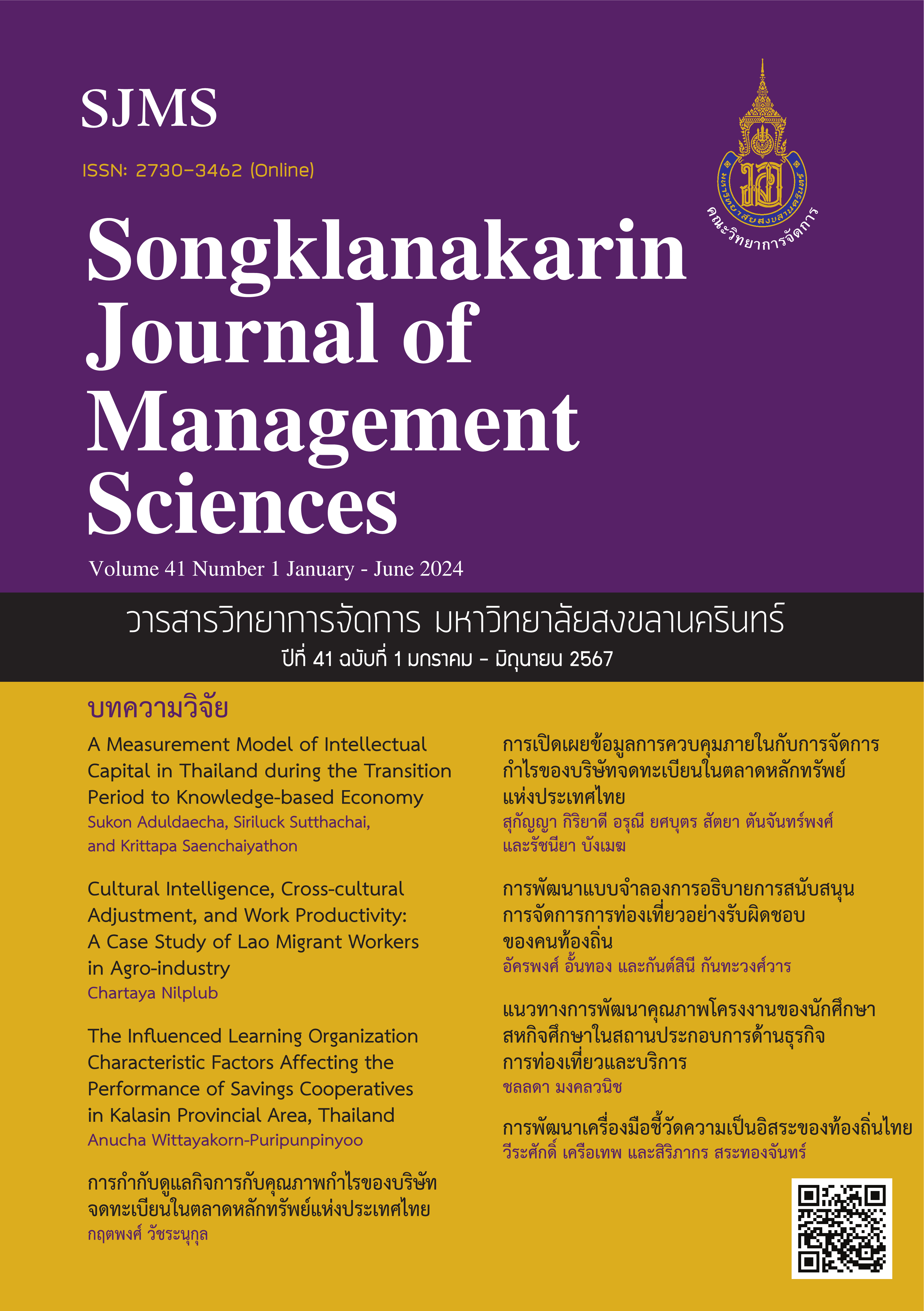
โมเดลการวัดทุนทางปัญญาในประเทศไทยระหว่างช่วงการเปลี่ยนแปลงสู่ระบบเศรษฐกิจฐานความรู้
Article Sidebar
Main Article Content
บทคัดย่อ
ในปัจจุบันนี้รัฐบาลไทยได้วางแผนที่จะเปลี่ยนแปลงระบบเศรษฐกิจในประเทศไทยให้เป็นเศรษฐกิจฐานความรู้ และทุนทางปัญญาเป็นปัจจัยที่สำคัญที่จะทำให้เกิดระบบเศรษฐกิจดังกล่าว งานวิจัยนี้มีวัตถุประสงค์เพื่อศึกษาและเสนอโมเดลตัววัดสำหรับทุนทางปัญญาในบริษัทที่จดทะเบียนในตลาดหลักทรัพย์แห่งประเทศไทย โดยพัฒนาแบบสอบถามจากงานวิจัยของ Bontis (1998) และมีกลุ่มตัวอย่างจำนวน 370 บริษัทที่ได้ตอบแบบสอบถามนี้ และงานวิจัยได้ใช้วิธีสถิติ PLS-SEM ในการวิเคราะห์ข้อมูลเพื่อพัฒนาโมเดล ซึ่งประกอบด้วยทุนมนุษย์ ทุนโครงสร้าง และทุนความสัมพันธ์ ผลการวิจัยสนับสนุนความเที่ยงและความตรงของโมเดล และตัววัดทุนมนุษย์สะท้อนผ่านความคิดสร้างสรรค์ของบุคลากร ทักษะการเรียนรู้ในการแก้ไขปัญหา และการทำงานอย่างเต็มที่ ในขณะที่ทุนโครงสร้างจะแสดงผ่านกระบวนปฏิบัติงานและการเข้าถึงระบบข้อมูล ส่วนทุนความสัมพันธ์จะสะท้อนผ่านความสัมพันธ์กับลูกค้าเป็นตัวหลัก ผลการวิจัยนี้จะทำให้ผู้บริหารเห็นแนวทางกิจกรรมในการพัฒนาทุนทางปัญญาในองค์กร นอกจากนี้ หน่วยงานกำกับดูแลสามารถเสนอแนะแนวทางของนโยบายเพื่อสนับสนุนให้บริษัทต่าง ๆ พัฒนาทุนทางปัญญาในองค์กรได้
Article Details

อนุญาตภายใต้เงื่อนไข Creative Commons Attribution-NonCommercial-NoDerivatives 4.0 International License.
บทความที่ตีพิมพ์ถือเป็นลิขสิทธิ์ของวารสารวิทยาการจัดการ มหาวิทยาลัยสงขลานครินทร์ อย่างไรก็ตาม กองบรรณาธิการไม่สงวนลิขสิทธิ์ในการทำซ้ำ คัดลอก หรือเผยแพร่ แต่จะต้องอ้างอิงให้ถูกต้องตามหลักวิชาการ
เอกสารอ้างอิง
Bontis, N. (1998). Intellectual capital: An exploratory study that develops measures and models. Management Decision, 36(2), 63-76.
Bontis, N., Janošević, S., & Dženopoljac, V. (2015). Intellectual capital in Serbia’s hotel industry. International Journal of Contemporary Hospitality Management, 27(6), 1365-1384.
Bozbura, F. T. (2004). Measurement and application of intellectual capital in Turkey. The Learning Organization, 11(4/5), 357-367.
Castro, J. P. G., Ramírez, D. F. D., & Escobar, J. M. (2021). The relationship between intellectual capital and financial performance in Colombian listed banking entities. Asia Pacific Management Review, 26(4), 237-247.
Chen, J., Zhao, X., & Wang, Y. (2015). A new measurement of intellectual capital and its impact on innovation performance in an open innovation paradigm. International Journal Technology Management, 67(1), 1-25.
Engelen, A., Flatten, T. C., Thalmann, J., & Brettel, M. (2014). The effect of organizational culture on entrepreneurial orientation: A comparison between Germany and Thailand. Journal of Small Business Management, 52(4), 732-752.
Ferreira, J. J., Fernandes, C., & Veiga, P. (2021). Multilevel approaches to advancing the measurement of intellectual capital research field–What can we learn from the literature?. Journal of Intellectual Capital, 22(6), 971-999.
Hair, J. F., Risher, J. J., Sarstedt, M., & Ringle, C. M. (2019). When to use and how to report the results of PLS-SEM. European Business Review, 31(1), 2-24.
Hair, J. F., Sarstedt, M., Hopkins, L., & Kuppelwieser, V. G. (2014). Partial least squares structural equation modeling (PLS-SEM): An emerging tool in business research. European Business Review, 26(2), 106-121.
Henseler, J. (2017). Partial least squares path modeling. In P. S. H. Leeflang, J. E. Wieringa, T. H. A. Bijmolt, and K. H. Pauwels (Eds.), Advanced Methods for Modeling Markets (pp. 361-381). International Series in Quantitative Marketing. Springer, Cham. https://doi.org/10.1007/978-3-319-53469-5_12
Huang, C. C., & Huang, S. M. (2020). External and internal capabilities and organizational performance: Does intellectual capital matter? Asia Pacific Management Review, 25(2), 111-120.
Hunter, L., Webster, E., & Wyatt, A. (2005). Measuring intangible capital: A review of current practice. Australian Accounting Review, 15(36), 4-21.
Jardon, C. M., & Martinez-Cobas, X. (2021). Measuring intellectual capital with financial data. PLOS ONE, 16(5), e0249989. https://doi.org/10.1371/journal.pone.0249989
Kannan, G., & Aulbur, W. G. (2004). Intellectual capital: Measurement effectiveness. Journal of Intellectual Capital, 5(3), 389-413.
Kianto, A., Ritala, P., Vanhala, M., & Hussinki, H. (2020). Reflections on the criteria for the sound measurement of intellectual capital: A knowledge-based perspective. Critical Perspectives on Accounting, 70(July), 1-15. https://doi.org/10.1016/j.cpa.2018.05.002
Kianto, A., Sáenz, J., & Aramburu, N. (2017). Knowledge-based human resource management practices, intellectual capital and innovation. Journal of Business Research, 81(December), 11-20. https://doi.org/10.1016/j.jbusres.2017.07.018
Kittikunchotiwut, P., & Siriyota, K. (2021). The impact of intellectual capital on knowledge management processes in Thailand. The Journal of Asian Finance, Economics and Business, 8(9), 249-260.
Lee, C. C., & Lin, C. K. (2019). The major determinants of influencing the operating performance from the perspective of intellectual capital: Evidence on CPA industry. Asia Pacific Management Review, 24(2), 124-139.
Loyarte, E., Garcia-Olaizola, I., Marcos, G., Moral, M., Gurrutxaga, N., Florez-Esnal, J., & Azua, I. (2018). Model for calculating the intellectual capital of research centres. Journal of Intellectual Capital, 19(4), 787-813.
Mention, A. L., & Bontis, N. (2013). Intellectual capital and performance within the banking sector of Luxembourg and Belgium. Journal of Intellectual Capital, 14(2), 286–309.
Na-Nan, K., Kanthong, S. N., Khummueng, K., & Dhienhirun, A. (2021). Intellectual capital of SMEs in Thailand: An employee behavioural measurement instrument. International Journal of Organizational Analysis, 29(4), 825-846.
Nimtrakoon, S. (2015). The relationship between intellectual capital, firms’ market value and financial performance: Empirical evidence from the ASEAN. Journal of Intellectual Capital, 16(3), 587-618.
Novas, J. C., Alves, M. D. C. G., & Sousa, A. (2017). The role of management accounting systems in the development of intellectual capital. Journal of Intellectual Capital, 18(2), 286-315.
Phusavat, K., Comepa, N., Sitko‐Lutek, A., & Ooi, K. B. (2012). Intellectual capital: National implications for industrial competitiveness. Industrial Management & Data Systems, 112(6), 866-890.
Pike, S., & Roos, G. (2007). Recent advances in the measurement of intellectual capital: a critical survey. The 8th European Conference on Knowledge Management, Barcelona.
Rehman, S. U., Bresciani, S., Ashfaq, K., & Alam, G. M. (2021). Intellectual capital, knowledge management and competitive advantage: A resource orchestration perspective. Journal of Knowledge Management, DOI: 10.1108/JKM-06-2021-0453
Roos, J., Roos, G., Edvinsson, L., & Dragonetti, N. C. (1997). Intellectual Capital: Navigating the New Business Landscape. Palgrave Macmillan. London.
Rönkkö, M., McIntosh, C. N., & Antonakis, J. (2015). On the adoption of partial least squares in psychological research: Caveat emptor. Personality and Individual Differences, 87(December), 76-84. https://doi.org/10.1016/j.paid.2015.07.019
Seleim, A. A., & Khalil, O. E. (2011). Understanding the knowledge management‐intellectual capital relationship: A two‐way analysis. Journal of Intellectual Capital, 12(4), 586-614.
Singh, S., Sidhu, J., Joshi, M., & Kansal, M. (2016). Measuring intellectual capital performance of Indian banks: A public and private sector comparison. Managerial Finance, 42(7), 635-655.
Srivihok, A. (2008). Intellectual capital of enterprises in Thailand: Measurement model by Baysean Network Algorithm. Communications of the IBIMA, 3(26), 193-199.
Tayles, M., Pike, R. H., & Sofian, S. (2007). Intellectual capital, management accounting practices and corporate performance: Perceptions of managers. Accounting, Auditing & Accountability Journal, 20(4), 522-548.
Vidotto, J. D. F., Ferenhof, H. A., Selig, P. M., & Bastos, R. C. (2017). A human capital measurement scale. Journal of Intellectual Capital, 18(2), 316-329.
Wang, Z., Wang, N., Cao, J., & Ye, X. (2016). The impact of intellectual capital-knowledge management strategy fit on firm performance. Management Decision, 54(8), 1861-1885.
Weqar, F., Sofi, Z. A., & Haque, S. I. (2020). Nexus between intellectual capital and business performance: Evidence from India. Asian Journal of Accounting Research, 6(2), 180-195.
World Intellectual Property Organization (WIPO) (2019). Global Innovation Index 2019. https://www.wipo.int/global_innovation_index/en/2019
World Intellectual Property Organization (WIPO) (2022). Global Innovation Index 2022. https://www.wipo.int/global_innovation_index/en/2022
Wu, W. Y., Chang, M. L., & Chen, C. W. (2008). Promoting innovation through the accumulation of intellectual capital, social capital, and entrepreneurial orientation. R&D Management, 38(3), 265-277.
Youndt, M. A., Subramaniam, M., & Snell, S. A. (2004). Intellectual capital profiles: An examination of investments and returns. Journal of Management Studies, 41(2), 335–361.
