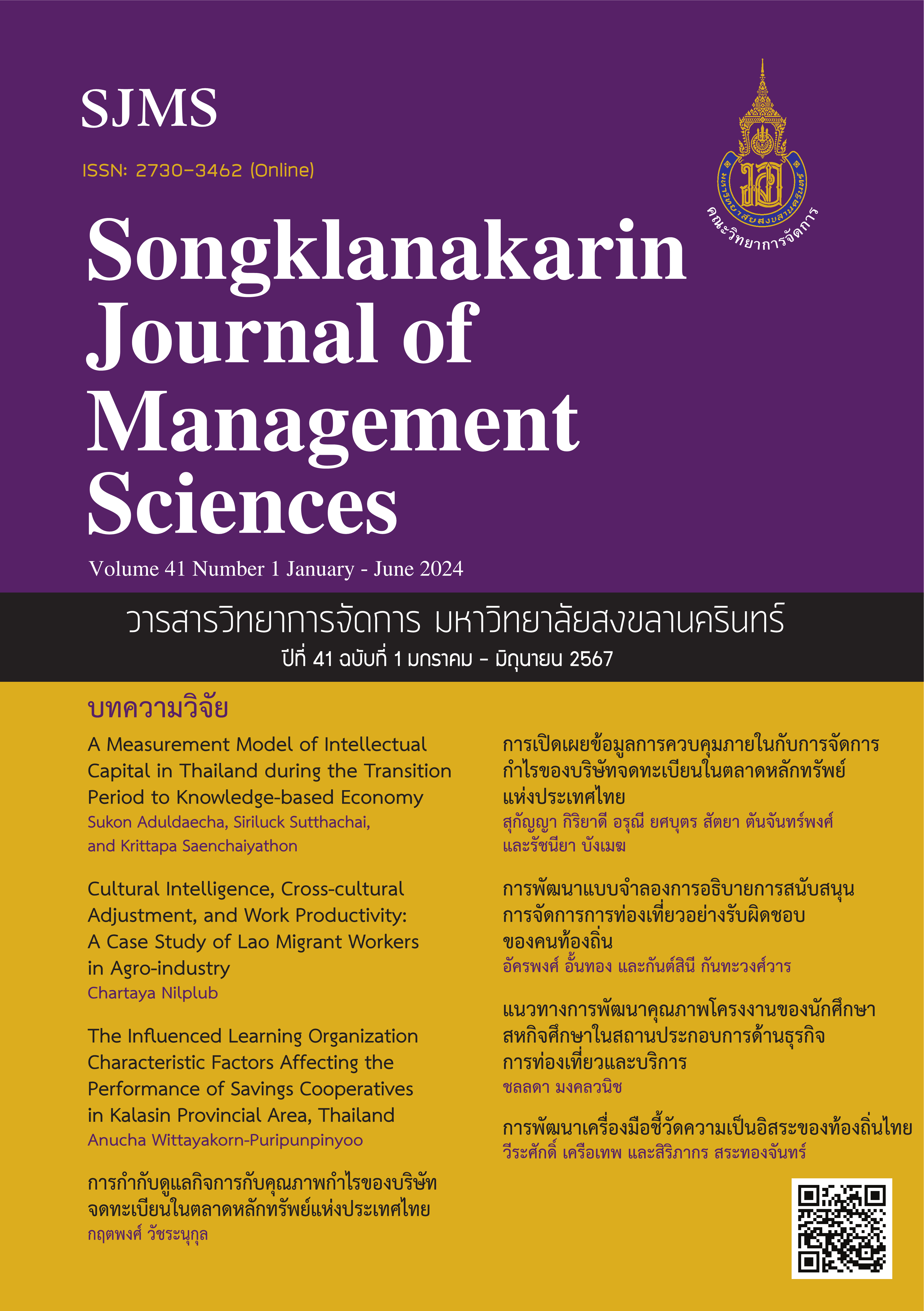
การพัฒนาแบบจำลองการอธิบายการสนับสนุนการจัดการการท่องเที่ยวอย่างรับผิดชอบของคนท้องถิ่น
Article Sidebar
Main Article Content
บทคัดย่อ
บทความนี้มีวัตถุประสงค์เพื่อพัฒนาแบบจำลองการอธิบายการสนับสนุนการจัดการการท่องเที่ยวอย่างรับผิดชอบของคนท้องถิ่น ที่ประกอบด้วยตัวแปรแฝง 5 ตัวแปร และตัวแปรสังเกต 16 ตัวแปร ประยุกต์ใช้แบบจำลองสมการโครงสร้างวิเคราะห์ข้อมูลจากการใช้แบบสอบถามกับคนท้องถิ่น 200 ตัวอย่าง ผลการศึกษา พบว่า การจัดการการท่องเที่ยวอย่างรับผิดชอบทำให้คนท้องถิ่นมีความพึงพอใจต่อคุณภาพชีวิตเพิ่มขึ้น ซึ่งเป็นสิ่งสำคัญที่ช่วยกระตุ้นให้คนท้องถิ่นสนับสนุนการจัดการการท่องเที่ยวอย่างรับผิดชอบ เช่นเดียวกับการให้ข้อมูลการจัดการตามแนวทางการท่องเที่ยวอย่างรับผิดชอบในชุมชนกับคนท้องถิ่น โดยเฉพาะเรื่องการดูแลแหล่งท่องเที่ยวในชุมชน ดังนั้น หากต้องการกระตุ้นให้คนท้องถิ่นมีส่วนร่วมและสนับสนุนการจัดการการท่องเที่ยวอย่างรับผิดชอบในชุมชน ภาคส่วนที่เกี่ยวข้องควรให้ข้อมูลกับคนท้องถิ่นเกี่ยวกับการจัดการดูแลการท่องเที่ยวอย่างรับผิดชอบในชุมชนอย่างสม่ำเสมอ และควรจัดเวทีเพื่อเปิดโอกาสให้คนท้องถิ่นมีส่วนร่วมกับการจัดการการท่องเที่ยวอย่างรับผิดชอบในชุมชน นอกจากนี้ ควรจัดกิจกรรมที่เกี่ยวข้องกับการท่องเที่ยวในชุมชนที่เป็นการเปิดโอกาสให้คนท้องถิ่นแสดงถึงความห่วงใยต่อผู้อื่นในสังคมและผู้เยี่ยมเยือน ซึ่งนอกจากทำให้คนท้องถิ่นสนับสนุนการท่องเที่ยวอย่างรับผิดชอบในชุมชนแล้วยังทำให้คนท้องถิ่นพึงพอใจต่อคุณภาพชีวิตเพิ่มขึ้นด้วย
Article Details

อนุญาตภายใต้เงื่อนไข Creative Commons Attribution-NonCommercial-NoDerivatives 4.0 International License.
บทความที่ตีพิมพ์ถือเป็นลิขสิทธิ์ของวารสารวิทยาการจัดการ มหาวิทยาลัยสงขลานครินทร์ อย่างไรก็ตาม กองบรรณาธิการไม่สงวนลิขสิทธิ์ในการทำซ้ำ คัดลอก หรือเผยแพร่ แต่จะต้องอ้างอิงให้ถูกต้องตามหลักวิชาการ
เอกสารอ้างอิง
Camilleri, M. A. (2016). Responsible tourism that creates shared value among stakeholders. Tourism Planning Development, 13(2), 219-235.
Dotto, D. M. R., & Slongo, L. A. (2020). Responsible tourism - Divergences between the principles of sustainability and the actions of the tourism sector in Brazil. Journal of Tourism, Culture and Territorial Development, 11(21), 23-41.
Erul, E., & Woosnam, K. M. (2022). Explaining residents’ behavioral support for tourism through two theoretical frameworks. Journal of Travel Research, 61(2), 362-377.
Eslami, S., Khalifah, Z., Mardani, A., Streimikiene, D., & Han, H. (2019). Community attachment, tourism impacts, quality of life and residents’ support for sustainable tourism development. Journal of Travel & Tourism Marketing, 36(9), 1061-1079.
Font, X., & Lynes, J. (2018). Corporate social responsibility in tourism and hospitality. Journal of Sustainable Tourism, 26(7), 1027-1042.
Ganji, S. F. G., Johnson, L. W., & Sadeghian, S. (2021). The effect of place image and place attachment on residents’ perceived value and support for tourism development. Current Issues in Tourism, 24(9), 1304-1318.
Goodwin, H. (2016). Responsible Tourism: Using Tourism for Sustainable Development. Oxford: Goodfellow Publishers Limited.
Hair, J. F., Black, W. C., Babin, B. J., & Anderson, R. E. (2019). Multivariate Data Analysis. 8th ed. Hampshire: Cengage Learning EMEA.
Hanafiah, M. H., Azman, I., Jamaluddin, M. R., & Aminuddin, N. (2016). Responsible tourism practices and quality of life: Perspective of Langkawi Island communities. Procedia - Social and Behavioral Sciences, 222, 406-413.
Hu, L. T., & Bentler, P. M. (1999). Cutoff criteria for fit indexes in covariance structure analysis: Conventional criteria versus new alternatives. Structural Equation Modeling, 6(1), 1-55.
Jöreskog, K. G., & Sörbom, D. (1999). LISREL 8 User’s Reference Guide. Lincolnwood, IL: Scientific Software International, Inc.
Kline, R. B. (2011). Principles and Practice of Structural Equation Modeling. 3rd ed. New York: The Guilford Press.
Kumar, A., & Nandani, G. (2016). Responsible tourism: Awareness among host community. Quest-The Journal of UGC-HRDC, 10(3), 293-298.
Mathew, P. V., & Sreejesh, S. (2017). Impact of responsible tourism on destination sustainability and quality of life of community in tourism destinations. Journal of Hospitality and Tourism Management, 31, 83-89.
Muthén, L. K., & Muthén, B. O. (2012). Mplus User’s Guide. Seven Edition. Los Angeles, CA: Muthén & Muthén.
Nunkoo, R., & So, K. K. F. (2016). Residents’ support for tourism: Testing alternative structural model. Journal of Travel Research, 55(7), 847-861.
Soper, D. S. (2022). A-priori Sample Size Calculator for Structural Equation Models. Retrieved June, 7, 2022, from https://www.danielsoper.com/statcalc/calculator.aspx?id=89
Steiger, J. H. (2007). Understanding the limitations of global fit assessment in structural equation modeling. Personality and Individual Differences, 42(5), 893-898.
Stoffelen, A., Adiyia, B., Vanneste, D., & Kotze, N. (2020). Post- apartheid local sustainable development through tourism: An analysis of policy perceptions among ‘responsible’ tourism stakeholders around Pilanesberg National Park, South Africa. Journal of Sustainable Tourism, 28(3), 414-432.
Tabachnick, B. G., & Fidell, L. S. (2013). Using Multivariate Statistics. 6th ed. New York: Pearson.
Tournois, L., & Djeric, G. (2019). Evaluating urban residents’ attitudes towards tourism development in Belgrade (Serbia). Current Issues in Tourism, 22(14), 1670-1678.
Untong, A. (2022). An application of theory reasoned action to examine factors explaining residents’ support for community-based tourism. Srinakharinwirot Research and Development (Journal of Humanities and Social Sciences), 14(7), 193-205.
Vodeb, K., Fabjan, D., & Krstinić Nižić, M. (2021). Residents’ perceptions of tourism impacts and support for tourism development. Tourism and Hospitality Management, 27(1), 143-166.
Zagonari, F. (2019). Multi-criteria, cost-benefit, and life-cycle analyses for decision-making to support responsible, sustainable, and alternative tourism. Sustainability, 11(4), 1-35.
Zaman, U., Aktan, M., Agrusa, J., & Ghani Khwaja, M. (2022). Linking regenerative travel and residents’ support for tourism development in Kaua’I Island (Hawaii): Moderating-mediation effect of travel-shaming and foreign tourist attractiveness. Journal of Travel Research, 62(4), 782-801.
Zgolli, S., & Zaiem, I. (2018). The responsible behavior of tourist: The role of personnel factors and public power and effect on the choice of destination. Arab Economics and Business Journal, 13(2), 168-178.
