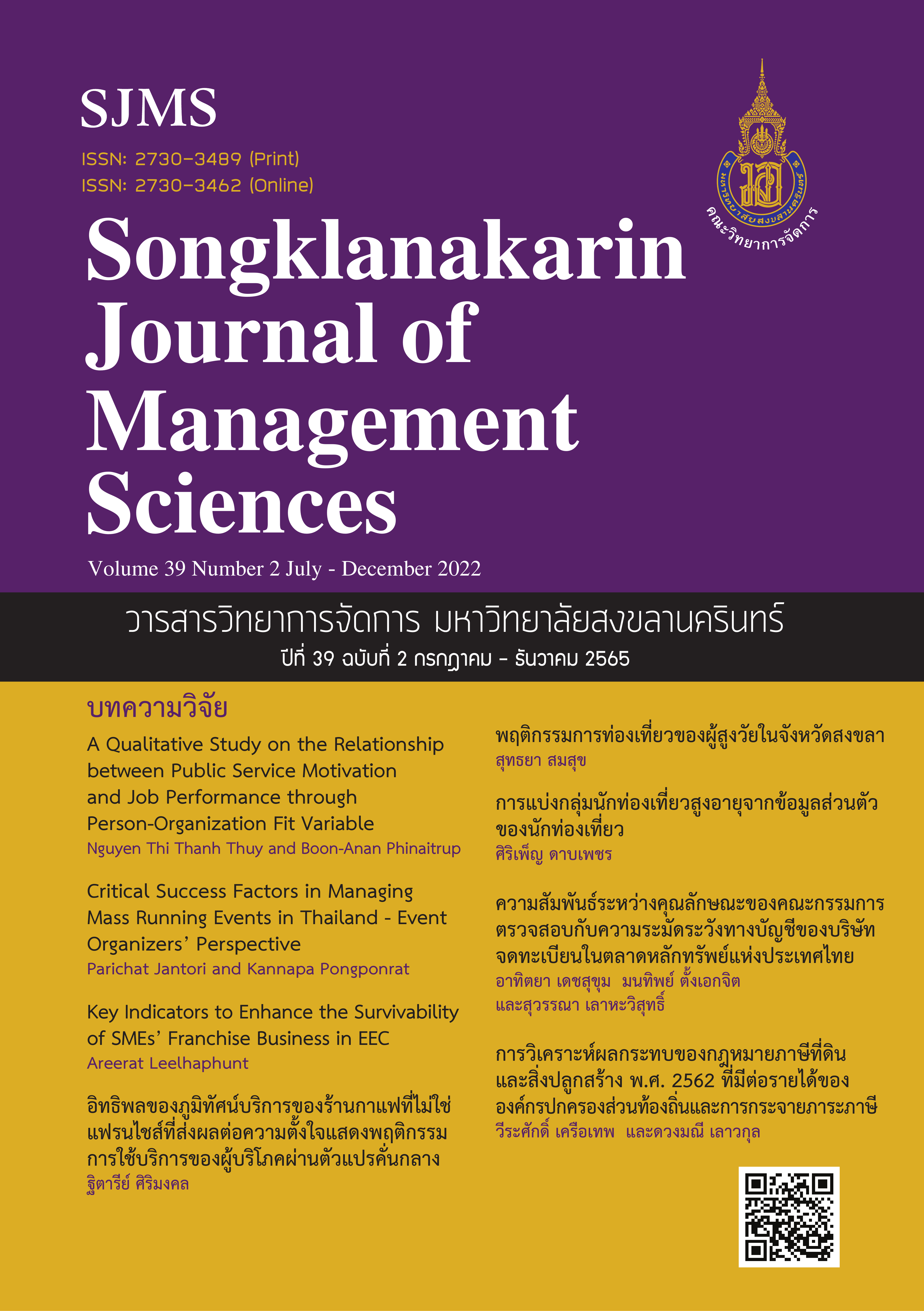
Relationship between Audit Committee Characteristics and Accounting Conservatism of Listed Companies in The Stock Exchange of Thailand
Article Sidebar
Main Article Content
Abstract
The objective of this research was to study the relationship between audit committee characteristics and accounting conservatism of listed companies in the stock exchange of Thailand. The data were collected by financial reports and annual reports of listed companies in the stock exchange of Thailand during B.E.2557 to B.E.2561. From multiple regression analysis, it was found that accounting and financial knowledge of audit committee was significantly positively related to accounting conservatism. The tenure of audit committee members was significantly negatively related to accounting conservatism. Lastly, the size of the audit committee and the frequency of the audit committee's meetings wasn't related to accounting conservatism. Therefore, the results of this study can be beneficial to the supervisory board of listed companies and the stakeholders that they should pay more attention to the characteristics of accounting and financial knowledge and the tenure of audit committee members. These characteristics affect the audit committee’s performance and perceived financial reports which can affect accounting conservatism in which the stakeholders can apply it in economic decision making. In addition, the results of this study are considered as an extension and development of knowledge about the relationship of audit committee characteristics and the quality of financial reports. Within the context of Thailand, the audit committee is considered as a mechanism and plays an important role in companies' audit and review according to appropriate standard.
Article Details

This work is licensed under a Creative Commons Attribution-NonCommercial-NoDerivatives 4.0 International License.
All published articles are SJMS’s copyright. The editorial board allows all published articles to be copied, excerpted, or disseminated with academic citation.
References
Ahmed, A. S., Billings, B. K., Morton, R. M., & Stanford-Harris, M. (2002). The role of accounting conservatism in mitigation bondholder-shareholder conflict. The Accounting review, 77(4), 867-90.
Ahmed, A. S., & Duellman, S. (2007). Accounting conservatism and board of director characteristics : An empirical analysis. Journal of accounting and economics, 43(2-3), 411-437.
Bank of Thailand. (2003). The Economic and Monetary Conditions in 2000. Retrieved April 15, 2020, from https://www.bot.or.th/Thai/MonetaryPolicy/EconomicConditions/AnnualReport/AnnualReport/econ_annual03.pdf
Basu, S. (1997). The conservatism principle and the asymmetric timeliness of earnings. Journal of Accounting and Economics, 24(1), 3-37.
Beekes, W., Pope, P., & Young, S. (2004). The like between earnings timeliness, earnings conservatism and board composition : evidence from the UK. Corporate Governance. An Internation Review, 12(1), 47-59.
Bedard, J., Chtourou. S. M., & Courteau, L. (2004). The effect of audit committee expertise, independence and activity on aggressive earnings management. Auditing A Journal of Practice and Theory, 23(2), 13-35.
Beaver, W. (1968). The information content of annual earnings announcements. Journal of Accounting Research, 6(3), 67-92.
Boonlert-U-Thai, K., & Phakdee, A. (2019). Audit committee, aboard education, and accounting conservatism. Journal of Business Administration, 42(162), 1-26.
Bungkilo, D. (2005). Conservatism of accounting earnings : The case of non-financial listed companies in the stock exchange of Thailand. Chulalongkorn University.
Defond, M., Hann, R. N., & Hu, X. (2005). Does the market value financial expertise on audit committees of board of directors?. Journal of Accounting Research, 27(3), 787-827.
Dhaliwal, D., Naiker, V., & Navissi, F. (2010). The association between accruals quaility and the characteristics of accounting experts and mix of expertise on audit committees. Contemporary Accounting Research, 27(3), 787-827.
Jensen, M., & Meckling, W. (1976). Theory of the Firm : Managerial Behavior, Agency Costs , and Ownnership Structure. Journal of Financial Economics, 3(4), 305-360.
Jun Lin, Z., Xiao, J. Z., & Tang, Q. (2008). The roles, responsibilities and characteristics of audit committee in China. Accounting, Auditing and Accountability Journal, 21(5), 721-751.
Givoly, D., & Hayn, C. K. (2000). The changing time series properties of earnings , cash flows and accruals : Has financial reporting become more conservative?. Journal of Accounting and Economics, 29(3), 287-320.
Hamdan, A. M. M., Al-Hayale, T. M., & Aboagela, E. M. (2012). The impact of audit committee characteristics on account conservatism : Additional evidence from Jordan. Journal of King Saud University, 24(1), 1-15.
Ho, J. A., (2009). Association between Board Characteristics and Accounting Conservatism: Empirical Evidence for Malaysia. Auckland Univerity of Technology.
LaFord, R., & Watts, R. L. (2008). The information role of conservatism. The accounting review, 83(2), 447-478.
Klein, A. (2002). Audit committee, board of director characteristics and Earning management. Journal of Accounting and Economics, 33(3), 375-400.
Komutputipong, N. (2014). Earnings quality measurement for security analysis. Chulalongkorn Business Review, 36(139), 1-18.
Krishnan, G. V., & Visvanathan, G. (2008). Does the SOX definition of an accounting expert matter? The association between audit committee directors' accounting expertise and accounting conservatism. Contemporary Accounting Research, 25(3), 827-858.
Olyhoek, K. (2017). Accounting conservatism and the Audit committee. Erasmus School of Economics.
Pae, J. (2007). Unexpected accruals and conditional accounting conservatism. Journal of business finance and accounting, 34(5&6), 681-704.
Pankam, P., & Sampet, J. (2017). The relationship between audit committee characteristics and earnings quality of listed companies in the Stock Exchange of Thailand. Accba Journal, 3(3), 208-219.
Sharma, V. D., & Iselin, E. R. (2012). The association between audit committee multiple-directorships, tenure, and financial misstatements. Auditing: A journal of Practice & Theory, 31(9), 149-175.
Sultana, N. (2015). Audit committee characteristics and accounting conservatism. International Journal of Auditing, 19(2), 88-102.
The Securities and Exchange Commission. (2010). Audit committee handbook. Retrieved April 10, 2020, from https://www.sec.or.th/cgthailand/TH/Documents/Regulation/AChandbook
The Stock Exchange of Thailand. (2016). Independent director and audit committee. Retrieved November 26, 2018, from https://www.set.or.th/th/regulations/simplified_regulations/
Vafeas, N. (2005). Audit committees, boards and the quality of reported earnings. Contemporary Accounting Research, 22(4), 1093-1122.
Watts, R. L. (2003). Conservatism in accounting part1 : Explanations and implications. Accounting Horizon, 17(3), 207-221.
Zhang, Y., Zhou, J., & Zhou, N. (2007). Audit committee quality, auditor independence and internal control weaknesses. Journal of accounting and public policy, 26(3), 300-327.
