A Structural Equation Modeling of Brand Love to Brand Loyalty and Word-of-Mouth of Thailand Post Service Users
Article Sidebar
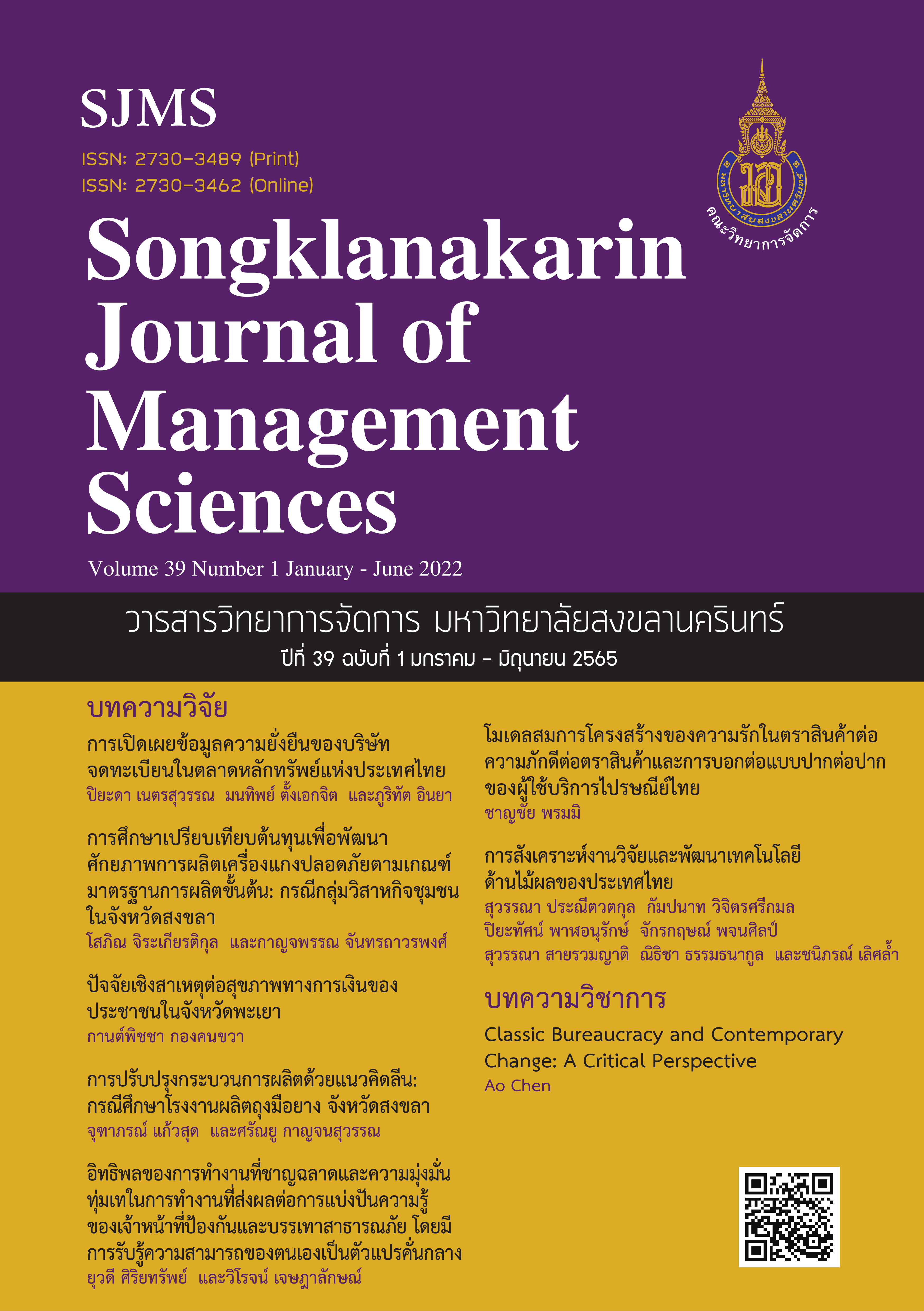
Main Article Content
Abstract
The objective of this research is to study the influence of brand love on brand loyalty and word-of-mouth of Thailand Post service users. Questionnaires were used to collect data from the infinite population in upper Northern provinces. A random sampling technique was used in this research. 395 collected questionnaires were returned and completed. The data was analyzed by structural equation modeling. The results indicated that brand love had a direct influence on brand loyalty and word-of-mouth, it also had an indirect influence on word-of-mouth with that has brand loyalty as a mediator. In terms of academic implications, this research reflected a prominent role of brand love in consumer behavioral expressions on the brand re-patronage, increasing the amount of time to use the service and giving advice to other people. Future research may be conducted on the influence of antecedents that drive brand love in the Thailand Post to investigate the causes of users thinking and feeling love over the brand. Additionally, with regard to practical implications, entrepreneurs can develop marketing strategies to motivate consumers’ love for the brand and to retain the consumers in the long term.
Article Details

This work is licensed under a Creative Commons Attribution-NonCommercial-NoDerivatives 4.0 International License.
All published articles are SJMS’s copyright. The editorial board allows all published articles to be copied, excerpted, or disseminated with academic citation.
References
Albert, N., & Merunka, D. (2015). Role of brand love in consumer brand relationships. In M. Fetscherin & T. Heilmann (Eds)., Consumer brand relationships (pp. 15-30). London: Palgrave Macmillan.
Albert, N., Merunka, D., & Valette-Florence, P. (2008). When Consumers Love their Brands: Exploring the Concept and its Dimensions. Journal of Business Research, 61(10), 1062-1075.
Amatyakul, S., & Polyorat, K. (2016). Brand Personality. Executive Journal, 36(2), 89-101.
Bairrada, C. M., Coelho, A., & Lizanets, V. (2018). The Impact of Brand Personality on Consumer Behavior: The Role of Brand Love. Journal of Fashion Marketing and Management, 23(1), 30-47.
Bangkokpost. (2020). 2020 Online Trade Set to Hit B220bn. Retrieved November 13, 2020, from https://www.bangkokpost.com/business/1921656/2020-online-trade-set-to-hit-b220bn
Batra, R., Ahuvia, A. C., & Bagozzi, R. P. (2012). Brand Love. Journal of Marketing, 76(2), 1-16.
Bıçakcıoğlu, N., İpek, İ., & Bayraktaroğlu, G. (2016). Antecedents and Outcomes of Brand Love: The Mediating Role of Brand Loyalty. Journal of Marketing Communications, 24(8), 863-877.
Carroll, B. A., & Ahuvia, A. C. (2006). Some Antecedent and Outcomes of Brand Love. Marketing Letters, 17(2), 79-89.
Dick, A., & Basu, K. (1994). Customer Loyalty: Toward an Integrated Conceptual Framework. Journal of the Academy of Marketing Science, 22(2), 99-113.
Fetscherin, M. (2014). What Type of Relationship Do We Have With Loved Brands?. Journal of Consumer Marketing, 31(6/7), 430-440.
Gremler, D. D., & Gwinner, K. P. (2000). Customer-Employee Rapport in Service Relationships. Journal of Service Research, 3(1), 82-104.
Hair, J. F. Jr., Black, W. C., Babin, B. J., & Anderson, R. E. (2010). Multivariate Data Analysis: A Global Perspective (7th Ed.). New Jersey: Prentice Hall.
Han, H., Yu, J., Chua, B-L., Lee, S., & Kim, W. (2019). Impact of Core- Product and Service-Encounter Quality, Attitude, Image, Trust and Love on Repurchase: Full-Service vs Low-Cost Carriers in South Korea. International Journal of Contemporary Hospitality Management, 31(4), 1588-1608.
Hayeemad, M., & Polyorat, K. (2013). Brand Loyalty: The Attitudinal and Behavioral Dimensions. Journal of Business, Economics and Communications, 8(1), 67-73.
Henseler, J., Ringle, C. M., & Sarstedt, M. (2015). A New Criterion for Assessing Discriminant Validity in Variance-Based Structural Equation Modeling. Journal of the Academy of Marketing Science, 43(1), 115-135.
Ismail, A. R., & Spinelli, G. (2012). Effects of Brand Love, Personality and Image on Word of Mouth: The Case of Fashion Brands among Young Consumers. Journal of Fashion Marketing and Management, 16(4), 386-398.
Ivanauskiene, N., & Auruskeviciene, V. (2009). Loyalty Programs Challenges in Retail Banking Industry. Economics & Management, 14, 407-412.
Jaenglom, K., & Tantipidok, P. (2020). 2020 EIC Business Analysis in Parcel Delivery Business: Continuous Growth Trend
in Intense Competition and Price Pressure. Retrieved August 3, 2020, from https://www.scbeic.com/th/detail/file/product/6563/fjy80kx109/EIC_Industry-review_parcel_20200120.pdf
Karjaluoto, H., Munnukka, J., & Kiuru, K. (2016). Brand Love and Positive Word of Mouth: The Moderating Effects of Experience and Price. Journal of Product & Brand Management, 25(6), 527-537.
Keller, K. L. (2013). Strategic Brand Management: Building, Measuring, and Managing Brand Equity (4th Ed.). New Jersey: Pearson Education Inc.
Ketudat, T., Kimpakorn, N., & Chulikavit, K. (2020). Impact of Corporate Image and Brand Image on Quality of Consumer-Brand Relationship in the Banking Sector. Journal of Mass Communication, 8(1), 1-33.
Kim, S-H., & Lee, S. A. (2020). The Role of Marketing Communication Mix on Korean Customers' Coffee Shop Brand Evaluations. Journal of Hospitality and Tourism Insights, 3(3), 291-309.
Kline, R. B. (2005). Principles and Practice of Structural Equation Modeling (2nd Ed.). New York: Guilford Press.
Loo, R., & Thorpe, K. (2000). Confirmatory Factor Analyses of the Full and Short Versions of the Marlowe-Crowne Social Desirability Scale. Journal of Social Psychology, 140(5), 628-635.
Mahittivanicha, N. (2019). E-Commerce Statistics 2019 by PriceZa. Retrieved August 2, 2020, from https://www.twfdigital.com/blog/2019/11/thailand-e-commerce-stats-2019-by-priceza/
Niyomsart, S., & Khamwon, A. (2016). Brand Love, Brand Loyalty, and Word of Mouth: A Case of Airasia. Conference of the International Journal of Arts & Sciences. 9(1), 263-268.
Pasunon, P. (2015). Validity of Questionnaire for Social Science Research. Journal of Social Science Srinakharinwirot University, 18(18), 375-396.
Phang, I. G., & Goh, Y. S. (2019). Offline Brand Outcomes of Instagram: Do Cognitive Network and Self-Congruity Matter?. Asian Journal of Business and Accounting, 12(2), 287-314.
Pontinha, V. M., & do Vale, R. C. (2020). Brand Love Measurement Scale Development: An Inter-Cultural Analysis. Journal of Product & Brand Management, 29(4), 471–489.
Richins, M. L. (1983). Negative Word-of-Mouth by Dis-satisfied Consumers: A Pilot Study. Journal of Marketing, 47(1), 68-78.
Roy, P., Khandeparkar, K., & Motiani, M. (2016). A Lovable Personality: The Effect of Brand Personality on Brand Love. Journal of Brand Management, 23(5), 97-113.
Sajjanit, C. (2020). Influence of Reference Groups and Positive eWOM on Consumer Responses to Green Products. Chulalongkorn Business Review, 42(3), 68-92.
Sallam, M. A. (2014). The Effects of Brand Image and Brand Identification on Brand Love and Purchase Decision Making: The Role of WOM. International Business Research, 7(10), 187-193.
Siritho, S., & Chanpanya, P. (2012). The Measurement and Prediction of Brand Loyalty on Mobile Phone Service Providers: The Comparison Case of AIS, DTAC and TRUEMOVE. MUT Journal of Business Administration, 9(2), 1-19.
Sitthichai, S., & Khunon, S. (2015). Measuring Customer Loyalty for Hotel Industry. Executive Journal, 35(1), 64-74.
Soedarto, T., Kurniawan, G. S. A., & Sunarsono, R. J. (2019). The Parceling of Loyalty: Brand Quality, Brand Affect, and Brand Trust Effect on Attitudinal Loyalty and Behavioral Loyalty. Academy of Strategic Management Journal, 18(1), 1-15.
Soonsan, N., & Sukahbot, S. (2020). Causal Relationships between Destination Image, Place Attachment, Overall Satisfaction, and Behavioral Intention of Western Tourists in Phuket. Chulalongkorn Business Review, 42(163), 68-83.
Suksawang, P. (2014). The Basics of Structural Equation Modeling. Princess Naradhiwas University Journal, 6(2), 136-145.
Thomson, M., MacInnis, D. J., & Park, C. W. (2005). The Ties that Bind: Measuring the Strength of Consumers’ Emotional Attachments to Brands. Journal of Consumer Psychology, 15(1), 77-91.
Wallace, E., Buil, L., & Chernatony, L. de. (2014). Consumer Engagement with Self-Expressive Brands: Brand Love and WOM Outcomes. Journal of Product & Brand Management, 23(1), 33–42.
Yasin, M., & Shamin, A. (2013). Brand Love: Mediating Role in Purchase Intentions and Word-of Mouth. IOSR Journal of Business and Management, 7(2), 101-109.
Yohn, D. L. (2020). The Pandemic Is Rewriting the Rules of Retail. Retrieved November 11, 2020, from https://hbr.org/2020/07/the-pandemic-is-rewriting-the-rules-of-retail
