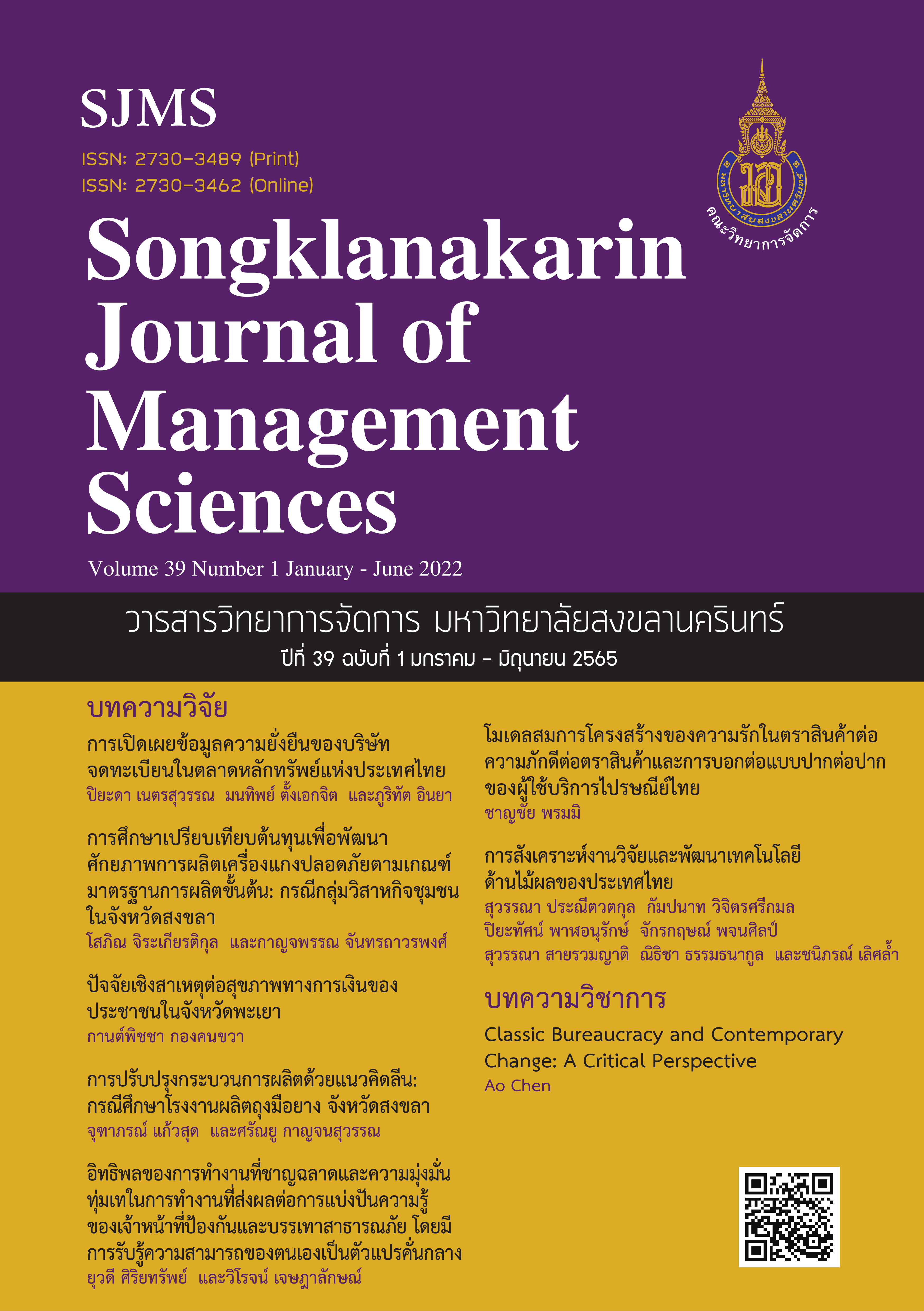
ปัจจัยเชิงสาเหตุต่อสุขภาพทางการเงินของประชาชนในจังหวัดพะเยา
Article Sidebar
Main Article Content
บทคัดย่อ
การวิจัยนี้มีวัตถุประสงค์เพื่อ (1) ประเมินสุขภาพทางการเงินและทักษะทางการเงิน และ (2) ศึกษาปัจจัยที่มีอิทธิพลต่อสุขภาพทางการเงิน โดยเก็บข้อมูลจากประชาชนที่มีอายุ 21-60 ปี ในจังหวัดพะเยาด้วยแบบสอบถามจำนวน 384 คน ซึ่งใช้การสุ่มแบบหลายขั้นตอน และใช้การวิเคราะห์เส้นทางเพื่อระบุความสัมพันธ์เชิงสาเหตุ ผลการวิจัย พบว่า ทุกกลุ่มอายุมีสุขภาพทางการเงินในระดับปานกลาง และมีทักษะทางการเงินในระดับสูง โดยกลุ่มอายุ 21-30 ปี มีคะแนนสุขภาพทางการเงินและทักษะทางการเงินสูงสุด แต่กลุ่มที่มีคะแนนต่ำสุดคือ กลุ่มอายุ 51-60 ปี นอกจากนี้ ผลการวิเคราะห์เส้นทาง พบว่า การเพิ่มขึ้นของสุขภาพทางการเงินมีอิทธิพลมาจากปัจจัยด้านสถานภาพ ระดับการศึกษา รายได้ ค่าใช้จ่าย ความรู้ด้านดอกเบี้ย ความรู้ด้านเงินเฟ้อ และความรู้ด้านกระจายความเสี่ยง ในทางตรงกันข้ามการลดลงของสุขภาพทางการเงินมีอิทธิพลมาจากปัจจัยด้านอายุ และอาชีพ ผลการวิจัยนี้แสดงให้เห็นถึงความสำคัญของการมีสุขภาพทางการเงินที่ดี ซึ่งสามารถแก้ไขปัญหาการใช้จ่าย หนี้สิน และสภาพคล่องทางการเงินส่วนบุคคลได้
Article Details

อนุญาตภายใต้เงื่อนไข Creative Commons Attribution-NonCommercial-NoDerivatives 4.0 International License.
บทความที่ตีพิมพ์ถือเป็นลิขสิทธิ์ของวารสารวิทยาการจัดการ มหาวิทยาลัยสงขลานครินทร์ อย่างไรก็ตาม กองบรรณาธิการไม่สงวนลิขสิทธิ์ในการทำซ้ำ คัดลอก หรือเผยแพร่ แต่จะต้องอ้างอิงให้ถูกต้องตามหลักวิชาการ
เอกสารอ้างอิง
Agarwalla, K. S., Barua, K. S., Jacob, J., & Varma, R. J. (2015). Financial literacy among working young in urban India. World Development, 67(1), 101-109.
Agnew, R. J., Bateman, H., & Thorp, S. (2013). Financial literacy and retirement planning in Australia. Numeracy, 6(2), 1-25.
Auepiyachut, W. (2017). Financial Literacy: Determinants and its Implications for Saving Behavior. Humanities and Social Sciences Burapha University, 25(47), 67-93.
Bank of Thailand. (2015). Financial Literacy Measurement and Saving for Retirement. Retrieved December 25, 2019, from https://www.bot.or.th
Beckmann, E. (2013). Financial literacy and household savings in Romania. Numeracy, 6(2), 1-22.
Behrman, R. J., Mitchell, S. O., Soo, K. C., & Bravo, D. (2012). How financial literacy affects household wealth accumulation. American Economic Review, 102(3), 300-304.
Clercq, D. B., & Venter, J. (2009). Factors influencing a prospective chartered accountant’s level of financial literacy: an exploratory study. Meditari Accountancy Research, 17(2), 47-60.
Halilovic, S., Zaimovic, A., Berilo, A. A., & Zaimovic, T. (2019). Financial literacy assessment in Bosnia and Herzegovina. Procedia Computer Science, 158(1), 863-843.
Hastings, S. J., & Mitchell, S. O. (2020). How financial literacy and impatience shape retirement wealth and investment behaviors. Journal of Pension Economics and Finance, 19(1), 1-20.
Huston, J. S. (2010). Measuring financial literacy. The Journal of Consumer Affairs, 44(2), 296-316.
Inlakorn, S. (2016). Personal Finance (5th Ed.). Bangkok: Kasetsart University Press.
Kapoor, J., Dlabay, L., & Hughes, J. R. (2013). Focus on Personal Finance: An Active Approach to Help You Develop Successful Financial Skill (4th Ed.). New York: Mc Graw-Hill.
Kenan Foundation Asia. (2015). Improvement for better Finance in Thailand. Retrieved December 22, 2019, from https://thaipublica.org
Koenen, B. T., Lusardi, A., Alessie, R., & Rooij, V. M. (2017). How financially literate are women? An overview and new insights. The Journal of Consumer Affairs, 51(2), 255-283.
Konkaew, W. (2014). The Health Behavior of Elderly of Klongtumru Sub-district, Amphoe Mueang Chon Buri. Retrieved December 28, 2019, from http://www2.gspa.buu.ac.th
Krejcie, V. R., & Morgan, W. D. (1970). Determining Sample Size for Research activities. Educational and Psychological Measurement, 30(3), 607-610.
Lusardi, A., & Mitchell, S. O. (2011). Financial literacy and planning: implications for retirement wellbeing. Retrieved December 28, 2019, from https://www.nber.org
Mihalcova, B., Csikosova, A., & Janoskova, M. (2014). Financial literacy – the urgent need today. Procedai – Social and Behavioral Sciences, 109(1), 317-321.
Nampud, S., Chareanjittrakram, A., & Wiwatthana, S. (2014). Strategic Personal Finance Management (6th Ed.). Bangkok: Thammasat University Press.
National Statistical Office of Thailand. (2019a, 2019b, 2019c). Statistics of household income and expenditure and their distribution. Retrieved December 20, 2019, from http://statbbi.nso.go.th
Posttoday. (2020). Financial health. Retrieved October 1, 2020, from https://www.posttoday.com
Saranjit, T. (2015). Problem of Poverty in Thailand. EAU Heritage Journal Social Science and Humanity, 5(2), 12-21.
Sektrakul, K. (2010). Personal Financial Planning. Retrieved December 2, 2019, from https://member.set.or.th
Supakitvanitchkul, A., & Phasunon, P. (2016). A Comparison of Savings Behavior and Financial Management before the Retirement: Case Study of the Staffs in Silpakorn University, Sanamchan Campus, Nakhon Pathom. Veridian E-Journal Silpakorn University Humanities, Social Sciences, and Arts, 9(2), 375-389.
The Stock Exchange of Thailand. (2011). Comprehensive Financial Planning (2nd Ed.). Bangkok: Boonsiri Printing Co., Ltd.
The Stock Exchange of Thailand. (2019). Financial Health Check. Retrieved December 30, 2019, from https://www.set.or.th
Vanichbuncha, K. (2019). Structural Equation Modeling Analysis with AMOS (3rd Ed.). Bangkok: Threelada Limited Partnership.
Wongjan, R. (2015). Personal Financial Management (3rd Ed.). Bangkok: Boonsiri Printing Co., Ltd.
Worthington, C. A. (2006). Predicting financial literacy in Australia. Financial Services Review, 15(1), 59-79.
