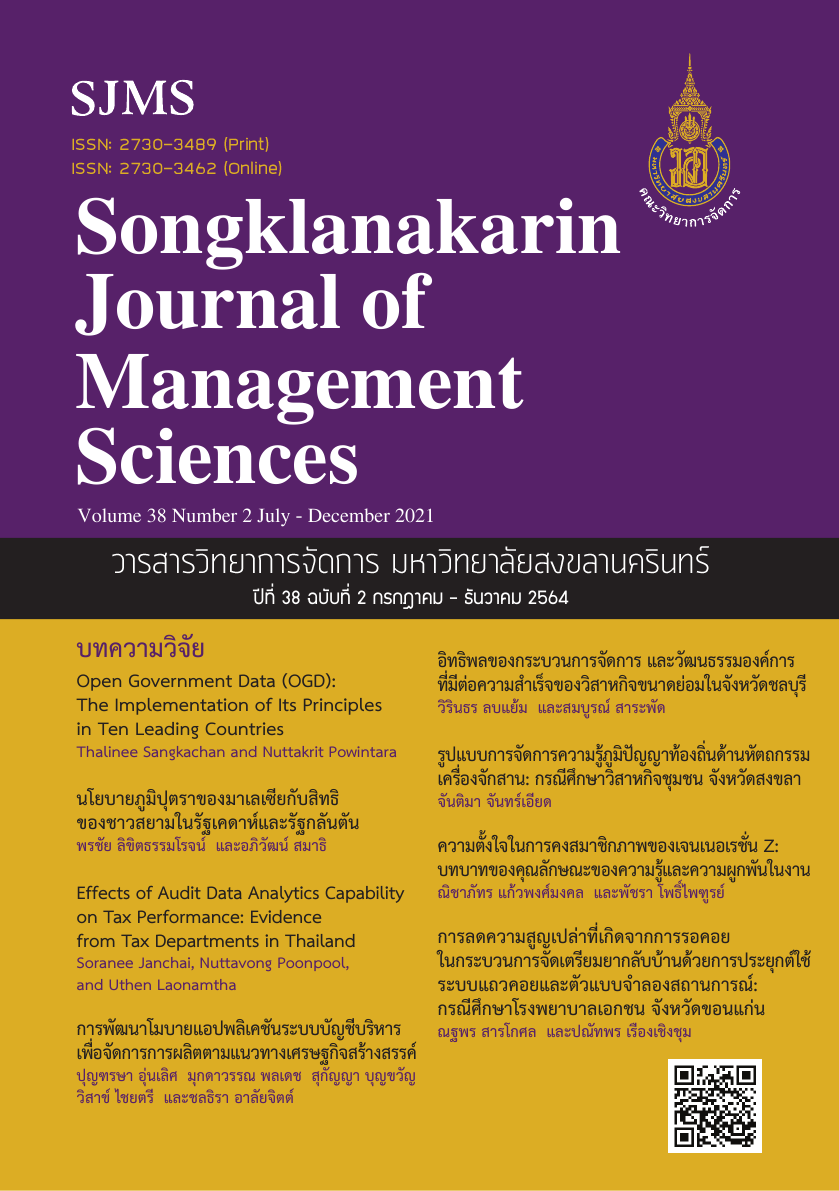
ความตั้งใจในการคงสมาชิกภาพของเจนเนอเรชั่น Z: บทบาทของคุณลักษณะของความรู้และความผูกพันในงาน
Article Sidebar
Main Article Content
บทคัดย่อ
งานวิจัยนี้มีวัตถุประสงค์เพื่อศึกษาอิทธิพลและบทบาทของคุณลักษณะของความรู้และความผูกพันในงานต่อความตั้งใจในการคงสมาชิกภาพของพนักงานเจนเนอเรชั่น Z โดยกลุ่มตัวอย่าง คือ ลูกจ้างภาคเอกชนในจังหวัดกรุงเทพมหานคร อายุระหว่าง 20-24 ปี จำนวน 200 คน ผู้วิจัยเก็บข้อมูลด้วยการใช้แบบสอบถามออนไลน์ ผลการวิเคราะห์การถดถอยพหุเชิงชั้น พบว่า ในการตัดสินใจคงสมาชิกภาพกับองค์กร พนักงานเจนเนอเรชั่น Z ให้ความสำคัญตามลำดับกับคุณลักษณะของความรู้ 2 ด้าน ได้แก่ ด้านที่ต้องใช้ความรู้ ความเชี่ยวชาญในงาน และด้านการใช้ความรู้เพื่อทำงานที่มีความซับซ้อน โดยคุณลักษณะของความรู้ดังกล่าวทำให้พนักงานเจนเนอเรชั่น Z มีความผูกพันในงานอันนำไปสู่การคงสมาชิกภาพต่อองค์กร หรือสรุปได้ว่า ความผูกพันในงานทำหน้าที่เป็นตัวแปรคั่นกลางโดยสมบูรณ์ระหว่างคุณลักษณะความรู้ด้านความเชี่ยวชาญในงานกับความตั้งใจในการคงสมาชิกภาพ และระหว่างคุณลักษณะความรู้ด้านความซับซ้อนของงานกับความตั้งใจในการคงสมาชิกภาพ ผลการวิจัยทำให้องค์กรเข้าใจบุคลากรกลุ่มเจนเนอเรชั่น Z มากยิ่งขึ้น และสามารถออกแบบงานที่จูงใจและตรงกับความต้องการของคนรุ่นใหม่ได้อย่างมีประสิทธิภาพ องค์กรสามารถใช้กลยุทธ์การออกแบบงานเป็นเครื่องมือ ในการสร้างความผูกพันและการรักษาบุคลากรให้คงอยู่กับองค์กรระยะยาว เพื่อสร้างความได้เปรียบในการบริหารทรัพยากรมนุษย์
Article Details

อนุญาตภายใต้เงื่อนไข Creative Commons Attribution-NonCommercial-NoDerivatives 4.0 International License.
บทความที่ตีพิมพ์ถือเป็นลิขสิทธิ์ของวารสารวิทยาการจัดการ มหาวิทยาลัยสงขลานครินทร์ อย่างไรก็ตาม กองบรรณาธิการไม่สงวนลิขสิทธิ์ในการทำซ้ำ คัดลอก หรือเผยแพร่ แต่จะต้องอ้างอิงให้ถูกต้องตามหลักวิชาการ
เอกสารอ้างอิง
Agarwal, U. A., & Gupta, V. (2018). Relationships between job characteristics, work engagement, conscientiousness and managers’ turnover intentions: a moderated-mediation analysis. Personnel Review, 47(2), 353-377.
Apisitniran L. (2019). How to meet changing labour demand. Bangkok Post, Retrieved July 29, 2020, from https://www.bangkokpost.com/business/1614914/how-to-meet-changing-labour-demand
Bakker, A. B., & Demerouti, E. (2008). Towards a model of work engagement. Career Development International, 13(3), 209-223.
Baron, R. M., & Kenny, D. A. (1986). The moderator-mediator variable distinction in social psychological research: conceptual, strategic and statistical considerations. Journal of Personality and Social Psychology, 51(6), 1173-1182.
Bencsik, A., Horváth-Csikós, G., & Juhász, T. (2016). Y and Z generations at workplaces. Journal of Competitiveness, 8(3), 90-106.
Bencsik, A., & Machova, R. (2016). Knowledge sharing problems from the viewpoint of intergeneration management. In ICMLG2016-4th International Conference on Management, Leadership and Governance: ICMLG2016 (p. 42). St Petersburg, Russia: Academic Conferences and Publishing Limited.
Cerasoli, C. P., Nicklin, J. M., & Ford, M. T. (2014). Intrinsic motivation and extrinsic incentives jointly predict performance: A 40-year meta-analysis. Psychological Bulletin, 140(4), 980-1008.
Cheng, Z., Nielsen, I., & Cutler, H. (2019). Perceived job quality, work-life interference and intention to stay: Evidence from the aged care workforce in Australia. International Journal of Manpower, 40(1), 17-35.
Chew, J., & Chan, C. (2008). Human resource practices, organizational commitment and intention to stay. International Journal of Manpower, 29(6), 503-522.
Chiou, H., Lee, Y., & Purnomo, S. H. (2010). The Influences of Transfer of Training on Relationship between Knowledge Characteristic of Work Design Model and Outcomes. International Journal of Innovation, Management and Technology, 1(2), 116-123.
Dechawatanapaisal, D. (2009). Perceptions of Generation Y’s Attributes and Motivational Preferences: Outlooks from Different Working Generations. Chulalongkorn Business Review, 31(3), 1-25.
Dechawatanapaisal, D. (2016). The relationship of quality of work life, work engagement and intention to quit. Chulalongkorn Business Review, 38(2), 121-148.
Fornell, C., & Larcker, D. F. (1981). Evaluating structural equation models with unobservable variables and measurement error. Journal of Marketing Research, 18(1), 39-50.
Friedrich, R., Peterson, M. Koster, A., & Blum, S. (2010). The rise of Generation C: Implications for the world of 2020, Booz & Company. Retrieved June 29, 2019, from https://www.strategyand.pwc.com/media/file/Strategyand_Rise-of-Generation-C.pdf.pdf
Hackman, J. R., & Oldham, G. R. (1976). Motivation through the design of work: Test of a theory. Organizational Behavior and Human Performance, 16(2), 250-279.
Hackman, J. R., & Oldham, G. R. (1980). Work Redesign, Addison-Wesley, Reading, MA.
Hausknecht, J. P., Trevor, C. O., & Howard, M. J. (2009). Unit-level voluntary turnover rates and customer service quality: Implications of group cohesiveness, newcomer concentration, and size. Journal of Applied Psychology, 94(4), 1068-1075.
Humphrey, S. E., Nahrgang, J. D., & Morgeson, F. P. (2007). Integrating motivational, social, and contextual work design features: A meta-analytic summary and theoretical extension of the work design literature. Journal of Applied Psychology, 92(5), 1332-1356.
Kim, S., Price, J. L., Mueller, C. W., & Watson, T. W. (1996). The determinants of career intent among physicians at a U.S. Air Force hospital. Human Relations, 49(7), 947-976.
Lyons, T.F. (1971). Role clarity, need for clarity, satisfaction, tension, and withdrawal. Organizational Behavior & Human Performance, 6(1), 99-110.
Mannheim, K. (1952). Essays on the Sociology of Knowledge. London: Routeledge & Kagan Paul Ltd.
Masrek, M. N., Noordin, S. A., Yusof, N. I., & Shuhidan, S. M. (2017). The effect of job design on innovative work behavior. International Journal of Mechanical Engineering and Technology, 8(8), 311-323.
Mathis, R. L., & Jackson, L. H. (2004). Human resource management. (12th ed.). Singapore: Seng Lee Press.
McCrindle, M. (2014). The ABC of XYZ: Understanding the global generations. (3rd ed.). Bella Vista: McCrindle Research.
Morgeson, F. P., & Humphrey, S. E. (2006). The Work Design Questionnaire (WDQ): Developing and validating a comprehensive measure for assessing job design and the nature of work. Journal of Applied Psychology, 91(6), 1321-1339.
Mustapha, N., Ahmad, A., Uli, J., & Idris, K. (2010). Job Characteristics as Antecedents of Intention to Stay and Mediating Effects of Work Family Facilitation and Family Satisfaction among Single Mothers in Malaysia. International Journal of Business and Social Science, 1(3), 59-74.
Parker, S. K., Van den Broeck, A., & Holman, D. (2017). Work design influences: A synthesis of multilevel factors that affect the design of jobs. Academy of Management Annals, 11(1), 267-308.
Podsakoff, P. M., MacKenzie, S. B., Lee, J.-Y., & Podsakoff, N. P. (2003). Common method biases in behavioral research: A critical review of the literature and recommended remedies. Journal of Applied Psychology, 88(5), 879-903.
Price, J., & Mueller, C. (1986). Handbook of organizational measurement. Marshfield, MA: Pitman & Publishing.
Saks, A. M. (2006). Antecedents and consequences of employee engagement. Journal of Managerial Psychology, 21(7), 600-619.
Schaufeli, W. B., & Bakker, A. B. (2004). Job demands, job resources, and their relationship with burnout and engagement: A multi-sample study. Journal of Organizational Behavior, 25(3), 293-315.
Schaufeli, W. B., Bakker, A. B., & Salanova, M. (2006). The measurement of work engagement with a short questionnaire: A cross-national study. Journal of Educational and Psychological Measurement, 66(4), 701-716.
Schaufeli, W. B., Salanova, M., González-romá, V., & Bakker, A. B. (2002). The measurement of engagement and burnout: A two sample confirmatory factor analytic approach. Journal of Happiness Studies, 3(1), 71-92.
Tett, R.P., & Meyer, J.P. (1993). Job satisfaction, organizational commitment, turnover intention, and turnover: Path analyses based on meta-analytic findings. Personnel Psychology, 46(2), 259-293.
Twenge, J. M., & Campbell, S. M. (2008). Generational differences in psychological traits and their impact on the workplace. Journal of Managerial Psychology, 23(8), 862-877.
Wan, Q., Li, Z., Zhou, W., & Shang, S. (2018). Effects of work environment and job characteristics on the turnover intention of experienced nurses: The mediating role of work engagement. Journal of Advanced Nursing, 74(6), 1332-1341.
Youngberg, R. (2019). 5 Critical Technical Skills for the Future of Work (and How to Prepare). Work shift hub, Retrieved July 29, 2020, from https://workshifthub.com/5-critical-tech-skills-for-future-work
Zemke, R. (2001). Here come the millennials. Training, 38(7), 44-49.
