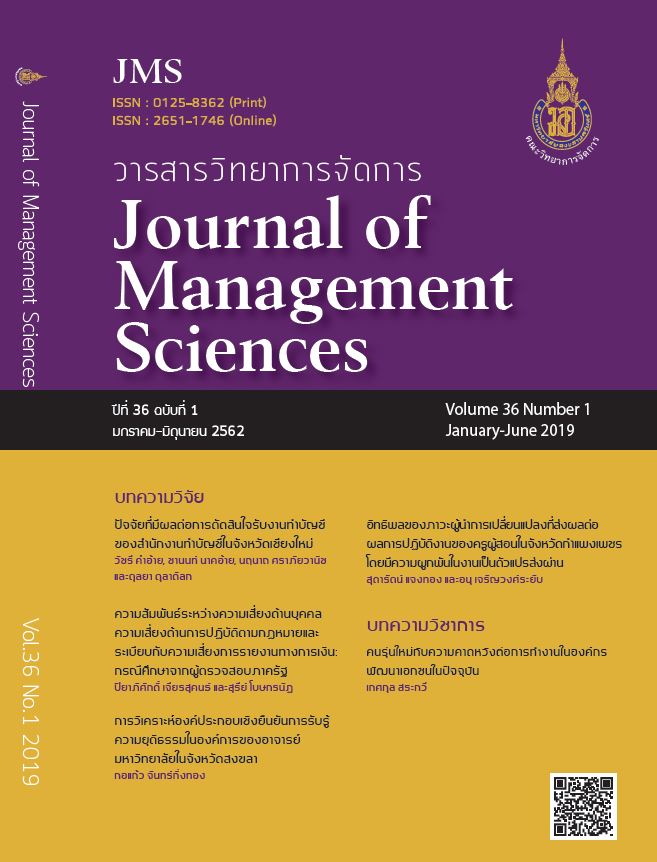
ความสัมพันธ์ระหว่างความเสี่ยงด้านบุคคล ความเสี่ยงด้านการปฏิบัติตามกฎหมายและระเบียบกับความเสี่ยงการรายงานทางการเงิน: กรณีศึกษาจากผู้ตรวจสอบภาครัฐ
Article Sidebar
Main Article Content
บทคัดย่อ
งานวิจัยนี้ มีวัตถุประสงค์เพื่อวิเคราะห์ (1) ความสัมพันธ์ระหว่างปัจจัยความเสี่ยง และ (2) อิทธิพลของปัจจัยความเสี่ยงที่มีต่อความเสี่ยงการรายงานทางการเงิน เก็บรวบรวมข้อมูลจากผู้ตรวจเงินแผ่นดินภาค 1-15 จำนวน 8 ราย และผู้ตรวจสอบภาครัฐ จำนวน 461 ราย เครื่องมือที่ใช้ คือ แบบสัมภาษณ์และ แบบสอบถาม วิเคราะห์ข้อมูลด้วยสถิติเชิงพรรณนาและเชิงอนุมาน
ผลการวิจัยพบว่า (1) ความเสี่ยงด้านส่วนบุคคล ความเสี่ยงด้านการปฏิบัติตามกฎหมายและระเบียบมีความสัมพันธ์เชิงบวกกับความเสี่ยงการรายงานทางการเงิน (2) ความเสี่ยงด้านส่วนบุคคล ความเสี่ยงด้านการปฏิบัติตามกฎหมายและระเบียบมีอิทธิพลทางตรงเชิงบวกต่อความเสี่ยงการรายงานทางการเงินให้ค่าสัมประสิทธิ์เส้นทางเท่ากับ .144 .455 และ .661 ตามลำดับ
ผลการวิจัยครั้งนี้จะเป็นข้อมูลพื้นฐานในการนำไปสู่การกำหนดกรอบแนวทางในการต่อต้านการทุจริตทั้งภาครัฐและเอกชน รวมถึงผลักดันให้ผู้บริหารตระหนักถึงความสำคัญของการจัดให้มีระบบการควบคุมภายในที่ดีที่จะสะท้อนให้เห็นถึงความโปร่งใส และความเชื่อถือได้ของการรายงานทางการเงิน
Article Details

อนุญาตภายใต้เงื่อนไข Creative Commons Attribution-NonCommercial-NoDerivatives 4.0 International License.
บทความที่ตีพิมพ์ถือเป็นลิขสิทธิ์ของวารสารวิทยาการจัดการ มหาวิทยาลัยสงขลานครินทร์ อย่างไรก็ตาม กองบรรณาธิการไม่สงวนลิขสิทธิ์ในการทำซ้ำ คัดลอก หรือเผยแพร่ แต่จะต้องอ้างอิงให้ถูกต้องตามหลักวิชาการ
เอกสารอ้างอิง
Akintoye, I. R., Akingunola, R. O., & Oseni, J. E. (2011). Ineffective Corporate Governance : Challenges of Internal Audit Function. International Journal of Research in Commerce & Management, 2(3), 16-22.
Alam, M. S. (1989). Anatomy of corruption: An approach to the political economy of underdevelopment. American Journal of Economics and sociology, 48(4), 441-456.
Albrecht, W.S., Albrecht, C. C, Albrecht C.O., & Zimbelman, M. F. (2009). Fraud Examination (3rd ed). Canada: South Western Cengage Learning.
Anantanasuwong, D. (2014). Fraud and Corruption Anatomy. In Sirilaksana Khoman et al. (Ed.), Corruption and Removal Mechanism. 7-28. Public Policy Studies Institute, Chiang Mai University.
Association of Certified Fraud Examiners (ACFE). (2012). Report to the nations on occupational fraud and abuse, 2012 Global fraud study. Texas: Austin.
Badara, M. A. S. (2012). The Role of Internal Auditors in Ensuring Effective Financial Control at Local Government Level: The Case of Alkaleri L.G.A., Bauchi State. Research Journal of Financial Accounting, 3(4), 57-65.
Bandura, A. (2002). Selective Moral Disengagement in the Exercise of Moral Agency. Journal of Moral Education, 31(2), 101-119.
Bartlett, N. E., Tonkin, E. R., & Williams, A. (2004). Audit Planning for the Detection of Fraud. Milton Queensland: John Wiley & Sons, Inc.
Bayley, D. H. (1966). The Effects Corruption in a Developing Nation. Western Political Quarterly, 19(4), 719-732.
Best , J. W., & James V. K. (1986). Research in Education. (5th ed). New Jersey: Prentice Hall Inc.
Black, K. (2006). Business statistics for contemporary decision making. (4th ed). New York, NY: John Wiley & Sons, Inc.
Bowles, R. (1999). Corruption in Encyclopedia of Law and Economics, VIII. Criminal Law, Economics of Crime and Law Enforcement. General Editors: Boudewijn Bouckaert and Gerrit De Geest. Publishers: Edward Elgar and the University of Ghent. Retrieved June 1, 2019 from https://encyclo.findlaw.com/tablebib.html.
Clinton, S. B., Pinello, A. S., & Skaife, H. A. (2014). The implications of ineffective internal control and sox 404 reporting for financial analysts. Journal of Accounting and Public Policy, 33(4), 303-327.
Cressey, D. R. (1953). Other People’s Money. New Jersey: Patterson Smith.
Cronbach, L. J. (1970). Essentials of Psychological Test. (5th ed). New York: Harper Collins.
Daniela, P., & Attila, T. (2013). Internal audit versus internal control and coaching. Procedia Economics and Finance, 6(13), 694-702.
Department of Local Administration (DLA). (2018). Data Auditing from Internal Auditor 2016-2017. Retrieved June 1, 2019 from https://www.dla.go.th/servlet/TemplateOrganizeServlet? organize=internal_audit.
Doody, H. (2009). Fraud risk management: A guide to good practice. London, England: Chartered Institute of Management Accountants.
Glaser, B. G., & Strauss, A. L. (1967). The discovery of grounded theory strategies for qualitative research. Illinois: Aldine Publishing.
Goudie, A. W. & Stasavage, D. (1997). Corruption: The Issues. Organization for Economic Cooperation and Development (OECD). Technical, 122.
Habib, A., & Hossain, M. (2013). CEO/CFO Characteristics and financial reporting quality. A Review Research in Accounting Regulation, 25(1), 88-100.
Heidenheimer, A. J., Arnold, J., Johnston, M., & Levine, V. T. (1989). Political Corruption: A Handbook. New Brunswick and Oxford : Transaction Publishers.
Hesse-Biber, S. N. (2010). Mixed Methods Research: Merging Theory Huntington, S. P. (1970). Political Corruption : Concepts & Contexts: Modernization and Corruption (15). U.S.A.: Library of Congress.
Isaksen, J. (2005). The budget Process and Corruption. Bergen, Norway: U4 Anti-Corruption Resource Centre, chr. michelsen institute.
Khan, M. (1996). The efficiency Implications of Corruption. Journal of International Development, 8(5), 683–696.
Lasritad, K., Muenthaisong, K., & Janjarasjit, S. (2015). Effects of Accounting PracticeTransparency on Financial Reporting Quality of Municipality in the Northeast Thailand. Journal of Humanities and Social Sciences Mahasarakham University, 34(4), 252-260.
Leff, N. H., (1964). Economic Development Through Bureaucratic Corruption. The American Behavior Scientist, November, 8(2), 8-14.
Likert, R. (1932). A Technique for the measurement of Attitude. Arch: Psychol.
Maesschalck, J. (2004). The Impact of New Public Management Reforms on Public Servants’ Ethics : Towards A Theory. Public Administration, 82(2), 465-489.
Margit, T. (2005). The Development of Stable Party Support: Electoral Dynamics in Post-Communist Europe. American Journal of Political Science, 49(2), 283-298.
Maslow, A. H. (1970). Motivation And Personality. (2nd ed). New York: Harper & Row Publishers, Inc.
McMullan, M. (1961). The Politics of Corruption–Explaining Corruption. UK: Edward Elgar Published.
Michael, J. (1995). The Search for Definitions: The Vitality of Politics and the Issue of Corruption. USA: Colgate University.
Mihaela, D., & Lulian, S. (2012). Internal Control and the Impact on Corporate Governance, in Romanian Listed Companies. Journal of Eastern Europe Research in Business & Economics, 2012, 1-10.
Moore, C. (2008). Moral Disengagement in Processes of Organizational Corruption. Journal of Business Ethics,
80(1), 129-139.
Naruedomkul, P., & Rodwanna, P. (2011). Employee Fraud in the Organization. Chulalongkorn Business Review, 33(130), 1-13.
Nunnally, J. C., & I. H. Bernstein. (1994). Psychometric Theory. New York.
Nye, J. S. (1967). Corruption and Political Development: A Cost- Benefit Analysis. American Political Science Review, 61(2), 417-427.
Office of the State Audit (Thailand). (2018). Data Personnel Information System. Retrieved May 13, 2019 from https://www.audit.go.th/th/ Organization Chart. With Practice. New York: Guilford.
__________. (2017). Operations Auditing of Government Organization 2012–2017 Years . Retrieved May 13, 2019 from https://www.audit.go.th/sites/default/files/files/reportaudit/pdf.
Rittenberg, L. (2013). COSO Internal control-integrated framework: turning principles into positive action. Altamonte Springs, Florida: The Institute for Internal Auditors Research Foundation.
Rose-Ackermann, S. (1999). Corruption and Government: Causes, Consequences and Reform. New York: Cambridge University Press, 91-110.
Rovinelli, R. J., & Hambleton, R. K. (1977). On the use of content specialists in the assessment of criterion-referenced test item validity. Dutch Journal of Educational Research, 2(1), 49-60.
Sandholtz, W., & Koetzle, W. (2000). Accounting for Corruption: Economic Structure, Democracy and Trade. International Studies Quarterly: Blackwell Publishing and The International Studies Association : JSTOR, 44(1), 31-50.
Shleifer, A., & Vishny, R. W. (1994). Politicians and firms. The Quarterly Journal of Economics, 109(4), 995-1025.
Singleton, T. W., Singleton, A., Bologna, J. & Lindquist, R. (2006). Fraud auditing and forensic accounting. (3rd ed). New York: John Wiley & Sons, Inc.
Srivithaya, S. (2015). The Rule of Law and the Reconciliation by Buddhist Ways in Thai Society. Journal of MCU Peace Studies. 3(2), 20-29.
Van Roy, E. (1970). On the Theory of Corruption. Economic Development and Cultural Change, 19(1), 86-110.
Victor, B., & Cullen, J. B. (1988). The organizational bases of ethical work climates. Administrative Science Quarterly, 33(1), 101-125.
Werner, S.B. (1983). New Direction in The Study of Administrative Corruption, Public Administration Review 43(2), 441-456.
William, R. J. (2000). Explaining Corruption. The Politics of Corruption 1 Cheltenham: Edward Elgar Publishing.
Wright, R. A. (2013). The internal auditor’s guide to risk assessment. Altamonte Springs, Florida: The Institute for Internal Auditors Research Foundation.
