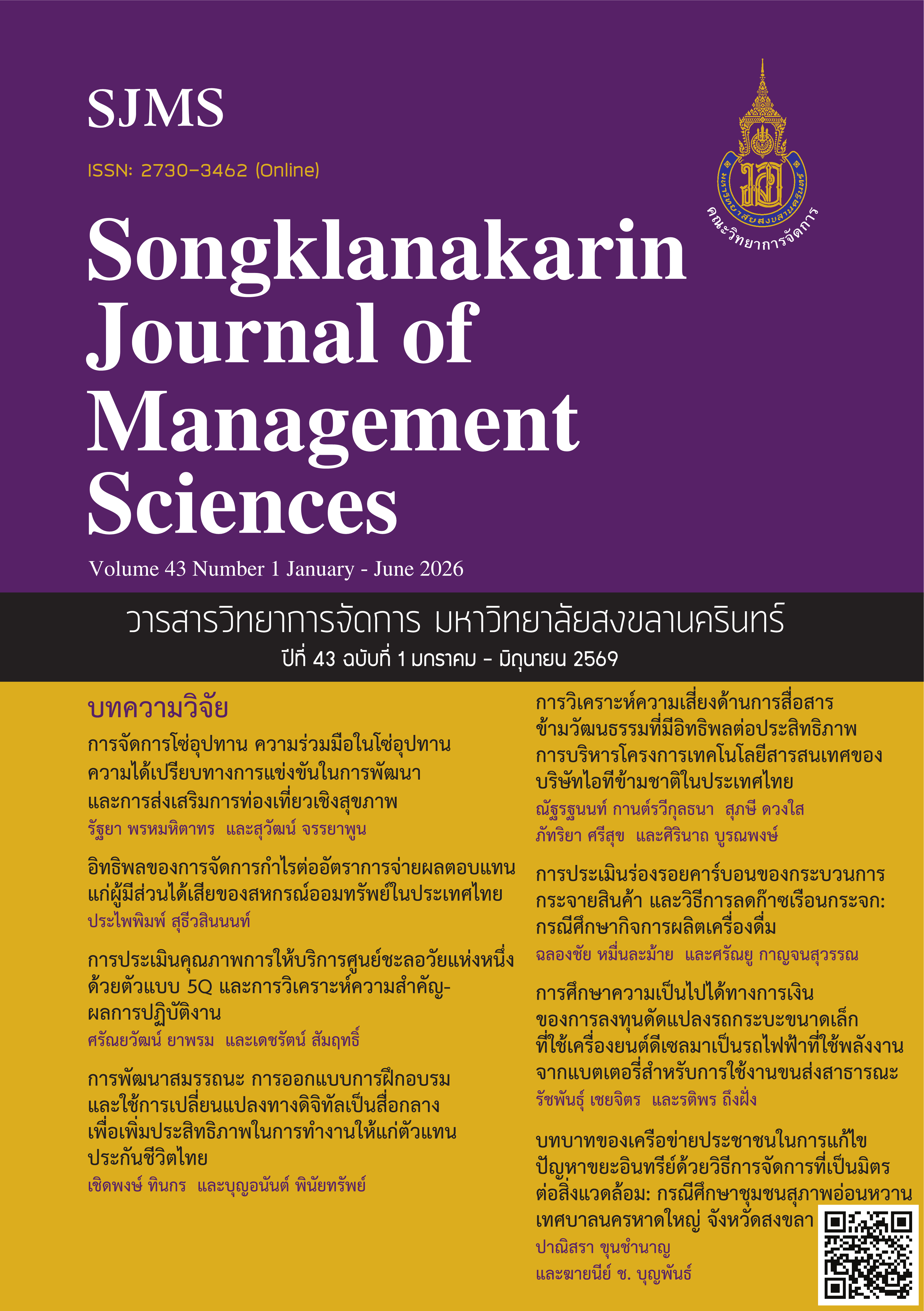
An Analysis of Cross-Cultural Communication Risks Influencing the Effectiveness of Information Technology Project Management in Multinational IT Companies in Thailand
Article Sidebar
Main Article Content
Abstract
The objective of this research was to study cross-cultural communication risks influencing the effectiveness of information technology (IT) project management. Specifically, the study sought to determine what those risks were and how they impacted the performance of multinational IT firms. This study employed a mixed-methods research approach. The sample group consisted of 385 personnel, comprising project managers, team leaders, and software engineers from multinational IT companies, selected via purposive and multi-stage sampling. The research instruments included a questionnaire, which was verified for content validity and reliability (0.85), and an expert panel meeting to confirm the results. Data analysis was conducted using Exploratory Factor Analysis (EFA), Confirmatory Factor Analysis (CFA), and Structural Equation Modeling (SEM). The results indicated that culture risk, organizational structure risk, and technology risk. Cross-cultural team collaboration was found to have a direct influence on communication effectiveness and project success at a statistical significance level of .001. Furthermore, risk assessment reflected that cultural risk exerted the highest influence on team collaboration. Findings regarding risk response suggested guidelines for risk mitigation and risk sharing to minimize uncertainty and enhance communication efficiency. Therefore, this research broadened empirical knowledge in cross-cultural risk management and served as a practical framework for organizations to formulate cultural communication strategies and competencies, ultimately elevating project outcomes.
Article Details

This work is licensed under a Creative Commons Attribution-NonCommercial-NoDerivatives 4.0 International License.
All published articles are SJMS’s copyright. The editorial board allows all published articles to be copied, excerpted, or disseminated with academic citation.
References
Alamer, A. (2025). Structural equation modeling (SEM) in L2 writing research. Language Testing, 42(2), 215-235. https://doi.org/10.1177/02655322211011624
Anglani, F., Pennetta, S., Reaiche, C., & Boyle, S. (2023). Crossing digital frontiers with cultural intelligence-a new paradigm for project managers. International Journal of Project Management, 41(8), 102543. https://doi.org/10.1016/j.ijproman.2023.102543
Bhale, S., & Bedi, P. (2023). SEM model fit indices: Meaning and acceptance of model fit literature support. Journal of Statistical Modeling, 15(4), 45-63. https://doi.org/10.2139/ssrn.4659352
Buchberger, E. S., & Moshagen, M. (2024). Estimating statistical power for structural equation models. Behavior Research Methods, 56(3), 1124-1136. https://doi.org/10.3758/s13428-024-02396-2
Eyiah, A. K., Bondinuba, F. K., Adu-Gyamfi, L., & Liphadzi, M. (2025). Promoting Effective Management of Cultural Diversity in Multinational Construction Project Teams. Buildings, 15(5), 659. https://doi.org/10.3390/buildings15050659
Fekete, D., & Pákay, B. (2023). Cross-cultural communication barriers in multinational IT project management: A Central European and Southeast Asian comparative study. Periodica Polytechnica Social and Management Sciences, 31(1), 41-48. https://doi.org/10.3311/PPso.23032
Hwang, J. (2025). Cross-cultural communication in global teams: Challenges and effective strategies collaboration in multinational corporations. World Journal of Advanced Research and Reviews. 26(01), 3146-3157. https://doi.org/10.30574/wjarr.2025.26.1.1428
Iriarte, C., & Bayona, S. (2020). IT projects success factors: a literature review. International Journal of Information Systems and Project Management, 8(2), 49-78. https://doi.org/10.12821/ijispm080203
Jensen, M., & Mandalis, S. (2022). Intercultural management in Thailand: Danish managers' experiences and perspectives. Master’s Thesis of Cand.ling.merc Erhvervssprog og International Erhvervskommunikation, International Business Communication Program, Copenhagen Business School, Frederiksberg, Denmark.
Jurado, E. (2025). Cross-Cultural Collaboration in Project Teams: A Comparative Analysis of Qualitative and Quantitative Findings. Open Journal of Business and Management, 13(2), 1202-1222. https://doi.org/10.4236/ojbm.2025.132063
Kanraweekultana, N., & Khongmalai, O. (2015). The Risks of University Operations on Student Loyalty: A Context for Science and Technology Education. Journal of Education Studies, 43(1), 19-36. http://doi.org/10.58837/.43.1.2
Kanraweekultana, N. (2022). Statistics social science research. Bangkok: Suan Dusit University.
Kelemen, Z., Malota, E., & Lendvai, K. (2025). Identifying cross-cultural communication barriers on Global IT rollout projects. Periodica Polytechnica Social and Management Sciences, 33(1), 44-58. https://doi.org/10.3311/PPso.23032
Kline, R. B. (2023). Principles and practice of structural equation modeling (4th ed.). New York: The Guilford Press.
Lee J. (1970). Essential of Psychology Testing. 3rd ed. New York: Harper and Row, Publishers, Inc.
Moshagen, M., & Musch, J. (2024). General power analysis for structural equation models. Behavior Research Methods, 56(1), 1-15. https://doi.org/10.3758/s13428-023-02254-7
Pamuji, S., Baharuddin, K. M., Novianto, A. Y., Kasmin, K., & Wibowo, E. P. (2024). Time Management: The Key to Success in Managing Complex Projects. Journal Markcount Finance, 2(3), 361-370. https://doi.org/ 10.70177/jmf.v2i3.1470
Parkitna, A., Sulich, A., & Wilk, M. (2020). Effective Time Management in IT Projects. Education Excellence and Innovation Management: a 2025 Vision to Sustain Economic Development During Global Challenges, 7425-7437.
Presbitero, A., Fujimoto, Y., & Lim, W. M. (2025). Employee engagement and retention in multicultural work groups: The interplay of employee and supervisory cultural intelligence. Journal of Business Research, 186(2025), 115012. https://doi.org/10.1016/j.jbusres.2024.115012
Project Management Institute. (2021). A guide to the project management body of knowledge (PMBOK® Guide) and The Standard for Project Management (7th ed.). PMI.
Rajpal, S., & Onyusheva, I. (2018). Managing cross-cultural differences in multinational corporations of Thailand. The Eurasian Journal of Business and Management, 6(4), 1-8. https://doi.org/10.35678/2539-5645
Tanasakulsak, T., Khongmalai, O., & Kanraweekultana, N. (2019). Perceived Risk for Technology Commercialization of Carbon Dioxide Cleaning: Context of Electronics Industry in Thailand. Journal of Business Administration and Languages, 7(1), 36-43.
Uttaranakorn, J., Khongmala, O., & Kanraweekultana, N. (2017). Risk management of new product development: mobile application context. Srinakharinwirot University Journal of Sciences and Technology, 9(11), 35-48.
Welsch, D., Burk, L., Mötefindt, D., & Neumann, M. (2023). Navigating cultural diversity: Barriers and potentials in multicultural agile software development teams. SAC 2024 for Leand and Agile Software Development Track. https://doi.org/10.48550/arXiv.2311
Wengel, J. (2025). Cultural intelligence and trust in global virtual teams. Business and Professional Communication Quarterly, 88(1), 54-72. https://doi.org/10.1177/232179915
Wolf, E. J., Harrington, K. M., Clark, M. A., & Miller, M. W. (2013). Sample Size Requirements for Structural Equation Models: An Evaluation of Power, Bias, and Solution Propriety. Psychological Methods, 73(6), 231-249. https://doi.org/10.1177/0013164413495237
Wongsatorn, T., Mangdindamb, T., & Noppasom, W. (2025). Breaking barriers: Examining the impact of language on employee-driven innovation in European multinational subsidiaries in Thailand. Cogent Business and Management. Cogent Arts and HumAnities, 12(1), 1-25. https://doi.org/10.1080/23311983.2025.2451492
Yao, B., Jiang, M., Bobinac, T., Yang, D., & Hu, J. (2023). Benchmarking machine translation with cultural awareness. Computation and Language. 3(1), 13078-13096. https://doi.org/10.48550/arXiv.2305.14328.
Yoshino, T., & Maximilian, G. (2024). Navigating Through Cross-Cultural Business Communication Challenges and Opportunities in the Digital Age: Understanding the Impact of Rapid Digital Transformation on Foreign Enterprises’ Partnerships with Japanese Businesses. Journal of Osaka University of Economics, 75(2), 79-88. https://doi.org/10.24644/75.2_79
Zhang, Y., & Li, D. (2024). Enhancing Project Performance through Effective Team Communication: A Comprehensive Study Integrating Project Management Quotient, Trust, and Management Information Systems. Journal of Information Systems Engineering and Management, 9(1), 25574. https://doi.org/10.55267/iadt.07.14317
Zhu, F., & Isayeva, O. (2025). Cross-cultural communication challenges in the age of independent knowledge systems. Information Development, 4(2025), 1-13. https://doi.org/10.1177/02666669251333385