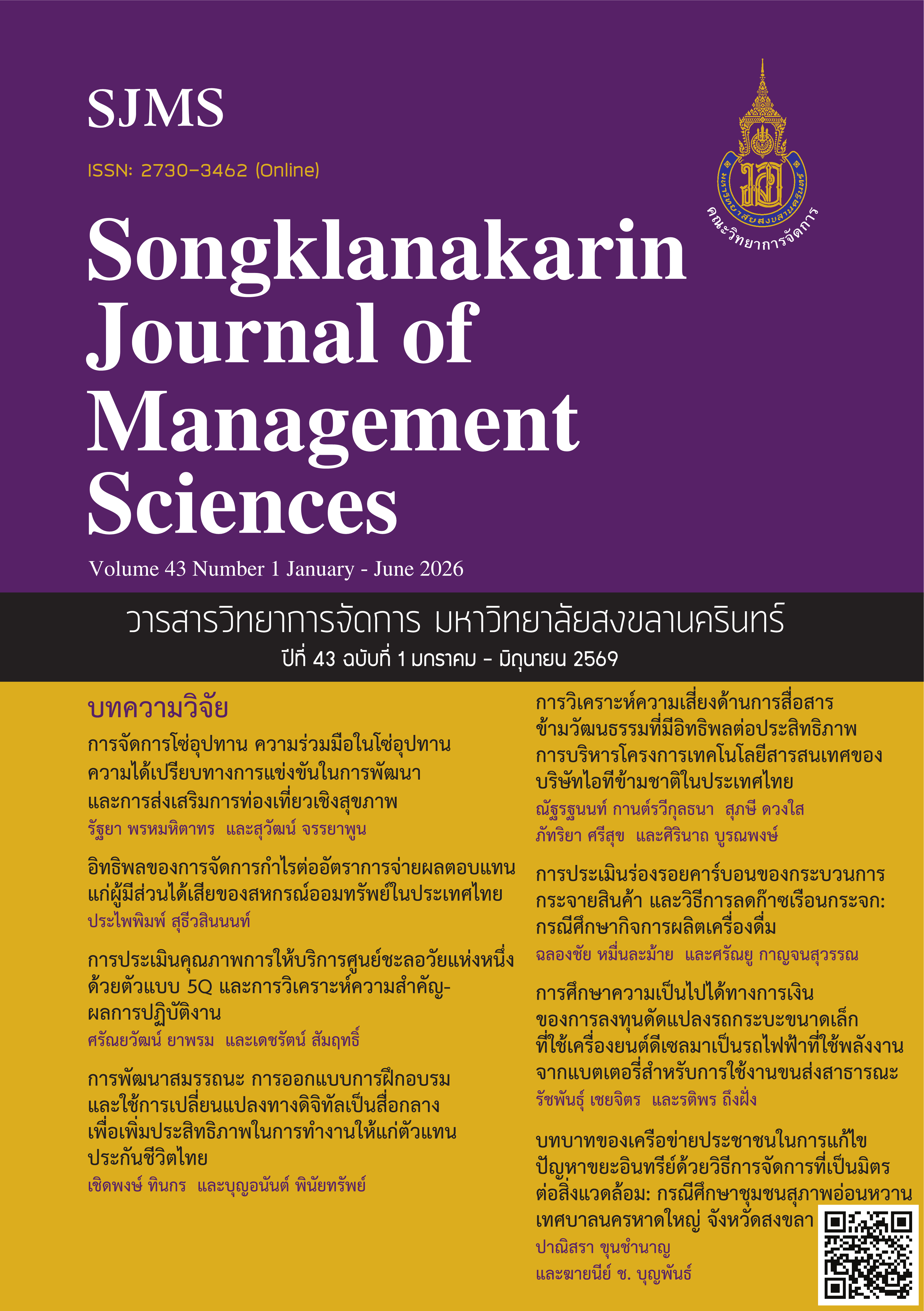
Service Quality Evaluation of an Anti-Aging Center Using the 5Q Model and Importance-Performance Analysis
Article Sidebar
Main Article Content
Abstract
This research aimed to evaluate the service quality of an anti-aging center from the perspective of service users by applying the 5Q Model, together with both traditional and modified Importance-Performance Analysis (IPA) based on Three-Factor Theory. The sample consisted of 316 clients of a single anti-aging center, selected using Yamane’s formula. Data were collected through a questionnaire measuring the levels of importance and performance across 20 service quality factors.
The results from the traditional IPA revealed that four factors were classified as strengths that should be maintained (“Keep up the good work”), namely safety (B1), service capability (B2), cleanliness (B10), and physician-patient communication (B15). In contrast, parking availability (B9) was identified as a factor requiring urgent improvement (“Concentrate here”). The application of Three-Factor Theory provided a more refined classification, identifying six basic factors requiring immediate improvement due to high importance but low satisfaction levels: safety (B1), service capability (B2), parking availability (B9), payment system (B11), technology utilization (B12), and physician responsiveness (B16). Meanwhile, cleanliness (B10), physician communication (B15), and an atmosphere that enhances confidence (B18) remained key strengths of the service. The integration of traditional IPA and Three-Factor Theory enabled a deeper understanding of service users’ true expectations and supported management in formulating systematic service quality improvement strategies to enhance competitive advantage in the preventive healthcare business.
Article Details

This work is licensed under a Creative Commons Attribution-NonCommercial-NoDerivatives 4.0 International License.
All published articles are SJMS’s copyright. The editorial board allows all published articles to be copied, excerpted, or disseminated with academic citation.
References
Ahmed, A., & Mostafa, M. M. (2020). Measuring service quality in healthcare: Importance-performance analysis. Journal of Health Management, 22(4), 612-625.
Ajarmah, B. S., Hashem, T. N., & Swies, R. J. (2017). The effect of 5Q model on patient's satisfaction in military hospitals in Jordan. International Journal of Productivity and Quality Management, 20(3), 273-290.
Alenzi, A., Alshammari, S. A., & Alrashidi, M. (2022). Patient satisfaction with anti-aging medical services in private clinics: A cross-sectional study. Journal of Patient Experience, 9, 1-8.
Alnasser, L., Alharbi, N., & Alotaibi, N. (2023). Personalized anti-aging programs and health behavior adherence in older adults. Journal of Preventive Medicine, 19(1), 45-52.
Altaf, M., Tabassum, N., & Mokhtar, S. S. M. (2018). Brand equity and the role of emergency medical care service quality of private cardiac institutes: An empirical investigation. International Journal of Pharmaceutical and Healthcare Marketing, 12(1), 44-60.
Awan, M. I., Shamim, A., & Ahn, J. (2021). Implementing ‘cleanliness is half of faith’ in re-designing tourists, experiences and salvaging the hotel industry in Malaysia during COVID-19 pandemic. Journal of Islamic Marketing, 12(3), 543-557.
Awang, Z., Afthanorhan, A., & Mamat, M. (2016). The Likert scale analysis using parametric based Structural Equation Modeling (SEM). Computational Methods in Social Sciences, 4(1), 13-21.
Azman, A., Rahman, A. A., & Karim, N. A. (2022). The role of preventive health services in aging societies: A Malaysian perspective. Asian Journal of Gerontology & Geriatrics, 17(2), 111-118.
Beier, F. (2020). Healthcare supply chain management: Best practices and strategic insights. Journal of Healthcare Logistics, 12(3), 145-158.
Benati, I., & Coccia, M. (2022). Global analysis of timely COVID-19 vaccinations: Improving governance to reinforce response policies for pandemic crises. International Journal of Health Governance, 27(3), 240-253.
Burke, D., & Cocoman, A. (2020). Training needs analysis of nurses caring for individuals with intellectual disability and/or autism spectrum disorder in a forensic service. Journal of Intellectual Disabilities and Offending Behaviour, 11(1), 9-22.
Camgöz‐Akdağ, H., & Zineldin, M. (2010). Quality of health care and patient satisfaction: An exploratory investigation of the 5Qs model at Turkey. Clinical Governance: An International Journal, 15(2), 92-101.
Connolly, D., & Wright, F. (2017). The nursing quality indicator framework tool. International Journal of Health Care Quality Assurance, 30(7), 603-616.
D. Trivedi, J., Mandalapu, S. D., & Dave, D. H. (2020). Real-time parking slot availability for Bhavnagar, using statistical block matching approach. World Journal of Engineering, 17(6), 811-821.
Deng, W. J., Kuo, Y. F., & Chen, W. C. (2008). Revised importance-performance analysis: Three-factor theory and benchmarking. The Service Industries Journal, 28(1), 37-51.
Deng, X., Lu, Y., & Smith, J. (2021). Using Importance-Performance Gap Analysis to identify bottlenecks in healthcare service delivery. International Journal of Health Services, 51(4), 567-582.
Hooper, D., Coughlan, J., & Mullen, M. R. (2008). Structural equation modelling: Guidelines for determining model fit. Electronic Journal of Business Research Methods, 6(1), 53-60.
Jabbarzadeh, A., Karimi, S., & Rahimi, M. (2022). Enhancing healthcare supply chain resilience through logistics optimization. Operations Management in Healthcare, 18(1), 33-50.
Keleş, A. (2014). Expert doctor verdis: Integrated medical expert system. Turkish Journal of Electrical Engineering and Computer Sciences, 22(4), 1032-1043.
Kim, M., Kim, S., & Bae, J. (2021). Multidisciplinary approach in anti-aging healthcare service. Journal of Integrative Health Science, 8(4), 223-230.
Kim, S., & Ryu, M. H. (2024). Online review based IPA and IPCA: The case of Korean mobile banking apps. International Journal of Bank Marketing, 43(4), 731-756.
Kong, Y., & Jung, H. S. (2023). The effect of customer experience on loyalty in private health and anti-aging services. International Journal of Healthcare Management, 16(2), 98-107.
Lee, H., & Hwang, J. (2020). Factors affecting patient satisfaction in preventive healthcare services for older adults. International Journal of Environmental Research and Public Health, 17(15), 5343.
Lee, J., & Lee, S. (2020). Future trends in personalized preventive medicine and anti-aging clinics. Journal of Healthcare Technology and Innovation, 6(1), 65-72.
Li, Z., Xing, Y., & Dong, P. (2024). A novel q-rung orthopair fuzzy best-worst method, Shannon entropy and MARCOS method for mobile medical app service quality evaluation. Applied Soft Computing, 155, 111417.
Madu, F. N., Onodugo, V. A., & Isichei, E. E. (2022). Electronic payment system and financial sustainability of tertiary institutions in Nigeria. African Journal of Economic and Management Studies, 13(4), 683-696.
Martilla, J. A., & James, J. C. (1977). Importance-performance analysis. Journal of Marketing Theory and Practice, 41(1), 77-79.
Morton, C., Habib, S., & Morris, J. (2021). What women want: The effect of health agency advertising on patient-doctor communication. International Journal of Pharmaceutical and Healthcare Marketing, 15(3), 451-465.
Nair, G. K., & Bindu, R. L. (2021). The 5Q model: Evaluating healthcare service quality in wellness and preventive centers. International Journal of Healthcare Management, 14(3), 888-897.
Nguyen, T., Le, M., & Pham, H. (2021). Preventive healthcare services for older adults: Current practices and future directions. Geriatric Health Reports, 3(1), 19-26.
Nguyen, T. N., & Pham, H. A. (2023). Preventive healthcare services and aging populations: Evidence from private wellness centers. Asia Pacific Journal of Health Management, 18(1), 23-30.
Nunthakit, N. (2020). A Comparative study of medical supplies for hospital emergency preparedness and response during the COVID-19 pandemic [Master’s Independent Study, Burapha University]. BUU.
Pratama, Y., Yuliani, R., & Suhendra, A. (2022). Optimizing medical supply chain performance in aging-focused healthcare centers. International Journal of Logistics Systems and Management, 42(2), 210-225.
Rahman, M. M., Akter, S., & Sultana, M. (2021). Health system readiness for an aging society: Challenges and policy responses. Health Policy and Technology, 10(1), 100508.
Sharma, V. (2017). Patient satisfaction and brand loyalty in health- care organizations in India. Journal of Asia Business Studies, 11(1), 73-87.
Tavakoli, N., Hasani, M., & Bahadori, M. (2022). Service quality expectations and satisfaction in health promotion centers: Evidence from a developing country. BMC Health Services Research, 22, Article 405.
Uthayakumar, R., & Priyan, M. S. (2021). Integrating service logistics and healthcare supply chain resilience: A systematic review. Health Systems and Logistics, 9(2), 101-115.
Verma, P., Kumar, S., & Sharma, S. K. (2020). E-healthcare service quality: Consumer satisfaction and its association with demographic characteristics. International Journal of Health Care Quality Assurance, 33(6), 413-428.
Verma, P., Kumar, S., & Sharma, S. K. (2022). Evaluating the total quality and its role in measuring consumer satisfaction with e-healthcare services using the 5Qs model: A structure equation modeling approach. Benchmarking: An International Journal, 29(1), 22-46.
Von Greiff, N., & Skogens, L. (2020). Abstinence or controlled drinking-a five-year follow-up on Swedish clients reporting positive change after treatment for substance use disorders. Drugs and Alcohol Today, 20(2), 147-156.
Westbrook, L. (2007). Chat reference communication patterns and implications: Applying politeness theory. Journal of Documentation, 63(5), 638-658.
Wu, L., So, K. K. F., Xiong, L., & King, C. (2019). The impact of employee conspicuous consumption cue and physical attractiveness on consumers’ behavioral responses to service failures. International Journal of Contemporary Hospitality Management, 31(1), 21-40.
Zineldin, M. (2006). The quality of health care and patient satisfaction: An exploratory investigation of the 5Qs model at some Egyptian and Jordanian medical clinics. International Journal of Health Care Quality Assurance, 19(1), 60-92.