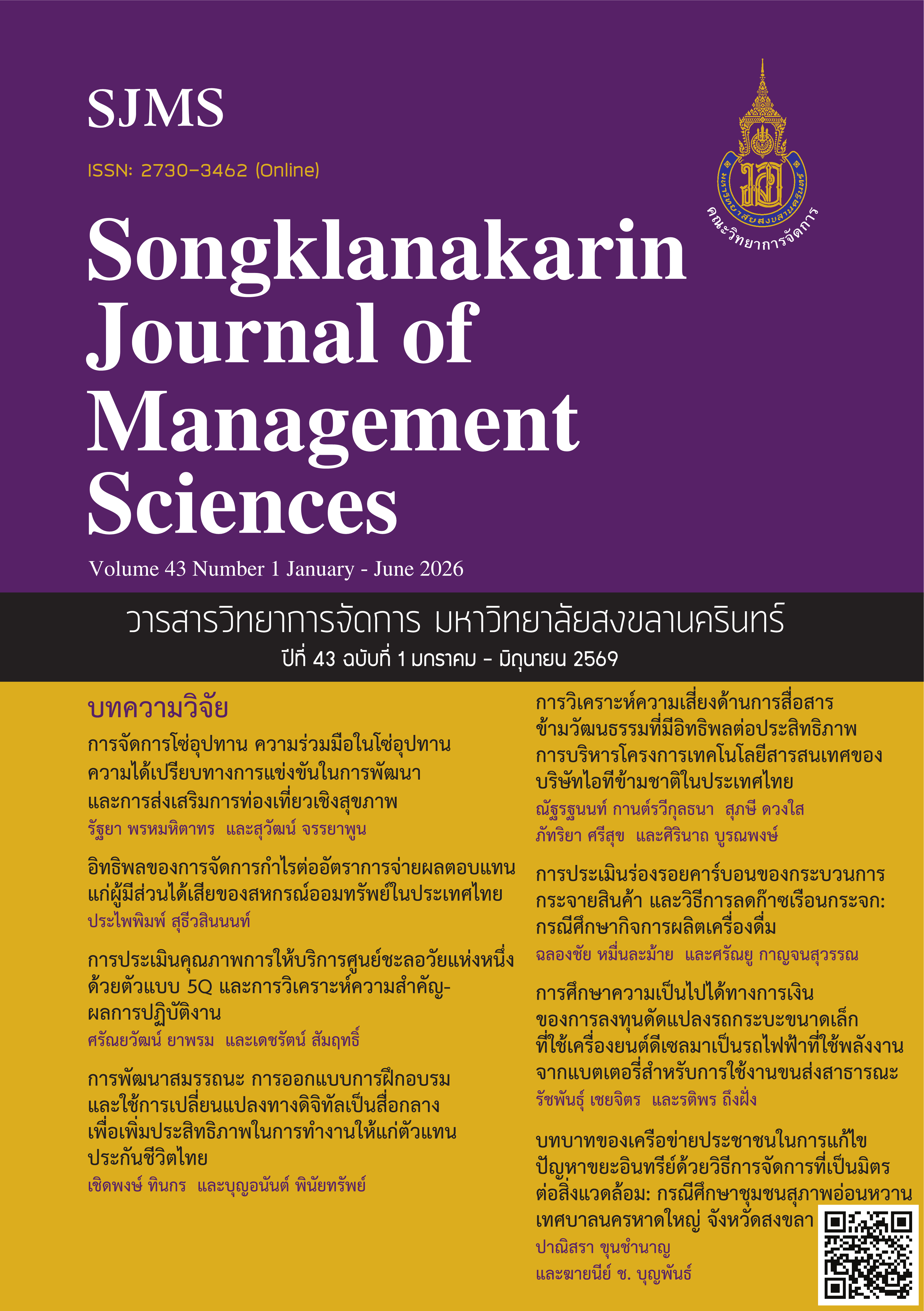
The Role of Community Networks in Solving Compostable Waste Problems Using Environmentally Friendly Management Methods: A Case Study of Suphap-on-wan Community, Hat Yai Municipality, Songkhla Province
Article Sidebar
Main Article Content
Abstract
This research aims to study the situation of compostable waste problems in Suphap-on-wan Community, Hat Yai Municipality, Songkhla Province; to examine the role of community networks in addressing compostable waste issues; to identify lessons learned regarding obstacles and management of compostable waste; and to investigate the application of the 5Rs principles (Reduce, Reuse, Reject, Recycle, Repair) in community waste management. This study employs a qualitative approach, using in-depth interviews with 24 key informants using purposive sampling, including 15 community residents (18 years or older), 2 community leaders, 2 local environmental volunteers, 2 public health volunteers, and 3 staff from the Public Health and Environment Division. The findings reveal that compostable waste problems stem from a lack of cooperation in waste separation and from improper waste disposal along the boundaries between local administrative organizations. Community networks play a vital role, with community leaders fostering participatory processes and community committees coordinating and distributing responsibilities. The major obstacles include inconsistent waste management among some residents, lack of cooperation from tenants in rental houses, and improper disposal of unsorted waste by outsiders. At the household level, waste is separated into three categories: compostable, general, and recyclable waste. The community effectively applies the principles of Recycle, Reuse, and Reduce through the operations of its community networks. As a result, Suphap-on-wan Community has successfully won the Zero Waste Community Award in 2023.
Article Details

This work is licensed under a Creative Commons Attribution-NonCommercial-NoDerivatives 4.0 International License.
All published articles are SJMS’s copyright. The editorial board allows all published articles to be copied, excerpted, or disseminated with academic citation.
References
Insee, N., Khiawlueng, T., & Wongwatthanaphong, K. (2022). Sustainable community participatory solid waste management process. Journal of Modern Learning Development, 7(11), 480–493.
Mattwakan, P. (2019). Recycling community: Building social networks for participatory waste management in Khlong Rang Subdistrict, Na Mom District, Songkhla Province [Master's thesis, Prince of Songkla University].
Office of the Secretary to the Cabinet. (2021). Action plan for solid waste reduction and separation of the Office of the Secretary to the Cabinet, 2565–2570.
Phimolsiripol, Y., Boonchuay, P., Rosakhrua, P., Kulsarin, J., Uthaisripadungkul, C., Sahaschat, P., Sitthitrai, K., Chotinan, S., & Chiawsuwan, M. (2024). Knowledge transfer and expansion of the bio-waste disposal system using black soldier fly larvae in Chiang Klang District, Nan Province, Thailand. Journal for Area-Based Research, 16(2), 117–138.
Poboon, J. (2008). Local government organizations and good waste management: A case study of Thepkasattri Subdistrict Municipality. Environmental Management Journal, 4(1), 27–65.
Pollution Control Department. (2020). Composting manual for solid waste. Retrieved April 15, 2024, from https://www.pcd.go.th/publication/5001/
Pollution Control Department. (2022). Community solid waste management information system. https://thaimsw.pcd.go.th/report_country.php?year=2565
Satitmannaitham, B. (2023). A participatory management approach to sustainable waste management. Interdisciplinary Academic and Research Journal, 3(6), 269–286.
Sranplaeng, N. (2009). Development of public participation in solid waste management: A case study of Cherng Talay Subdistrict Municipality, Thalang District, Phuket Province [Master's thesis, Prince of Songkla University].
Srimuang, S., & Yolchayawong, P. (2019). Building participatory networks for community waste problem solving in Nong Khaem District, Bangkok. Graduate School Journal, Pichayatharrasan, Southeast Asia University, 15(1), 203-211.
Srisontisuk, S., Aimimtham S., Buasri M., Wanong P., Saengkaew A., Yang W., Sengonkeo P., & Yanpaisan S., (2020). The roles of Sub District Administration Organization in sustainable waste management in the local communities: A case study of Khu Mueang Sub District Administration Organization, Nong Bua Daeng District, Chaiyaphum Province. Rajabhat Chiang Mai Research Journal, 21(2), 112–127.
Tangpradit, W., Sukhapramate, S., & Holumyong, T. (2023). Participatory sustainable waste management from communities surrounding Amata City Chonburi Industrial Estate. Interdisciplinary Research Journal: Graduate School Edition, Bangkok Thonburi University, 12(1), 20–33.
The Government Public Relation Department. (2023) Thailand enters the era of global boiling. Retrieved April 15, 2024, https://radiothailand.prd.go.th/th/content/category/detail/id/1378/iid/230233
Thongmee, N. (2023). Community-based waste management to promote a clean province: Ban Pa Tung Ngam community, Pa Sak Subdistrict, Mueang Lamphun District, Lamphun Province. 24th National Graduate Conference, 1(5), 1–13.
United Nations Thailand. (2022). Causes and impacts of climate change. Retrieved April 15, 2024, from https://thailand.un.org/th/174652
