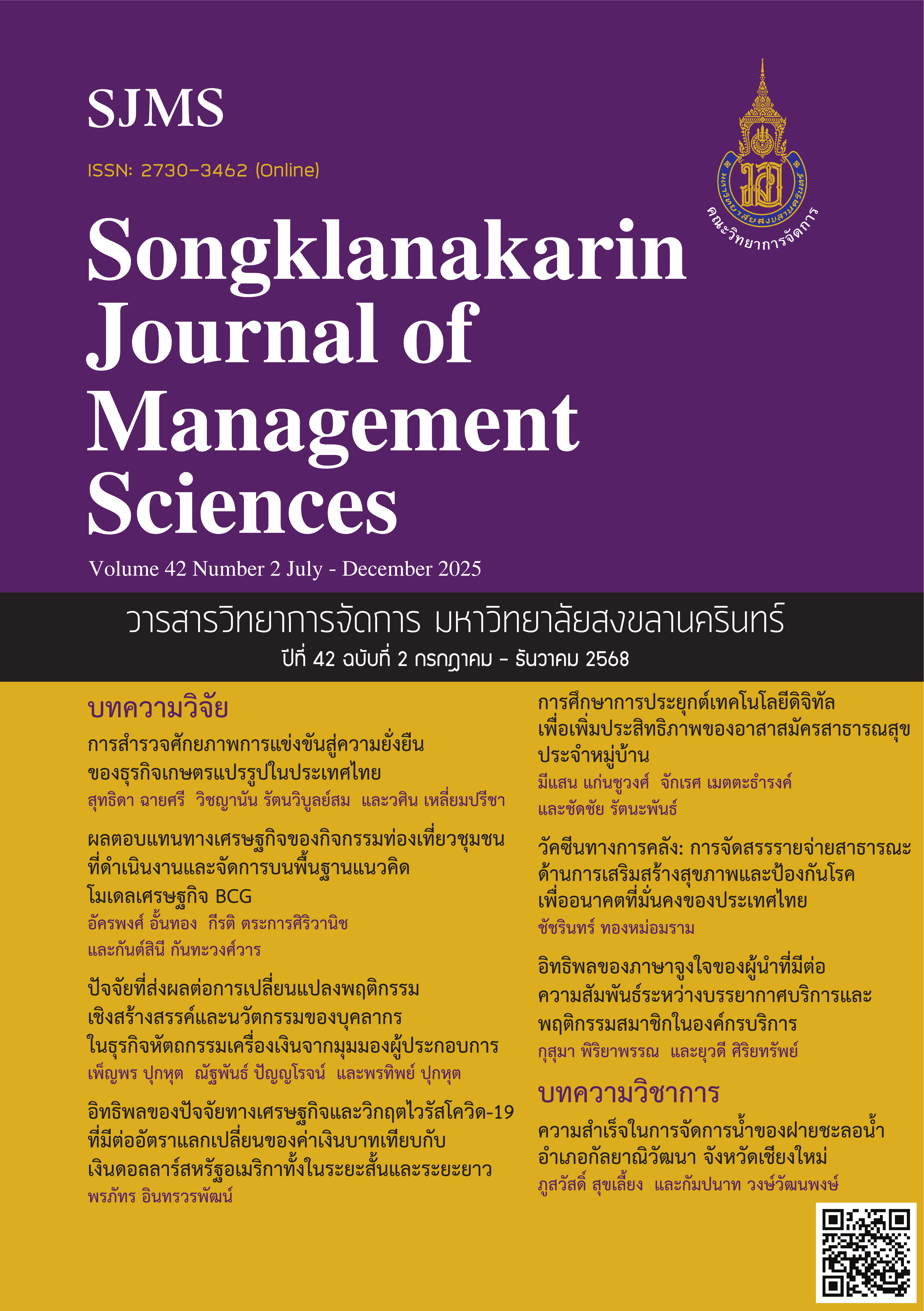
Economic Factors and COVID-19 Pandemic Influencing Exchange Rate of Baht against U.S. Dollar in the Short-run and Long-run
Article Sidebar
Main Article Content
Abstract
The purpose of this research was to investigate the Influencing of economic variables and COVID-19 pandemic on Exchange Rate of Baht against U.S. Dollar in the short-run and long-run in two periods: (1) Before the COVID-19 (January 2014 - December 2019) and (2) During the COVID-19 (January 2020 - Apirl 2023) and analyzed the influence of the independent variables by Co-integration model (long-run model) and Error Correction Model (short-run model).
The findings indicate that (1) before the COVID-19, both in short-run and long-run, exchange rate of Baht against U.S. dollar was influenced by interest rate gap between Thai and US, Thai money supply, international reserves, and public debt, (2) During the COVID-19, in short-run, Baht against U.S. dollar was influenced by interest rate gap, international reserves, and COVID-19 death rate in Thailand. But in long-run, the sharp increase in Thai government debt has led to a Baht Depreciation. This reflects that, although public debt during crisis may be inevitable, Thai government must manage public expenditures in a way that maximizes their effectiveness in supporting economic recovery, while simultaneously administering international reserves to ensure resilience against potential future economic crises, thereby maintaining the long-term stability of Thai Baht.
Article Details

This work is licensed under a Creative Commons Attribution-NonCommercial-NoDerivatives 4.0 International License.
All published articles are SJMS’s copyright. The editorial board allows all published articles to be copied, excerpted, or disseminated with academic citation.
References
Banchuenvijit, W. (2022). Factors Determining Exchange Rates between Thai Baht and US Dollar as well as Thai Baht and Chinese Yuan under President Donald Trump's Administration. Journal of Family Business & Management Studies, 14(2), 79-89.
Banda, F., & Edriss, A. (2023). How did Covid-19 affect the structural relationship between exchange rates and money supply? evidence from Malawi. International Journal of Economics and Financial, 13(1), 199-205.
Bank of Thailand. (2021). Thailand's Economic Condition in 2022. Retrieved February 2, 2025, from https://www.bot.or.th/content/dam/bot/documents/th/thai-economy/state-of-thai-economy/annual-report/annual-econ-report-th-2563.pdf
Bank of Thailand. (2024). EC_MB_051 Foreign exchange purchases and sales by commercial banks. Retrieved January 22, 2025, from https://app.bot.or.th/BTWS_STAT/statistics/BOTWEBSTAT.aspx?reportID=35&language=TH
Buato, S. (2019). The determinant impacting on bilateral exchange rate: a case study of the Thai Baht against the U.S. Dollar. Chulalongkorn University Theses and Dissertations (Chula ETD).
Chasanah, A. N., Riyono, R., & Ristanto, H. (2022). Factors Affecting the Rupiah Exchange Rate During the Covid 19 Pandemic. Journal of Economics and Public Health, 1(2), 79-88.
Diao, Y. (2023). Empirical analysis of factors influencing RMB exchange rate volatility in the context of RMB internationalization. Frontiers in Business, Economics and Management, 11(3), 23-33.
Engle, R., & Granger, C. (2015). Co-integration and error correction: Representation, estimation, and testing. Applied Econometrics, 39(3), 106-135.
Flodén, M. (2020). The open economy revisited: The Mundell-Fleming model and the exchange-rate regime. Stockholm: Stockholm School of Economics.
Ghauri, S. P., Ahmed, R. R., Streimikiene, D., Qadir, H., & Hayat, A. (2024). Macroeconomic factors driving exchange rate volatility and economic sustainability: Case study of Pakistan. The Amfiteatru Economic journal, 26(66), 612–628.
Gongkhonkwa, G. (2021). COVID-19 Pandemic: Impact on Thai Baht Exchange Rate. Journal of Asian Finance, Economics and Business, 8(7), 121–127.
Husted, S., & Melvin, M. (2020). International economics. (9th Ed.). Boston: Addison Wesley Longman.
International Monetary Fund. (2025). Thailand: Selected Issues; IMF Country Report No. 25/46. Retrieved April 12, 2025, from https://acrobat.adobe.com/id/urn:aaid:sc:AP:9d2779f0-b7bc-47a2-951b-15d2007d4c79
Islam, D., & Faisal, M. A. A. (2024). Determinants of Uruguay's Real Effective Exchange Rate: A Mundell-Fleming Model Approach. arXiv Prepr. arXiv2403.16452.
Jamal, A., & Bhat, B. (2022). COVID-19 pandemic and the exchange rate movements: evidence from six major COVID-19 hot spots. Future Business Journal, 8(1), 1-11.
Leightner, J. E. (2024). Small-Country Mundell–Fleming (IS/LM/BP) Model Predictions Under Both Fixed and Flexible Exchange Rates: Evidence from Australia and S. Korea. Journal of Risk and Financial Management, 17(11), 1-20.
Li, C., Su, Z. W., Yaqoob, T., & Sajid, Y. (2022). COVID-19 and currency market: a comparative analysis of exchange rate movement in China and USA during pandemic. Economic research-Ekonomska istraživanja, 35(1), 2477-2492.
Li, L., Pan, F., & Wang, C., (2019). Analysis of Influencing factors of RMB exchange rate trend based on least square method. Journal of Physics: Conference Series, 1168, 032036.
Pesaran, M. H., Shin, Y., & Smith, R. J. (2001). Bounds testing approaches the analysis of level relationships. Journal of applied econometrics, 16(3), 289-326.
Pilbeam, K. (2023). International finance. Bloomsbury Publishing.
Vargas-Herrera, H., Ospina, J. J., & Romero, J. V. (2022). The Covid-19 shock and the monetary policy response in Colombia. BIS Papers chapters, 122, 79-114.
Von Beschwitz, B. (2024). Internationalization of the Chinese renminbi: progress and outlook. Retrieved January 2, 2025, from https://www.federalreserve.gov/econres/notes/feds-notes/internationalization-of-the-chinese-renminbi-progress-and-outlook-20240830.html?utm_source=chatgpt.com
World Bank Group (2020). Thailand Economic Monitor: Thailand in the Time of Covid-19. Retrieved January 2, 2025, from https://documents1.worldbank.org/curated/en/456171593190431246/pdf/Thailand-Economic-Monitor-Thailand-in-the-Time-of-Covid-19.pdf
Zareei, A., Karimzadeh, M., Koshalshahi, Z., & Ranjbarian, Z. (2022). External Debt and Exchange Rate Fluctuations in Iran: Markov Switching Approach. Iranian Economic Review, 26(3), 577-594.
