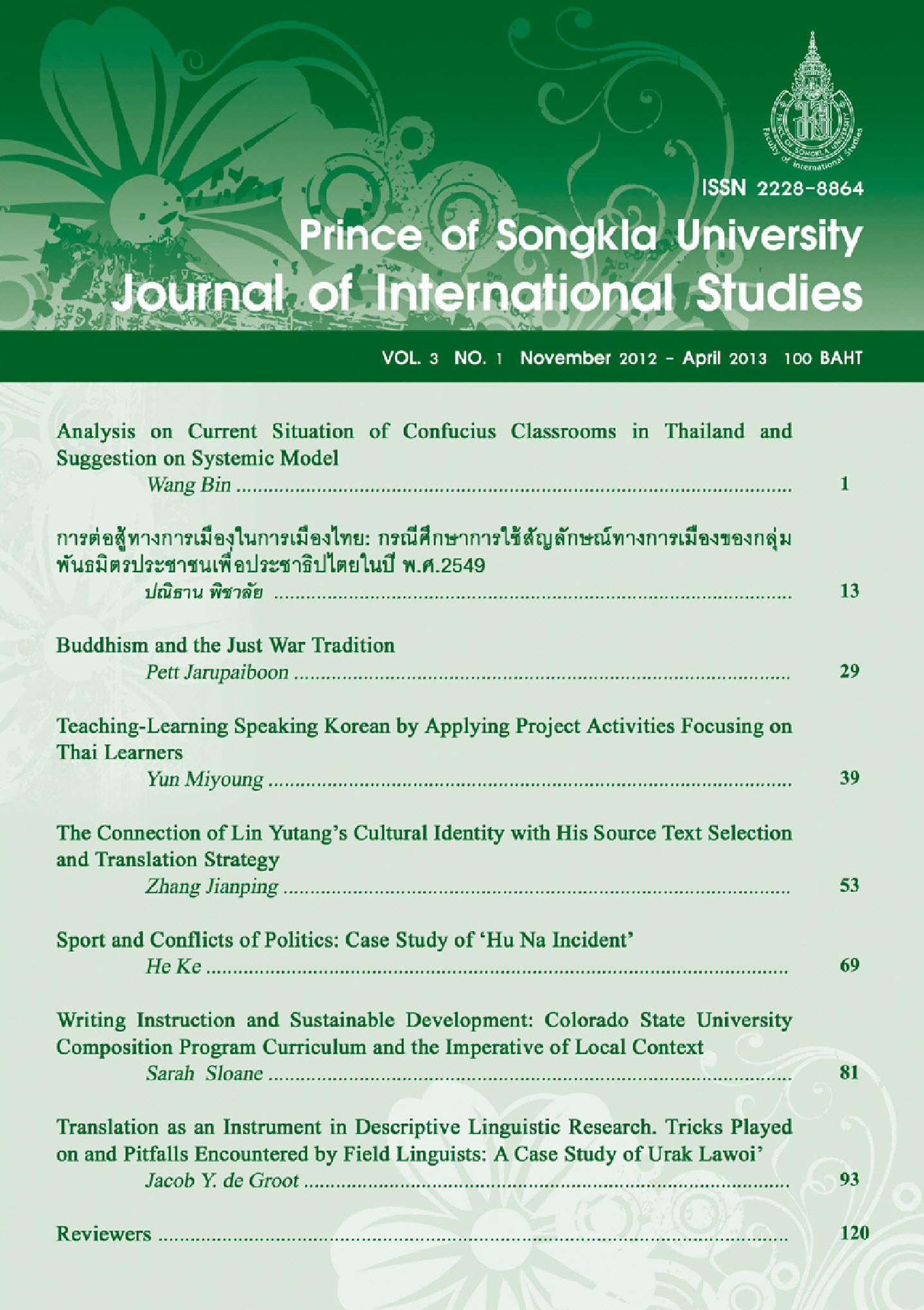
การสอนการเขียนและการพัฒนาที่ยั่งยืน: หลักสูตรโปรแกรมการเขียนเรียงความของมหาวิทยาลัยรัฐโคโลราโด และกฎเกณฑ์ของบริบทเฉพาะที่
Article Sidebar
Main Article Content
บทคัดย่อ
บทความนี้อภิปรายถึงโปรแกรมการเขียนเรียงความของมหาวิทยาลัยรัฐโคโลราโด ว่าพัฒนา หลักสูตรเชิงวาทศิลป์ซึ่งสามารถสอนหลักของการพัฒนาที่ยั่งยืนได้อย่างไร และยงนาเสนอ การให้ความรู้ในการเขียนขั้นพื้นฐาน แผนงานเริ่มต้นสองแผนงานขององค์การสหประชาชาติ ทศวรรษแห่งการรู้หนังสือ และ ทศวรรษแห่งการศึกษาเพื่อการพัฒนาที่ยั่งยืน ระหว่างปี ค.ศ.2005 - 2012 เน้นย้ําถึงความจําเป็นที่หลักสูตรการเขียนและการสอนจะต้องให้ความสนใจกับการพัฒนา ที่ยั่งยืน หลักสูตรที่ได้ชื่อว่า "วาทศิลป์สีเขียว" เป็นการตอบสนองแผนงานเริ่มต้นขององค์การ สหประชาชาติของมหาวิทยาลัยรัฐโคโลราโด ซึ่งคํานึงถึงการให้ความสําคัญต่อบริบทท้องถิ่น ในการออกแบบหลักสูตรและการสอน โดยการอธิบายหลักสูตรของมหาวิทยาลัยรัฐโคโลราโด อย่างละเอียดครบถ้วน บทความนี้แสดงให้เห็นวิธีหนึ่งของการพิจารณาแนวคิดของ จาย่า เกรฟ (2002) โคนัย เฮลู ธามาน (2010) เด็บบี้ คอตต้อน, เอียน เบลีย์, มาร์ติน วอร์เรน และซูซี่บิสเซล (2009) ที่คํานึงถึงบริทบท้องถิ่นและใช้แนวทางการสอนแบบสหวิทยาการเพื่อรองรับการเปลี่ยนแปลงที่ เกิดจากการพัฒนาที่ยั่งยืน
Article Details
ข้อความและความคิดเห็นที่แสดงในบทความ เป็นแนวคิดของผู้เขียน มิใช่ความรับผิดชอบของกองบรรณาธิการ และคณะผู้จัดทำแต่อย่างใด
บทความ ข้อมูล เนื้อหา รูปภาพ ฯลฯ ที่ได้รับการตีพิมพ์ในวารสารวิเทศศึกษา ถือเป็นลิขสิทธิ์ของวารสารวิเทศศึกษา หากบุคคลหรือหน่วยงานใดต้องการนำทั้งหมดหรือส่วนหนึ่งส่วนใดไปเผยแพร่ต่อหรือเพื่อกระทำการใด ๆ จะต้องได้รับอนุญาตเป็นลายลักษณ์อักษรจากวารสารวิเทศศึกษา ก่อนเท่านั้น
เอกสารอ้างอิง
Cotton, D., Bailey, I., Warren, M., & Bissell, S. (2009). Revolutions and second-best solutions: Education for sustainable development in higher education. Studies in Higher Education, 34(7), 719-733.
Graves, J. (2002). Developing a global dimension in the curriculum. Curriculum Journal, 13(3), 303-311. doi: 10.1080/0958517022000014682
Jiogitt, D., Haigh, M., & Chalkley, B. (2005). Towards the UN Decade of Education for Sustainable Development: Introduction. Journal of Geography in Higher Education, 29(1), 13-17. doi: 10.1080/03098260500030272
johnson-Sheehan, R., & Morgan, L. (2009). Conservation Writing: An Emerging Field in Technical Communication, Technical Communication Quarterly, 18(1), 9-27. doi: 10.1080/10572250802437283
Pigozzi, M. J. (2010). Implementing the UN Decade of Education for Sustainable Development (DESD): Achievements, open questions and strategies for the way forward. International Review of Education, 56(2-3), 255-269. doi: 10.1007/s11159-010-9163-y
Programme design & delivery. (n.d.). UNESCO Education. Retrieved December 2, 2012, from http://www.unesco.org/new/en/education/themes/education-building-blocks/ literacy/programme-design-delivery/
Selby, D. (2006). The firm and shaky ground of education for sustainable development. Journal of Geography in Higher Education, 30(2), 351-365. doi: 10.1080/ T 03098260600717471
Thaman, K. H. (2010). Teacher capacities for working towards peace and sustainable development. International Journal of Sustainability in Higher Education, 11(4),
353-364. doi: 10.1108/14676371011077577
United National General Assembly, 66th session. (2012, September 11). Resolution adopted by the General Assembly A/RES/66/288. The future we want. UN News Center. Retrieved December 2, 2012, from http://www.un.org/ga/search/view_doc.asp?symbol=A/RES/66/288 United Nations. (20-22 June 2012) Report of the United Nations Conference on Sustainable Development. Rio de Janeiro, Brazil,,
