
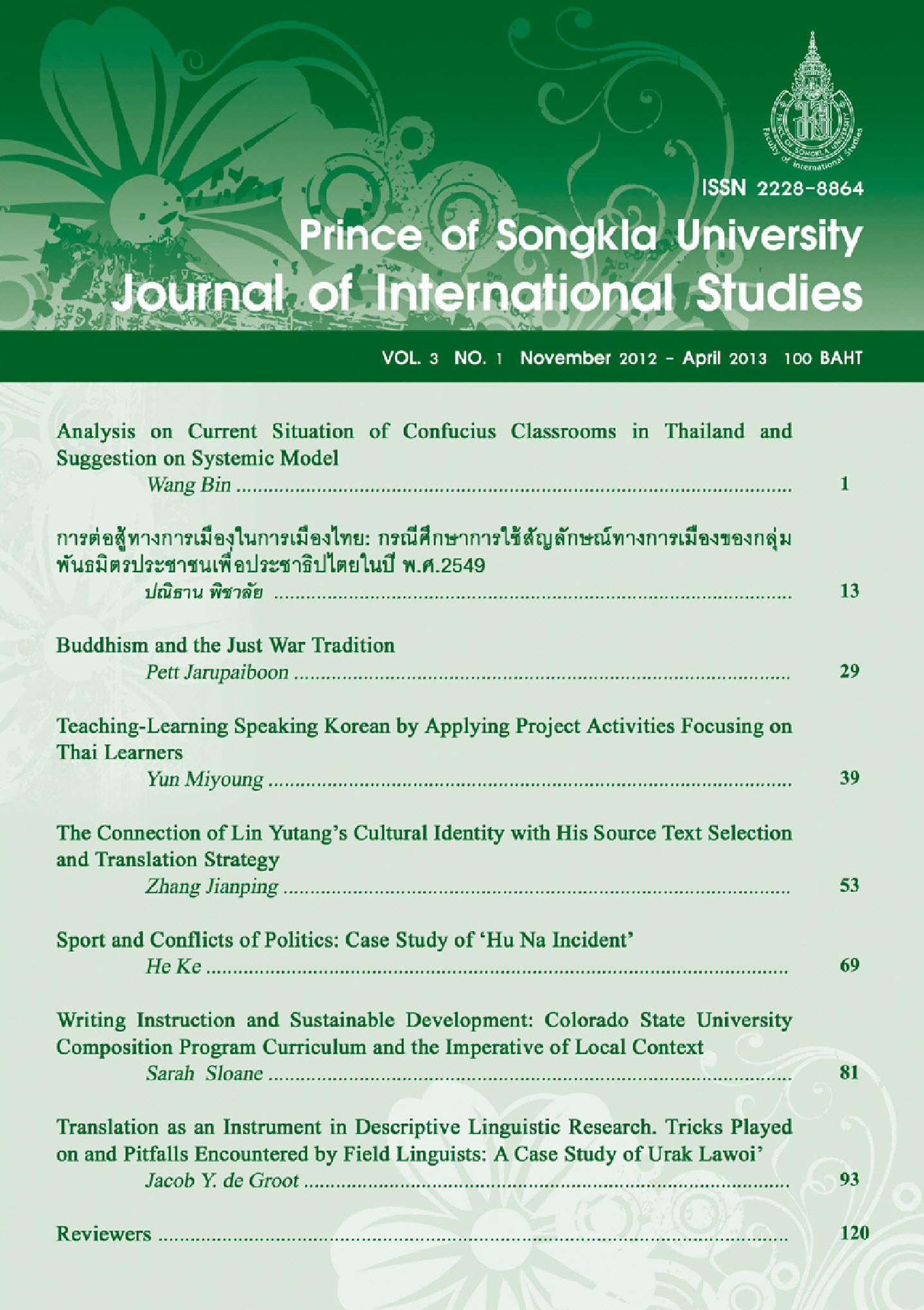
พุทธศาสนากับขนบว่าด้วยสงครามอันชอบธรรม
Article Sidebar
Main Article Content
บทคัดย่อ
งานวิจัยเรื่องนี้มุ่งศึกษาประเด็นทางทฤษฎีสําคัญสองประการที่อธิบายความสัมพันธ์ระหว่าง พุทธศาสนาและขนบว่าด้วยสงครามอันชอบธรรม โดยประเด็นหลักของงานวิจัยจะศึกษาว่า หลักคําสอนทางพุทธศาสนาสามารถถูกนําไปตีความเพื่ออ้างความชอบธรรมในการทาสงคราม ได้อย่างไร และประเด็นต่อมามีความเกี่ยวพันกับประเด็นแรกโดยตรง หากแต่จะเน้นความสาคัญ ในแง่การเมืองเรื่องการตีความและการเมืองเรื่องการอ้างความชอบธรรมในการทําสงครามจริง กล่าวโดยสรุปคือ จะศึกษาว่าหลักธรรมของพุทธศาสนาถูกตีความโดยผู้นําทางศาสนาบางคนอย่างไร เพื่อใช้สร้างความชอบธรรมในการเข้าร่วมสงคราม
Article Details
ข้อความและความคิดเห็นที่แสดงในบทความ เป็นแนวคิดของผู้เขียน มิใช่ความรับผิดชอบของกองบรรณาธิการ และคณะผู้จัดทำแต่อย่างใด
บทความ ข้อมูล เนื้อหา รูปภาพ ฯลฯ ที่ได้รับการตีพิมพ์ในวารสารวิเทศศึกษา ถือเป็นลิขสิทธิ์ของวารสารวิเทศศึกษา หากบุคคลหรือหน่วยงานใดต้องการนำทั้งหมดหรือส่วนหนึ่งส่วนใดไปเผยแพร่ต่อหรือเพื่อกระทำการใด ๆ จะต้องได้รับอนุญาตเป็นลายลักษณ์อักษรจากวารสารวิเทศศึกษา ก่อนเท่านั้น
เอกสารอ้างอิง
Chappell, D. W. (2004). Buddhist Perspectives on Weapons of Mass Destruction. In S. H. Hashmi & S. P. Lee (Eds.), Ethics and Weapons of Mass Destruction: Religious and Secular Perspectives (pp. 213-236). New York: Cambridge University Press.
Ferguson, J. (1977). War and Peace in the World's Religions. London: Sheldon Press.
Harvey, P. (2000). An Introduction to Buddhist Ethics: Foundations, Values and Issues. Cambridge: Cambridge University Press.
Kent, D. W. (2010). Onward Buddhist Soldiers: Preaching to the Sri Lankan Army. In M. Jerryson & M. Juergenmeyer (Eds.), Buddhist Warfare (pp. 157-178). New York: Oxford University.
Keown, D. (2005). Buddhist Ethics: A Very Short Introduction, New York: Oxford
University Press.
King, S. B. (2005). Being Benevolence: The Social Ethics of Engaged Buddhism Honolulu: University of Hawai'i Press.
Paige, G D. & Gilliatt, S. (Eds.). (1999). Buddhism and Non-Violent Global Problem Solving: Ulan Bator Explorations. Honolulu: Center for Global Nonviolence
Payutto, P.A., Bhikkhu. (2007). Vision of the Dhamma: A Collection of Buddhist Writin
in English. Nakhon Pathom: Wat Nyanavesakavan.
Prebish, C. S. & Keown, D. (2006). Introducing Buddhism. New York: Routledge.
Schmithausen, L. 1999. Aspects of the Buddhist Attitude towards War. In J. E.M. Houben
& K. R. van Kooij, Violence Denied: Violence, Non-violence and the Rationalization
of holence in South Asian Cultural History (pp. 45-68).
Leiden, Brill. Suzuki, D.T. (1959). Zen and Japanese Culture. Princeton: Princeton University Press.
Victoria, B. D. (2003). Zen War Stories. New York: RoutledgeCurzon.
Walshe, M., Trans. (1987). Thus Have I heard: The Long Discourses of the Buddha
[Dīgha Nikāya). London: Wisdom Publications,
Welch, H. (1965). The Reinterpretation of Buddhism. The China Quarterly, 22, 143-153
Wenker, K. H. (1996). Buddhism and War. In D. A. Wells (Ed.), An Encyclopedia of
War and Ethics (pp. 50). Westport, CT: Greenwood Press.
